"Khachapuri is not just cheese in dough: why Georgian cuisine is conquering city after city"
Georgian cuisine is spreading around the world not through marketing, but through its structure: each dish carries the logic of the region, season, and social ritual. This makes it more resilient than most gastronomic trends.

By Tetiana Suchkova-Ladik
June 8, 2026 · 3 min read
When a Georgian restaurant opens in London, Berlin, or New York, it typically doesn't close after a year. This is rare for ethnic cuisine in an unfamiliar market — and behind this lies not chance, but an architecture of flavors that is difficult to reduce to fast food or "healthy eating."
A cuisine built by trade routes
Georgian cuisine did not emerge in isolation. According to RadioCafe, researchers date the appearance of khachapuri, khinkali, and churchkhela to the 2nd millennium BC — and the dishes have barely changed since then. But in the Middle Ages, through active trade, spices and herbs from India and Persia, vegetables and fruits from the Mediterranean were added to basic recipes. It was then that sauces appeared — particularly, satsivi — and meat preparation techniques were refined.
What seems like "authenticity" is actually the result of hundreds of years of cultural exchange. Georgians have been making wine for over 8,000 years — longer than any other known tradition — and this experience directly influenced how they combine cheeses, herbs, and spices here.
Five cuisines in one country
A common mistake is to perceive Georgian cuisine as unified. In reality, each historical province has its own culinary tradition: Mingrelian, Ajar, Kakheti, Svan, and Imereti. The spiciest and most flavorful regions are Adjara and Samegrelo in the western part of the country.
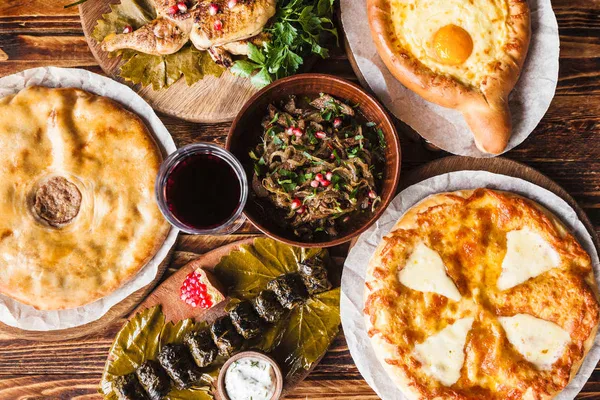
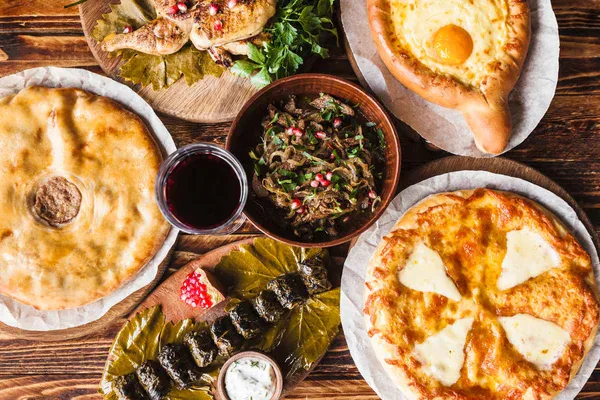
- Ajar khachapuri — open, in the shape of a boat, with an egg and butter on top. No other region does it this way.
- Mingrelian cuisine — the spiciest, with intensive use of red pepper and adjika.
- Kakheti — the wine region, where feasts are built around qvevri and aged varieties.
- Svan cuisine — mountainous, more austere, with unique Svan salt (a mixture of salt, garlic, fenugreek, and spices) that cannot be replicated outside the region.
Most Georgian dishes are united by one thing: walnuts, aromatic herbs, garlic, vinegar, various cheeses, pomegranate seeds, and barberry. This matrix yields endless variations with a relatively simple set of ingredients.
Khinkali: a dish with protocol
Khinkali is not merely dumplings with broth inside. It is a dish with a clear consumption ritual: you hold it by the "tail," bite from the bottom, drink the broth — and only then eat the rest. Violating this order immediately reveals an outsider. The "tails" are not eaten — they are left on the plate as a counter of what has been consumed.
Such attention to detail is a marker of the depth of tradition. It is this that distinguishes cuisine with culture from cuisine as a collection of recipes.
Supra: feasting as a social institution
The least known element outside Georgia — and the most important for understanding the cuisine's popularity — is the supra. It is not merely a banquet, but a social ritual with a clear hierarchy and dramaturgy.
"The tamada leads the feast and delivers each toast with wit, wisdom, and humor. If there are many guests, he appoints assistant toast-makers called tolumbashs."
Discover the Flavors of Georgian Cuisine and Supra Feast
It is noteworthy that the term "tamada" itself is of Circassian origin, and "tolumbash" is of Turkish origin. As Wikipedia notes, both words appear in Georgian sources only in the 19th century — meaning the ritual in its current form is younger than the legend about it. This does not diminish the tradition, but shows: feasting culture, like cuisine itself, absorbed what was foreign and made it its own.
In Samegrelo, toasts are delivered faster and more sharply. In Kakheti — more slowly, with emphasis on wine. In mountainous Svaneti, the supra is more intimate and focused. One name — different tempos and characters.
Why this works outside Georgia
Georgian restaurants open where Georgian emigrants live — and survive thanks to imports of key ingredients: tkemali, Georgian spices, regional cheeses. Matsoni can be replaced with yogurt, sulguni with mozzarella or halloumi, but the basic flavor structure remains recognizable even in the adapted version.
A cuisine that scales without loss of identity is rare. Most regional cuisines either simplify to the point of unrecognizability, or remain closed clubs for their own people. Georgian cuisine has found a third way.
The question remains open: if the global popularity of Georgian cuisine is built on regional diversity — will restaurants outside Georgia be able to maintain this diversity when demand grows and menu standardization begins for the sake of scale?