Director Wins Twice: Mungiu's "Fjord" Wins Palme d'Or for Film About Norway Taking Children from Immigrants
Christian Mungiu became only the tenth director in Cannes history to win the Palme d'Or twice — 19 years after his first victory. His "Fiord" is more than just a family drama; it's a film about how liberal institutions can become instruments of pressure.

By Tetiana Suchkova-Ladik
May 25, 2026 · 2 min read
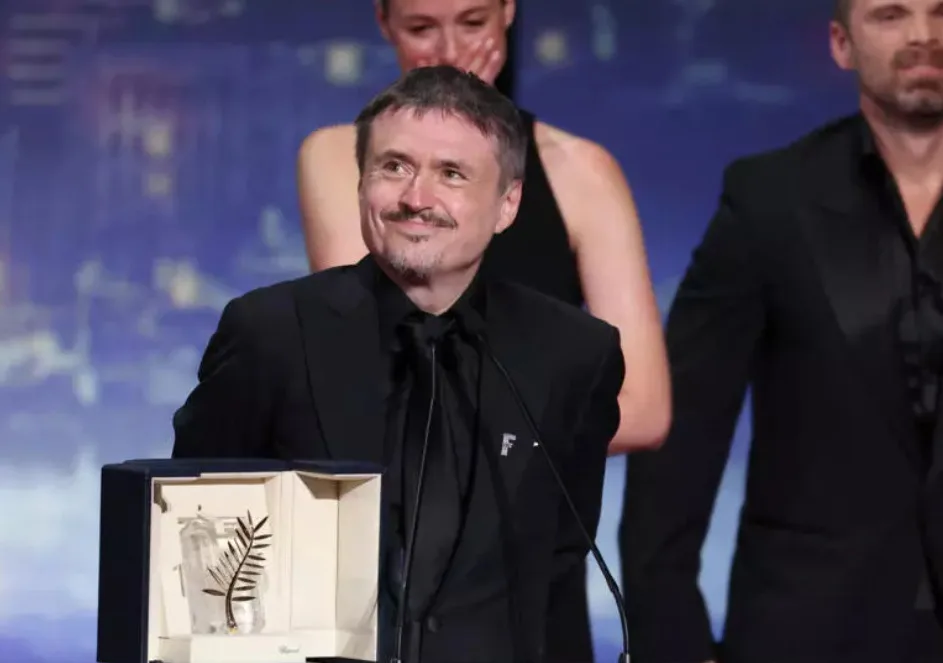
At the 79th Cannes Film Festival, the Golden Palm went to the Norwegian drama "Fjord" by Romanian director Cristian Mungiu. This is already his second victory at the festival — he won his first in 2007 for "4 Months, 3 Weeks and 2 Days," an abortion drama about communist Romania. Between the two Palms lies 19 years and a fundamentally different country, language, and system.
A plot that has already been in the news
"Fjord" is Mungiu's first film shot entirely outside of Romania and set entirely outside Romania. A couple of Romanian evangelists (Sebastian Stan and Norwegian actress Renate Reinsve) moves to a small Norwegian town. After teachers at the local school notice signs of abuse, the social service Barnevernet removes five children from the family.
This is not a fictional conflict. According to NRK, the film was inspired by a real case that once sparked mass protests outside Norwegian embassies — from Washington to Bucharest. Norsk barnevern has long been at the center of international criticism precisely because of cases involving immigrant families and religious communities.
"Today society is divided. It is radicalized. This film is a warning against any fundamentalism. Including leftist fundamentalism."
— Cristian Mungiu, speech at the awards ceremony
Why this film and why now
"Fjord" was one of the most debated films in competition: critics disagreed on its merits and which side the author takes. According to Variety, it was precisely this ambiguity that seemingly united the jury headed by South Korean director Park Chan-wook. Mungiu humbly accepted the award with the words: "All awards are contextual."
Another detail unrelated to art but important for the industry: American distributor Neon acquired the rights to "Fjord" before the festival began — and secured the Palm for the seventh year in a row. For a small indie company, this is no longer a coincidence but a selection system.
Other awards
- Grand Prix — "Minotaur" by Andrey Zvyagintsev
- Best Director Prize — shared by Javier Calvo and Javier Ambrosí ("La Bola Negra") and Paweł Pawlikowski ("Fatherland")
- Jury Prize — "The Dreamed Adventure" by Valeska Grisebach
It is significant that the Grand Prix went to Zvyagintsev — a director who, after Russia's full-scale invasion, is refused screenings at many venues across Europe. Cannes this year chose "art without context" — and this decision already sparks a separate debate.
If "Fjord" gets a wide theatrical release and provokes public conversation about Barnevernet and the rights of immigrant families in Scandinavia — will an artistic film be able to achieve what years of lawsuits and diplomatic notes could not?