205 out of 8000: first tranche of exchange that took months to negotiate
May 15 is not just another exchange. It is the launch of the most ambitious deal in three years, "1000 for 1000," which was negotiated through the mediation of the USA and Turkey — and which ultimately took place only on May 23-25.

By Tetiana Suchkova-Ladik
May 15, 2026 · 2 min read
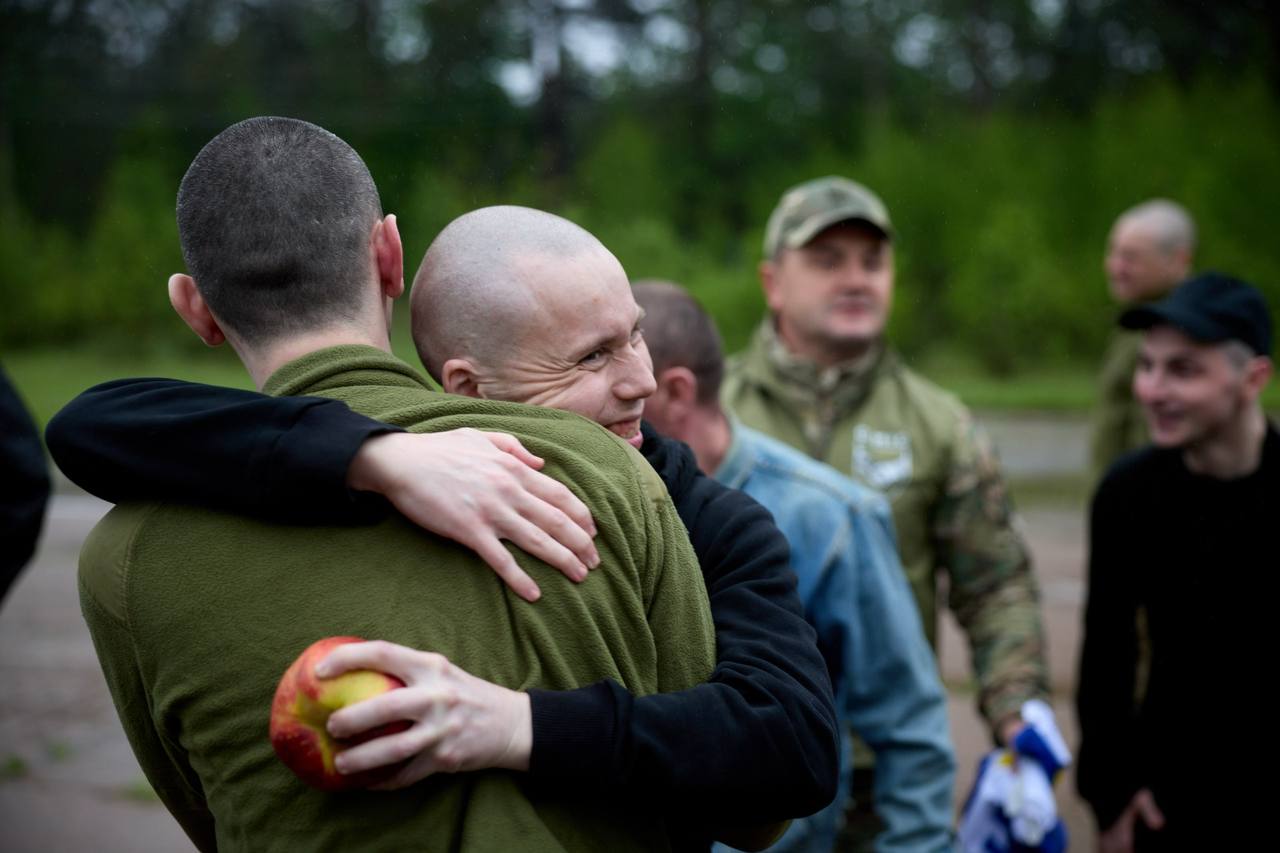
On May 6, 2025, Ukraine returned 205 prisoners of war — the fifth exchange of the year and the 64th since February 2022. Privates, sergeants, officers. Defenders of Mariupol, Azovstal, Donetsk, Luhansk, Kharkiv, Kherson, Zaporizhzhia, Sumy, Kyiv directions and Chornobyl. Most of them have been in captivity since 2022.
Behind these 205 people lie three years of negotiations, dozens of failed agreements and at least 8,000 Ukrainian soldiers who remain in Russian places of detention, according to Iryna Vereshchuk, Deputy Head of the Presidential Office.
How they agreed on "1000 for 1000"
The May 6 exchange took place through the mediation of the UAE — in a "one-for-one" format. But in parallel, other preparations were underway. Secretary of the National Security and Defense Council Rustem Umierov met with Steve Witkoff and Jared Kushner. The result was an agreement on a thousand-person exchange — announced by Donald Trump and confirmed by Zelenskyy: Kyiv provided lists, Moscow dragged its feet.
"Regarding the 1000-for-1000 exchange — Ukraine has done its part of the preparatory work. Russia needs to speed up."
Andriy Yermak, Head of the Presidential Office
Ombudsman Dmytro Lubinets directly called this deliberate stalling on Moscow's part — and simultaneous shifting of responsibility to Kyiv in the public sphere. Putin claimed that Ukraine had "disappeared from the radar," even though the Ukrainian side had already provided the lists.
The Real Scale: What Does 390 + 307 + 303 Mean
The major "1000 for 1000" exchange finally started on May 23 — after negotiations in Istanbul, the first direct talks between the parties since the full-scale invasion. It stretched over three days:
- May 23 — 390 people, including 270 military personnel and 120 civilians
- May 24 — 307 Ukrainians
- May 25 — 303 people
According to Trump's special representative Keith Kellogg, this is the "most positive result" of the negotiations. According to Zelenskyy — only the beginning: Kyiv insists on exchanging "all for all," a position Moscow has rejected for three years.
Between the Number and Reality
1,000 returned — a record. But even this covers slightly more than one-eighth of the known number of prisoners. There is no mechanism for continuous exchange: each operation is a separate agreement with a separate mediator and a separate political cost. The UAE, Turkey, the USA — each time a different configuration.
According to the Coordination Headquarters on the Treatment of Prisoners of War, since March 2022, more than 5,000 Ukrainians have been returned. In 2025 — a record 2,310 people across 10 exchanges and three days of the Istanbul track.
If the Istanbul track produces a second round of agreements — the next question is no longer "how many," but who exactly and by what criteria get on the lists: this is what Kyiv and Moscow dispute as fiercely as they do along the front line.



