218 signatures — and Johnson must put Ukraine to a vote despite his position
A discharge petition forced the Speaker of the House of Representatives to hold a vote on a bill he had blocked for the first time in a decade. The legislation includes $1.3 billion in military aid, $8 billion in loans, and sanctions against Russia.

By Tetiana Suchkova-Ladik
May 13, 2026 · 2 min read
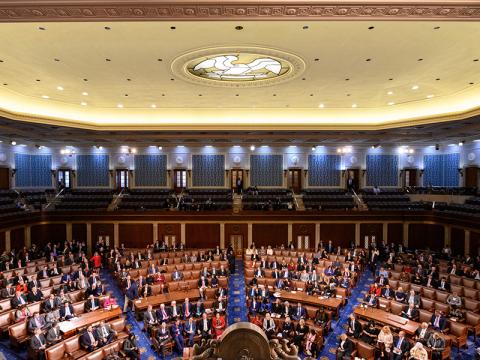
When on May 14 congressman Kevin Kiley signed a petition to aid Ukraine, he did not simply become the 218th on the list — he legally obligated Speaker Mike Johnson to bring the bill to a vote, despite his opposition. This is a rare mechanism: a discharge petition allows a simple majority of the House to bypass committee leadership and the speaker himself.
What's in the bill
The Ukraine Support Act, submitted in April 2025 by Democrat Gregory Meeks — the ranking Democrat on the Foreign Affairs Committee — consists of three parts. The first reaffirms support for Ukraine and NATO and provides for a position of special coordinator for the country's reconstruction. The second authorizes over $1.3 billion in direct military and other aid, as well as up to $8 billion in direct loans. The third introduces strict sanctions and export controls against Russia, including restrictions on financial transactions.
Who signed — and what it says about Congress
The petition was signed by all 215 House Democrats and two Republicans — Bryan Fitzpatrick from Pennsylvania and Don Bacon from Nebraska. Kiley joined last: in March, he left the Republican Party and became an independent, but continues to sit with the Republicans. According to Reuters, his signature made the quorum possible.
"Recent Ukrainian successes have created an opportunity for peace, but the failure of the recent ceasefire shows that leverage is needed for diplomacy to work"
Kevin Kiley, independent congressman from California
According to The Hill, this is the sixth case in the current Congress when a discharge petition has reached 218 signatures — an extraordinary frequency that signals a systemic rift between rank-and-file House members and Republican leadership.
Johnson must — but a vote does not guarantee passage
A discharge petition obliges the speaker to put the question to a vote, but does not determine its outcome. According to Axios, the vote may not occur before the end of May — after Memorial Day. For Republicans, it carries a double risk: supporting an ally against Russia or not angering Trump, who continues to withhold support for Kyiv.
If the bill does pass the House, it will still need to go through the Senate — where no such compulsory mechanism exists. The question is not whether a vote will take place, but rather how many Republicans will dare to support it publicly under pressure from the White House — and whether those votes will be enough for a majority.



