32 countries, 0.25% of GDP and open sabotage: how NATO divides responsibility for Ukraine
Rutte publicly named the circle of "top performers" — thus singling out the rest. France and Britain have already blocked the proposal to make this norm mandatory.

By Tetiana Suchkova-Ladik
May 21, 2026 · 2 min read
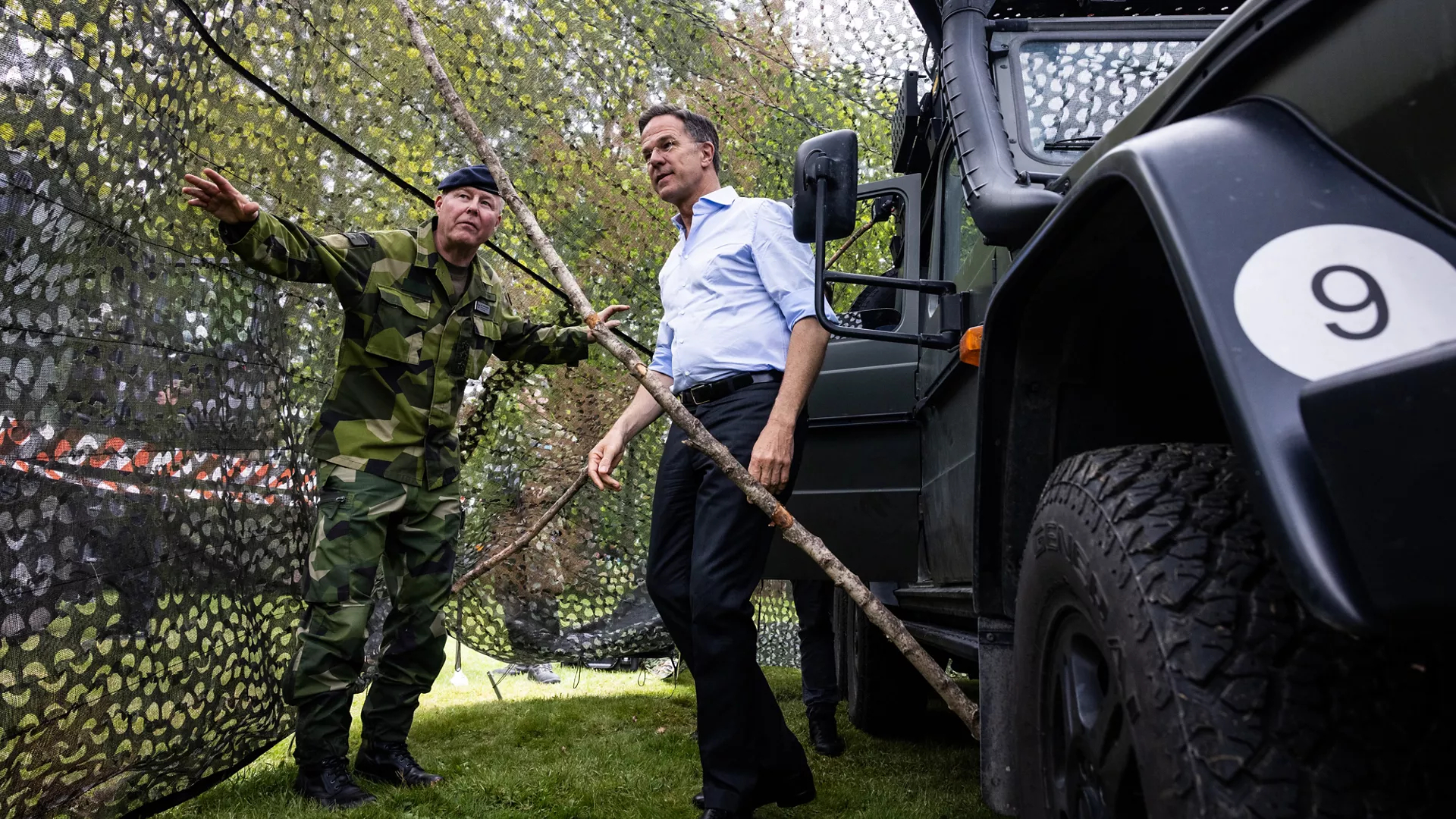
NATO Secretary General Mark Rutte arrived in Sweden and said aloud what is usually discussed behind closed doors in Brussels: aid to Ukraine in the Alliance is distributed unevenly, and a significant portion of the 32 member states spends insufficient resources on it.
According to him, there is a limited circle of countries that "exceed their capabilities" — Sweden, Canada, Germany, the Netherlands, Denmark, Norway, and Northern European and Baltic states. The data confirms this with specific figures: Lithuania spends 1.8% of GDP, Latvia — 1.53%, Sweden — 0.92%, the Netherlands — 0.78%. For comparison — France allocates 0.18% of GDP, Italy — 0.12%.
A proposal that has already been buried
At the end of April, at a closed meeting of Alliance ambassadors, Rutte proposed to establish a norm: each NATO country annually directs 0.25% of its GDP to support Ukraine. According to Politico, citing sources in the Alliance, the idea did not emerge on its own — it is a reformatting of a proposal that Zelenskyy voiced last year.
The mathematics looks convincing: the combined GDP of 32 NATO countries is approximately $57.2 trillion, so 0.25% equals $143 billion per year. Last year, Ukraine received military aid from Alliance members totaling approximately $45 billion. The difference is a tripling of aid.
"Rutte's proposal met with rejection from France and Great Britain"
Politico, citing diplomatic sources in NATO
According to diplomats' assessments, in its current form, the initiative has almost no chance of being adopted at the July summit in Ankara. France and Britain — both nuclear powers with veto rights on consensus decisions — oppose the mandatory norm.
Why "0.25%" is more than just a number
Currently, country contributions are voluntary and unpredictable. Ukraine cannot plan weapons purchases two to three years ahead because it does not know how much will arrive in the next quarter. A mandatory norm would solve precisely this problem — stability and predictability of the flow, not just its volume.
- Top performers (over 0.25% of GDP): Lithuania, Latvia, Estonia, Finland, Sweden, Poland, the Netherlands, Denmark, Norway, Canada
- Average performers (around the norm): Germany, most of Central Europe
- Laggards (significantly below 0.25%): France (0.18%), Italy (0.12%), Turkey (0.01%)
Rutte did not name the "laggards" directly — but by listing the "top performers," he effectively did so. Public pressure through the media during an official visit to Sweden is not accidental candor, but a way of conducting negotiations.
If France and Britain block the norm in Ankara, the question will return to square one: are the "top performers" ready to continue compensating for others' inactivity — or will they start openly expressing discontent within the Alliance itself.



