"40% of Russia's oil exports knocked out of commission — just as prices surpass $100"
Strikes on Baltic and Black Sea terminals caused the biggest disruption to Russian oil supplies in its modern history. But not through sanctions — through drones, at a moment when Washington eased those very sanctions.

By Tetiana Suchkova-Ladik
April 7, 2026 · 3 min read
At the beginning of 2026, Russia was experiencing the worst fiscal quarter since the start of the full-scale invasion. Oil and gas revenues fell 50% year-over-year, the budget deficit for the first two months reached $42 billion — the Kremlin was preparing to cut non-military spending by 10%. It seemed sanctions had finally worked.
Then the US struck Iran. The Strait of Hormuz — through which passes a fifth of the world's oil — effectively closed. Simultaneously, the Trump administration issued a temporary permit for legal purchase of Russian oil for India, canceling the price cap for the relevant batches without any requirements for reporting or control mechanisms. According to PIIE analysts' calculations, Russia could receive $161 billion in additional export revenues from just three months of such market conditions — approximately $500 million per day.
"The thoughtfulness, scale, and directions of the strikes, as well as the precision of their execution — all together produced an effect that I personally don't recall from more than four years of war"
Boris Aronshtein, independent oil and gas industry analyst — for Current Time
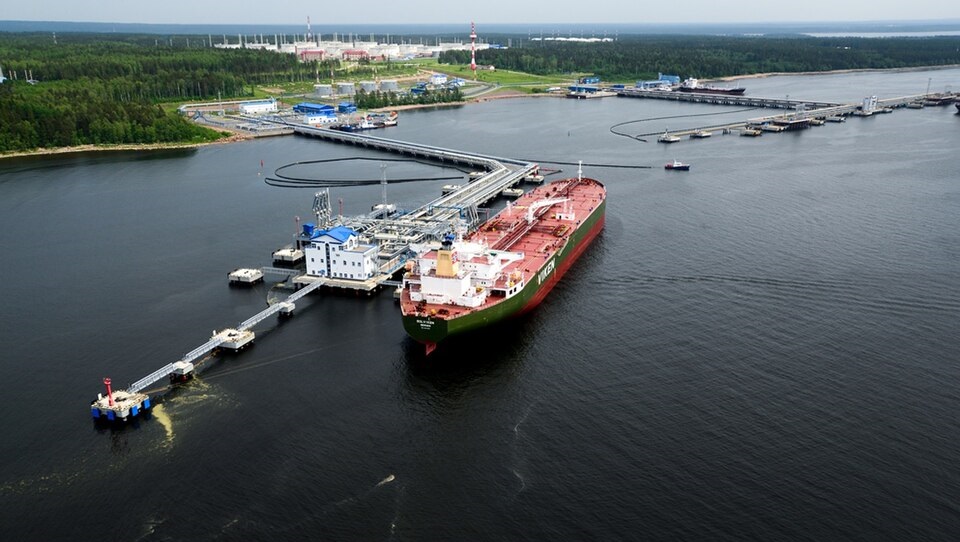
It was at this moment that Ukraine responded with a series of strikes on oil infrastructure. According to Financial Times, five strikes on the ports of Primorsk and Ust-Luga — through which more than 40% of Russia's maritime oil exports pass — destroyed $200 million worth of oil in Primorsk alone. The number of vessels at these ports dropped from 40–50 per week to one. Simultaneously, drones attacked the terminal in Novorossiysk on the Black Sea — damaging a pipeline, berths, and four storage tanks. On the night of April 5–6, a Lukoil oil refinery in the Nizhny Novgorod region came under fire.
As reported by Kyiv Independent citing analysts, collectively these strikes disabled at least 40% of Russia's oil export capacity — the largest disruption of oil supplies in the country's modern history, and it coincided with the moment when oil prices exceeded $100 per barrel.
Why sanctions didn't work on their own
The G7 price cap introduced in December 2022 was built on the assumption that the West controls maritime insurance and shipping. But, as confirmed by academic research based on 25,399 cargo records, the cap was never a real constraint: Russia invested in a "shadow fleet" of ~350 vessels that transport 56% of volumes, and 67% of all Russian crude oil is transported outside G7 jurisdiction.
Therefore, CFR characterizes Washington's decision as paradoxical: an administration that declared pressure on Russia for the sake of peace negotiations actually provided the Kremlin with a financial lifeline — without any conditions regarding de-escalation.
What comes next with repairs
Partial restoration of shipments from damaged terminals is possible within days, but damaged storage tanks require months of repair, and restoration of production lines in Ust-Luga will take more than a month. This means that even in the absence of new strikes, the structural effect will persist.
- Primorsk and Ust-Luga ports: more than 40% of Russia's maritime oil exports — halted
- Novorossiysk: terminal, pipeline and storage tanks — damaged
- Lukoil refinery in Nizhny Novgorod: attacked on the night of April 6
- Losses from lost export revenue alone — approximately $1 billion according to FT
Zelenskyy stated that Ukraine is ready to stop strikes on oil infrastructure only if Russia takes symmetrical steps — specifically, ceasing attacks on Ukrainian energy facilities. Russia violated the previous agreement in February, striking power plants and substations during severe frost.
If Washington continues to weaken sanctions, and oil prices remain above $100 — will Kyiv have enough drones to compensate for what diplomacy did not achieve?



