"The brigade was already being loaded onto a ship — now it's being sent back home"
The Pentagon cancelled the rotation of 4,000 soldiers to Poland after some of them had already arrived in Europe. Hrynkevych assured that NATO would hold — but Congress cast doubt on this.

By Tetiana Suchkova-Ladik
May 19, 2026 · 3 min read
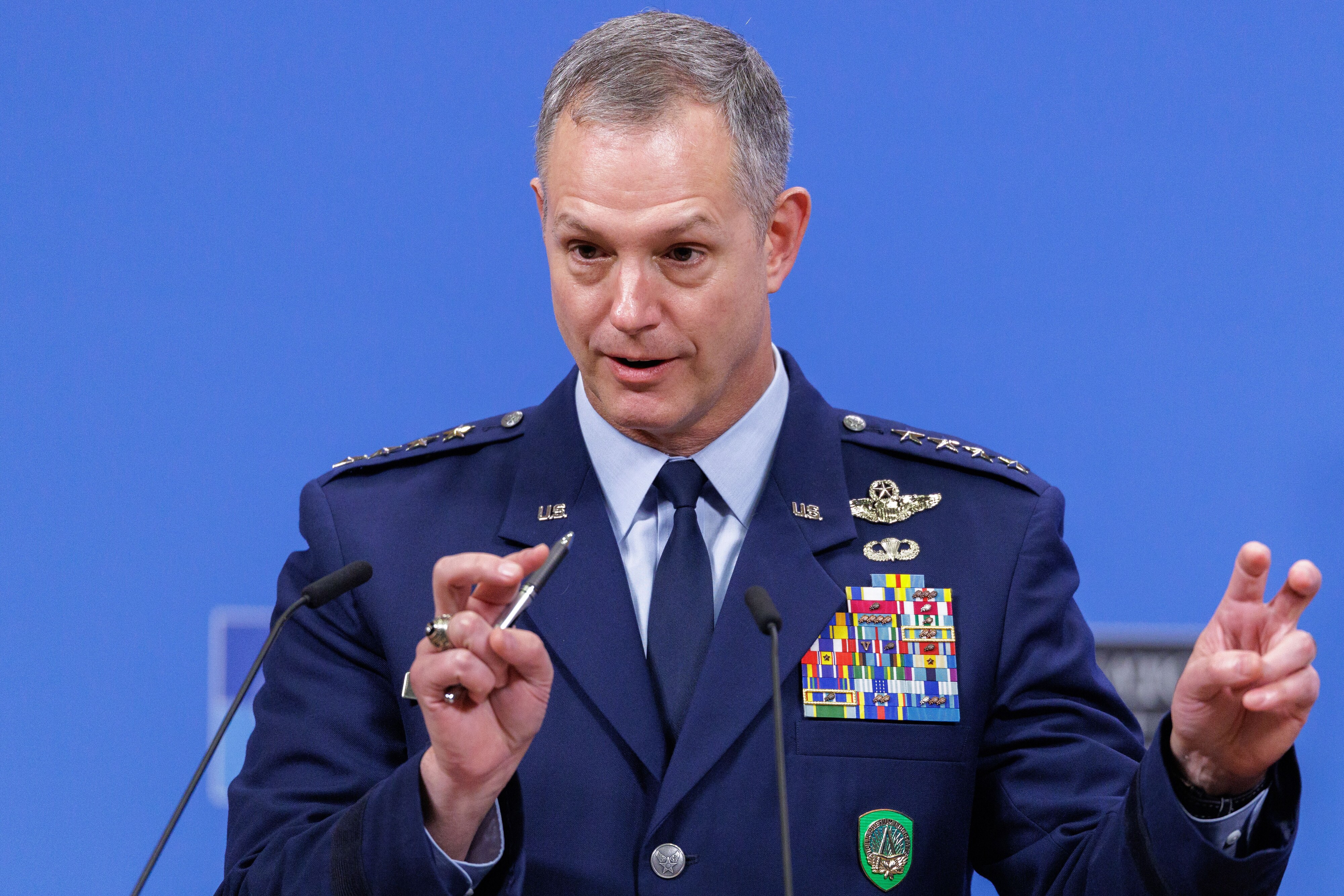
On May 19, General Alexus Grynkewich, Supreme Allied Commander Europe of NATO, announced that 5,000 American troops would leave Europe without replacement. While the figure has been known since early May, details that emerged a week before the press conference shift the message's tone.
What was actually cancelled
This concerns two decisions by Defense Secretary Pete Hegseth. The first is the withdrawal of approximately 5,000 troops from Germany, announced on May 1 as a result of a "thorough review of force posture in Europe." The second, and more significant, is the cancellation of a planned nine-month rotation of the 2nd Armored Brigade Combat Team, 1st Cavalry Division to Poland.
More than 4,000 soldiers from Texas were to cover NATO's eastern flank—Poland and the Baltic states. Part of the personnel had already held a "colors ceremony" and arrived in Europe when the order came to return. Simultaneously, the deployment of the 3rd Battalion, 12th Field Artillery Regiment—a unit operating long-range rocket systems—was cancelled, along with the command responsible for managing long-range artillery in the region, which is also being withdrawn.
"The decision was made relatively recently—probably in the last two weeks"
General Christopher LaVine, Acting Chief of Staff of the U.S. Army, during Congressional hearings on May 15
This testimony contradicted the Pentagon's official statement that the cancellation "was not unexpected or made at the last moment."
How Grynkewich explains the logic
At a press conference in Brussels, Grynkewich outlined a concept Washington is promoting within the alliance: as NATO's "European pillar" strengthens, the United States can reduce its presence and focus on "critical capabilities that allies cannot yet provide independently." No specific list of such capabilities was mentioned at the press conference.
At the same time, the general confirmed a previously stated position: despite losses in Ukraine, Russia "maintains the capability and potential to threaten U.S. interests"—including through its nuclear arsenal and asymmetric means.
Reactions: from Warsaw to Capitol Hill
Polish Prime Minister Donald Tusk publicly stated he received assurances that the decision was "of a logistical nature" and "will not directly affect deterrence and our security." Meanwhile, in Congress, Republican Don Bacon called the cancellation of the rotation "a horrible signal to Russia and our allies," and Representative Austin Scott questioned the Pentagon's characterization of the decision as "planned."
Notably, before the current cuts, the U.S. had already closed the 101st Airborne Brigade's rotational mission in Romania in October. Together with the withdrawal from Poland, this returns the number of American forces in Europe to approximately the level it was before Russia's full-scale invasion of Ukraine in February 2022.
"We are reducing significantly more than 5,000"
U.S. President Donald Trump, in comments to journalists, May 2026
What remains unanswered
Grynkewich did not name the specific critical capabilities the U.S. will retain in Europe—whether nuclear, intelligence, or strike capabilities. Instead, allies have been offered assurances without a verifiable mechanism: as Europe builds up its own forces, the U.S. will "adjust" its presence. However, the pace of buildup and the pace of withdrawal have not yet been synchronized by any public document.
If Trump implements his threatened cuts in Italy and Spain—countries he has accused of refusing to support American operations in the Strait of Hormuz—the question will no longer be whether the "European pillar" can withstand logistics, but whether it can gain real combat weight before Washington's next decision.



