Fico Flies to Moscow via Georgia: How NATO's Three-Country Ban Doubled Flight Time
Lithuania, Latvia, and Estonia have closed their airspace to the Slovak Prime Minister's plane — and he is once again, as a year ago, seeking an alternative route via the Black Sea. The difference: this time he is flying to the 80th "Victory Parade," which is not officially listed in his schedule.

By Tetiana Suchkova-Ladik
April 19, 2026 · 2 min read
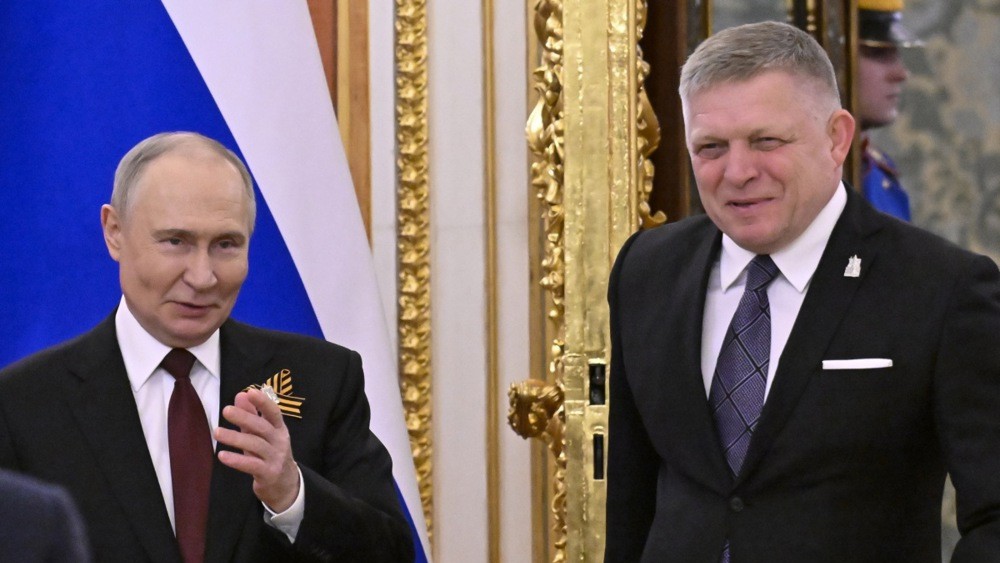
Robert Fico is flying to Moscow on May 9 for the second year in a row. And for the second year in a row, three NATO countries—Lithuania, Latvia, and Estonia—are closing their airspace to him. But while in 2024 this looked like a precedent, in 2025 it is already a procedure.
A route that reveals everything
Normally, a flight from Bratislava to Moscow takes about 2.5 hours—through Lithuanian airspace, which after the Ryanair incident in Belarus in 2021 became the standard corridor for European flights to Russia. This time, Fico is flying via Hungary, Romania, the Black Sea, and Georgia—a route that costs him an additional 2.5 hours in the air and, apparently, significantly more aviation fuel at the expense of Slovak taxpayers.
Lithuanian President Gitanas Nausėda confirmed to Reuters that the country has closed its airspace to Fico's flights and to Serbian President Aleksandar Vučić. Latvia and Estonia acted similarly, citing the "political sensitivity of the flight's destination."
"A parade" that is not on the agenda
The official program of the visit, published by the Slovak government, does not include participation in the military parade in Red Square. Fico stated that he is going to lay flowers at the Tomb of the Unknown Soldier near the Kremlin walls and conduct bilateral meetings with Putin, Xi Jinping, and Brazilian President Luiz Inácio Lula da Silva.
"Lithuania and Latvia have already informed us that they will not allow flights through their territory on the way to Moscow. But I will find another route."
Robert Fico, Facebook video address
Exactly what he said a year ago.
Kaja versus Fico: a dispute over sovereignty
EU High Representative for Foreign Affairs Kaja Kallas made it clear that participation in Moscow events is incompatible with the EU's position. Fico responded sharply:
"Is Ms. Kallas's warning blackmail? It is now 2025, not 1939. No one can tell me where I have the right to travel."
Robert Fico
Formally, he is right: there is no legal mechanism that would prohibit an EU country's leader from flying to Russia. Closing airspace is the only tool that neighbors have used.
Vučić solved the problem via Azerbaijan
The Serbian president faced the same problem and chose a similar workaround—via Azerbaijan. The principle is the same: if the direct route is closed, there is a longer one. Flight bans create inconvenience, but not an obstacle.
- 29 foreign leaders are announced for the parade in Moscow, including Xi Jinping
- Fico and Vučić are the only representatives from countries with EU agreements or membership
- 5 hours—Fico's flight time via the detour route instead of the usual 2.5
Meanwhile, Moscow uses each such arrival as a signal: the sanctions front is not monolithic. Fico understands this—and that is precisely why he is flying.
The question is not whether Fico will arrive. He will. The question is whether a specific mechanism in EU law will emerge afterward—for example, temporary suspension of voting in the Council—or whether closing the skies will remain the only response that allies can give to a leader who is demonstratively flying to an aggressor country for the second year in a row.



