Fleet Without a Sea: How Ukrainian Strikes Transformed Russia's Black Sea Fleet Into Coastal Artillery
After the destruction of the "Moskva," withdrawal from Sevastopol, and a series of strikes on Novorossiysk, the Russian Black Sea Fleet has lost its ability to operate as a fleet — and now functions mainly as a carrier of missiles for strikes on land.

By Tetiana Suchkova-Ladik
April 16, 2026 · 2 min read
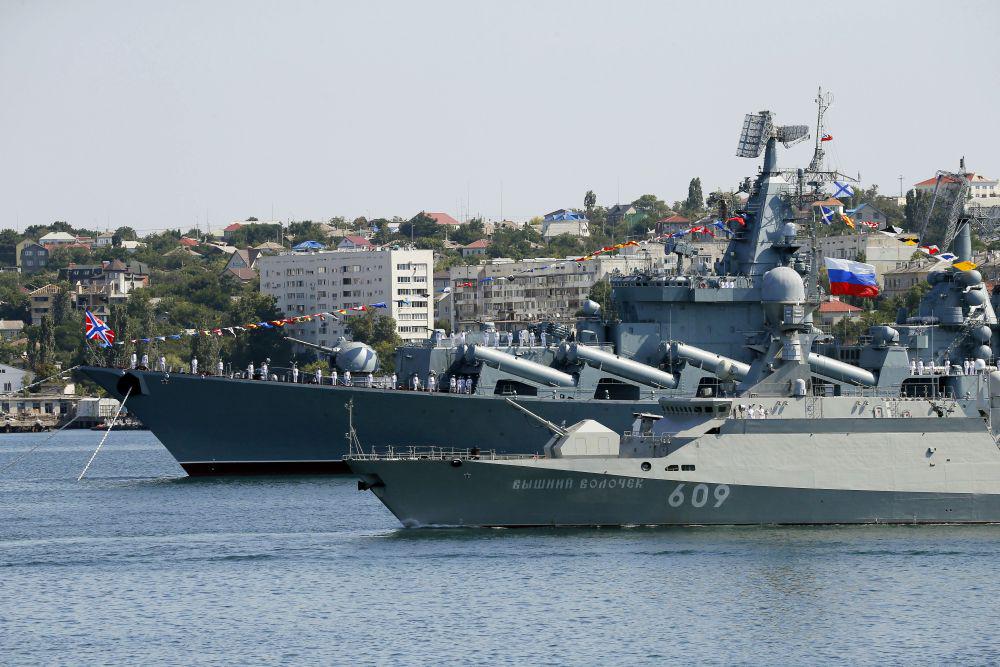
Russia's Black Sea Fleet is no longer a fleet in the classical sense. After three years of Ukrainian strikes, it has transformed into an instrument for supporting ground operations — a launch platform for Kalibr missiles, devoid of freedom of maneuver. This assessment was voiced in a commentary to LIGA.net by a serviceman of the 413th SBU Regiment "Raid," Defense Express expert Ivan Kyryshevsky.
From Flagship to Scrap Metal
The degradation of Russia's Black Sea Fleet began in April 2022: the Moskva, a guided-missile cruiser and the fleet's flagship and largest combat ship, sank after being struck by Ukrainian anti-ship missiles. Then came the Rostov-on-Don submarine, damaged in Sevastopol in September 2023, forcing the fleet to withdraw to Novorossiysk.
But Novorossiysk did not become a safe haven. The frigates Admiral Makarov and Admiral Essen have already been targeted by Ukrainian forces — and Essen became the first target of the new Neptune long-range missile, as confirmed by Defense Minister Herman Smetanin in March 2025. The Sivash drilling platform — the former Boyko Tower, seized by Russia in 2014 — was destroyed along with Russian special forces and surveillance and electronic warfare equipment that controlled the northwestern part of the Black Sea.
"It is difficult for Russia to project force at sea when Black Sea Fleet ships essentially have nowhere to go."
Ivan Kyryshevsky, Defense Express expert
What Remains and What It Threatens
At the time of the full-scale invasion, Russia's Black Sea Fleet had five submarines carrying Kalibr missiles. Now, only three remain combat-capable. It is impossible to return damaged vessels to the Black Sea: Turkey adheres to the Montreux Convention and does not allow military ships of warring parties through the straits.
In other words, each loss is irreversible. This asymmetry is the key tactical result of Ukraine's three-year naval campaign: destroying a carrier means permanently reducing the enemy's missile potential, not simply disabling it temporarily for repairs.
- Surface component: unable to operate in the waters — main ships are pinned down in ports.
- Submarine component: reduced by approximately half from the initial force, with no possibility of replenishment.
- Intelligence infrastructure: the Sivash platform along with its electronic warfare and close-range air defense systems has been eliminated.
Fleet as Artillery
The new role of Russia's Black Sea Fleet is missile strikes against Ukrainian infrastructure and positions from a safe distance. According to Kyryshevsky's assessment, the fleet has ceased to be an instrument for projecting force at sea and has become, in fact, a coastal missile complex with ship-based deployment. ISW analysts observed this shift following the fleet's withdrawal from Sevastopol in autumn 2023: a ship that cannot go to sea is not a fleet, but a floating launch platform.
Even this remaining function is narrowing: each damaged submarine or Kalibr carrier means fewer missiles in a salvo. According to open-source data, Russia's Black Sea Fleet has been reduced to 30–40% of its original combat strength since the full-scale invasion began.
If Ukraine's armed forces manage to strike the remaining submarine carriers in Novorossiysk — a city that has already been targeted by naval drones — the question will not be whether Russia's Black Sea Fleet exists, but whether it will be capable of delivering even a single full-scale missile volley.



