"Geranium" with a Soviet-era rocket: How the R-60M became a threat with radioactive debris
The SBU detected elevated radiation levels on fragments of an R-60M missile that Russia mounted on a Shahed-2 drone and used against the Chernihiv region. The use of depleted uranium in the warhead is not a new technology, but represents a new context of application.

By Tetiana Suchkova-Ladik
May 20, 2026 · 2 min read
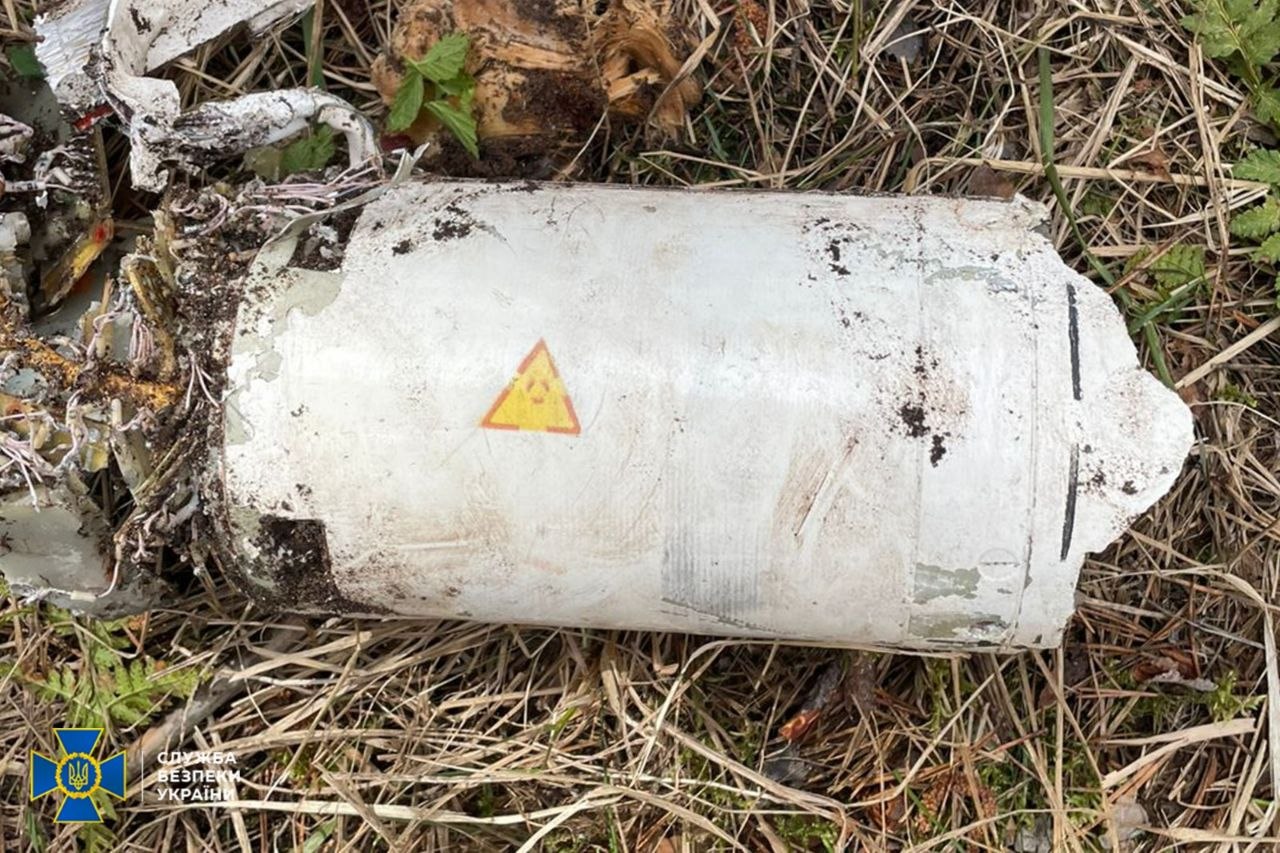
On the night of April 7, 2026, Russian forces attacked the Chernihiv region using a modified Geran-2 drone armed with an R-60M air-to-air missile. After the strike, SBU specialists discovered debris with elevated radiation levels near the village of Kamka and established the cause: the missile warhead contained depleted uranium rods.
What is the R-60M and why does it contain depleted uranium
The R-60M is a Soviet short-range air-to-air missile adopted in a version with an improved homing warhead around 1982. Its 3.5 kg warhead uses the "continuous rod" principle: upon detonation, steel and uranium rods scatter in a circle, cutting through the target's fuselage. According to open-source data from Wikipedia and international mine clearance standards IMAS, the R-60M variant carries 1.6 kg of depleted uranium rods — to increase density and strike effectiveness.
Depleted uranium (U-238) is not a nuclear weapon. It is weakly radioactive, but when burned and pulverized, it forms fine dust that is toxic when inhaled. This is precisely why the debris requires special handling — and this is precisely why radiation level documentation is legally significant.
New tactic: anti-aircraft missile on a strike drone
As early as December 2025, the GUR revealed a new modification of the Geran-2 equipped with the R-60. According to SBU data, the logic of deployment is twofold: the missile strikes Ukrainian aircraft and helicopters that intercept enemy UAVs, turning the drone itself into a trap for the interceptor. In other words, the Geran flies not only toward a ground target — it carries a means of self-defense in the air.
"Law enforcement officials established that Russian forces use such missiles during mass attacks to strike Ukrainian aircraft and helicopters that intercept enemy UAVs".
— Security Service of Ukraine
The SBU has opened a pre-trial investigation under the article on war crimes. Debris samples have been sent for examination.
Broader context: not an isolated incident
Radioactive R-60M fragments are not the only unconventional threat from Russia. According to General Staff of the Armed Forces of Ukraine data, only during January 2026 were 224 cases of chemical munitions use documented — primarily K-51 grenades and RG-VO with CS and CN agents dropped from drones onto positions. Overall, since the start of the full-scale invasion, over 12,000 such episodes have been documented. Moscow consistently denies involvement and shifts responsibility to Kyiv.
- R-60M: Soviet air-to-air missile, warhead — 1.6 kg of depleted uranium rods
- Geran-2: manufactured at a rate of approximately 170 units per day at the plant in Elabuга; contains hundreds of foreign components despite sanctions
- Location: Kamka, Chernihiv region, night of April 7, 2026
- Legal qualification: pre-trial investigation under Article 438 of the Criminal Code of Ukraine (violation of laws and customs of war)
What comes next
The key question is not the depleted uranium in the R-60M itself — it has been known from specifications since the 1980s. The question is different: will independent international expertise confirm that the debris from Kamka corresponds specifically to the uranium-carrying R-60M variant rather than another modification — and if so, will Ukraine's allies classify this as the use of weapons with radioactive components in a populated area with corresponding consequences for the supply of NBC protection systems to the front.



