GUR Strikes Two Landing Ships of Black Sea Fleet: What This Changes at Sea
Ukrainian intelligence confirmed damage to the icebreaker "Yamal" and the vessel "Nikolai Filchenko" — two more units of the Russian fleet that Moscow has been trying to preserve from destruction for years.

By Tetiana Suchkova-Ladik
April 20, 2026 · 2 min read
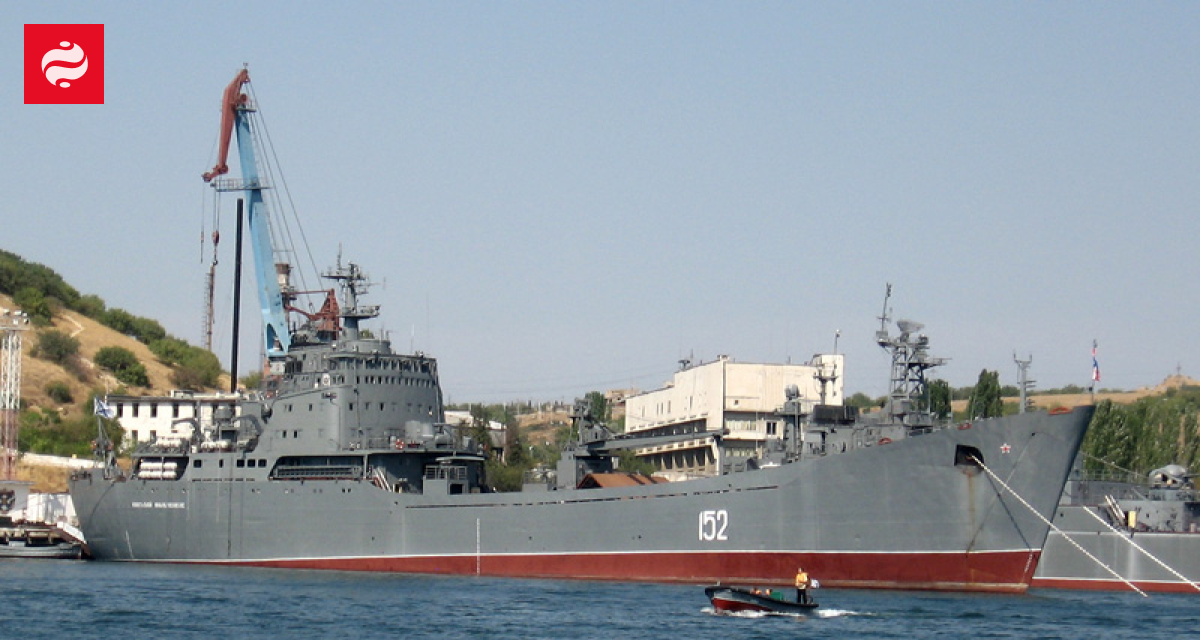
The Main Intelligence Directorate of Ukraine released video footage of strikes against two large landing ships of Russia's Black Sea Fleet — "Yamal" and "Nikolai Filchenkov". Both vessels belong to the class of large landing ships (LPD) designed for amphibious operations and transporting armored vehicles and personnel.
The strikes were confirmed by videos distributed by the GUR. The footage shows direct hits and subsequent smoke billowing from the vessels' decks. Official details about the crews' condition and the extent of damage were not clarified.
How many ships has Russia already lost
Since the beginning of the full-scale invasion, Ukraine has destroyed or disabled at least one-third of Russia's Black Sea Fleet's ship strength. Among the major losses are the fleet's flagship, the cruiser "Moskva," the submarine "Rostov-on-Don," the large landing ship "Cesar Kunikov," and several small missile ships.
After a series of successful attacks, Russia was forced to relocate a significant portion of its fleet from Sevastopol to Novorossiysk — a port that is further from the effective strike range of Ukrainian drones and missiles. This substantially limited the fleet's operational capabilities in the northwestern part of the Black Sea.
Why does Russia need landing ships in 2024
LPDs are more than just transport vessels. In the context of war, they serve as a logistical lifeline between Russian ports and occupied territories, supplying equipment, ammunition, and reinforcements while bypassing overland routes. Additionally, the mere presence of landing ships in the Black Sea represents constant pressure on the Ukrainian coast: the threat of amphibious landings forces Kyiv to maintain forces in coastal defense.
The destruction of "Yamal" and "Nikolai Filchenkov," should the damage prove critical, reduces this pressure and further narrows the fleet's logistical capabilities.
How Ukraine does this without a navy
Ukraine's military-naval fleet in the classical sense is effectively non-existent in the Black Sea — following the loss of Sevastopol in 2014 and the destruction of ships in the first days of the invasion. Instead, the GUR and Naval Forces have developed asymmetric tactics: naval kamikaze drones, strikes with Neptune and Grom cruise missiles, and operations using domestically-produced surface drones.
Such drones, according to open-source reports, were used in a series of previous attacks on ships in Sevastopol Bay and near the Kerch Strait.
Russia's Black Sea Fleet is gradually transforming from an instrument of pressure into a burden that must be protected. The question is whether Moscow will manage to restore its lost potential before Ukraine receives long-range weapons capable of systematically reaching Novorossiysk.



