"Hussars" Return: Polish F-35 Husarz Lands Where Soviet MiGs Once Stood
Three American fifth-generation fighter jets landed at Łask Air Base — a place where Soviet MiG-29s were stationed just a few decades ago. For Poland, this is not just new equipment, but the final chapter of a thirty-year exit from Moscow's orbit.

By Tetiana Suchkova-Ladik
May 22, 2026 · 3 min read
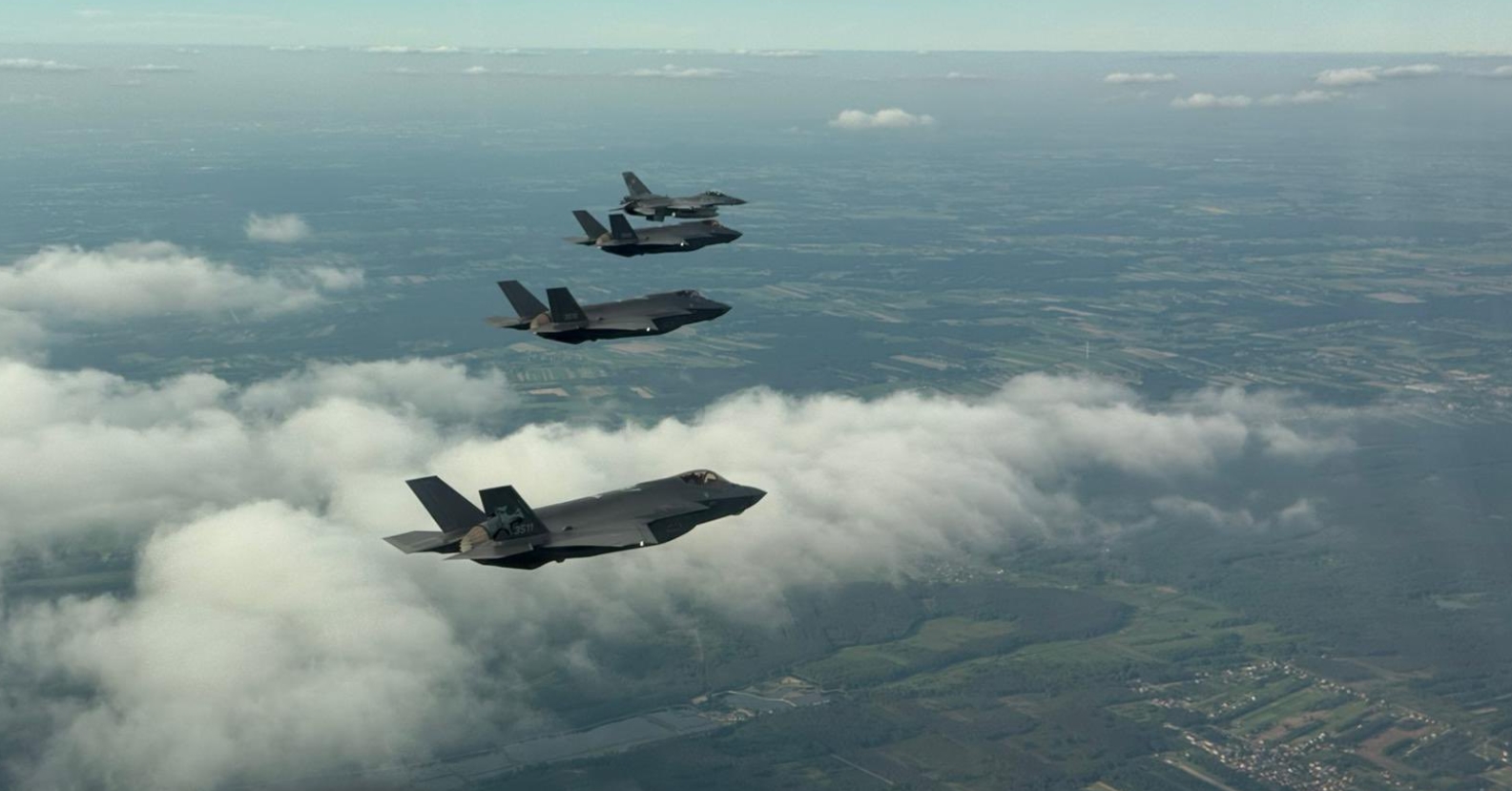
On May 20, three F-35A Husarz touched down on runway 32 at the tactical air base in Łask. Poland became the first country on NATO's eastern flank to independently operate a fifth-generation fighter — and did so at the same base where Soviet MiG-29s and Su-22s were previously stationed, some of which Warsaw has already transferred to Ukraine following the full-scale invasion.
From MiG to "Husarz" in One Generation
Poland named its F-35s "Husarz" — after the winged hussars of the 16th–17th centuries, cavalry of the Polish-Lithuanian Commonwealth that struck fear into Ottoman and Muscovite armies. This is more than marketing: Polish air forces traditionally give foreign aircraft their own names — F-16s are called "Jastrzęb" (hawk) here. According to Defence Minister Władysław Kosiniak-Kamysz, "Husarz" is an entry ticket to the exclusive club of modern air forces worldwide.
The path to this club took six years and cost $4.6 billion. The contract for 32 aircraft was signed in 2020. Polish pilots trained at Ebbing Air Base in Arkansas — alongside Finnish, German, and Singaporean colleagues, who are also transitioning to the F-35.
What F-35 Presence Actually Changes in the East
Technical advantage lies not in speed or maneuverability. The F-35's main asset is sensor fusion: the aircraft collects data from onboard radars, electronic warfare systems, ground-based air defense, and allied aircraft to form a single digital picture of the battlefield. All F-35s in NATO — regardless of the operating country — are connected via a secure MADL channel, allowing Polish, Norwegian, and American aircraft to operate as a single network.
"Polish F-35s will conduct low-observable penetration and intelligence gathering missions, while modernized F-16s will carry the main strike load"
Defence Express, citing the Defence24 Days conference in Warsaw
For comparison: Russia's only fifth-generation fighter, the Su-57, has a radar signature 20–30 times larger than the F-22, and fewer than 35 are in service — due to sanctions and limited industrial capacity.
Poland Builds Two-Tiered Air Force
The F-35 will not replace Polish F-16s — they will work alongside each other. In 2025, Warsaw concluded an $3.8 billion agreement to modernize all 48 F-16C/Ds to Block 72 standard with AESA radars and full integration with F-35 systems. In parallel, both air bases — Łask and Świdwin — are being upgraded for fifth-generation operations: new technical centers, secure digital networks, maintenance facilities.
By the end of the decade, Poland plans to establish a rapid reaction squadron under NATO command — with a Quick Reaction Alert mission in the Alliance's integrated air defense system. A second base in Świdwin will be established later.
While its own aircraft were entering service, Warsaw did not wait: Norwegian and Dutch F-35s have already patrolled Polish airspace — twice in the past year — responding to the growing number of incidents with Russian aircraft over the Baltic.
What's Next
Poland ordered 32 aircraft and has already announced expansion plans — air force command estimates the need for ten tactical air squadrons, while currently there are eight. If Warsaw indeed declares a QRA mission by the end of 2026, F-35 Husarz will cease to be a symbol and become an operational element of NATO's densest air defense system in the east — the same system that prevents Moscow from the temptation to test Article 5 in practice.



