Kubilus wants a defense union modeled on Schengen — with Ukraine inside, but without an enforcement mechanism
The EU Defense Commissioner proposed an intergovernmental agreement that bypasses vetoes in existing EU treaties. France, Germany, and Belgium are already objecting — and their position will determine whether the proposal becomes an agreement.

By Tetiana Suchkova-Ladik
April 17, 2026 · 3 min read
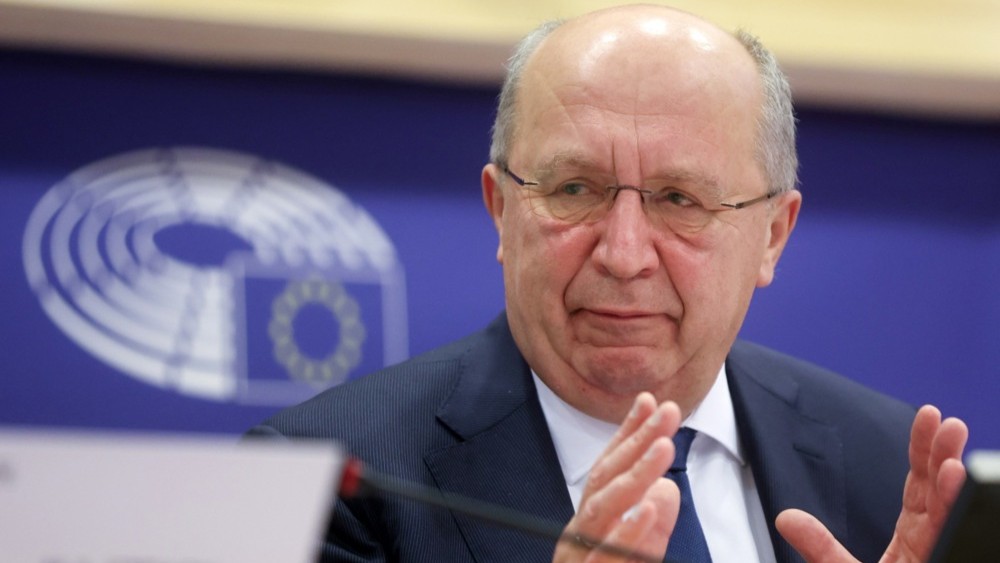
Andrius Kubilius raised a rhetorical question at the fourth conference of the EU Legal Service in Brussels, which is essentially a diagnosis: "Are existing treaties and decision-making rules a help or an obstacle to European defense?" His answer is a new intergovernmental treaty modeled on the Schengen Agreement.
What exactly was proposed
According to Kubilius, the current EU legal framework is insufficient to build a full-fledged defense union. The Schengen logic is not accidental here: in 1985, several countries signed an agreement outside the framework of the then-current EU treaties, and only later was it integrated into the acquis. Similarly, the proposed defense union could start with those ready to participate — without waiting for unanimity of all 27.
"If there is agreement that the Security Council also needs decision-making powers, then a new special intergovernmental treaty is necessary — as was done with the Schengen Agreement regarding freedom of movement for people"
— Andrius Kubilius, speech text published on the commissioner's personal website
A fundamentally important detail: the treaty should be open to non-EU members from the outset — the United Kingdom, Norway, and Ukraine. As the Bruegel Institute analyzes, Ukraine meets membership criteria as "a European democracy that shares the continent's common defense interest," and its accession to the treaty would require it to sign a Defense and Security Partnership Agreement — similar to what Norway did in 2024.
What the proposal lacks
There is no specific mechanism for enforcing obligations. The Bruegel Institute, which developed a similarly-spirited scheme for a European Defense Mechanism (EDM), envisioned joint procurement, common assets (such as air defense systems or reconnaissance satellites), and bond issuance for financing. But even in this more detailed version, an open question remained: any involvement of EU structures requires unanimity of all 27 member states, which opens the door to a veto.
Notably, Kubilius himself acknowledges the limitations: the treaty can be launched through an "enhanced cooperation" mechanism within existing EU agreements — but only if full decision-making powers are not required. As soon as the need for a real command hierarchy emerges, a new treaty is needed, whose ratification timeline in each signatory country is unpredictable.
Who objects and why it matters
France, Germany, and Belgium have already raised reservations: in their view, existing instruments should first be exhausted — the European Investment Bank, the European Defense Fund, and the ReArm Europe program with an €800 billion envelope. The position of these three countries is decisive: without Paris and Berlin, any "coalition" treaty becomes a second-tier document.
Finabel analysts identify another structural problem: defense treaties between states are typically lengthy and unpredictable processes, because defense industry is tightly tied to national sovereignty. No country signs on to competitive tenders in an area where protecting its own defense industrial base is a matter of domestic politics.
Ukraine: a potential participant without guarantees
For Kyiv, participation in such a union would mean official recognition of its role in Europe's security architecture — even before the completion of negotiations on EU accession. But here the Kubilius proposal is most vague: there is no clear answer as to what obligations the union assumes toward Ukraine and what Ukraine assumes toward the union. A declaration of openness ≠ an invitation to the negotiating table with ratified commitments.
In November 2025, Kubilius himself said that the concept of a defense union was "at the very beginning" and work on it was just starting. Since then, a speech at the Legal Service conference has appeared — but no draft treaty text.
If France and Germany do not change their positions before the European Commission proposes a specific mandate for negotiations, this initiative will remain in a state where it has been many times before: an ambitious idea without a ratification roadmap.



