Madjar accuses Szijjártó of destroying documents: what's happening at Hungary's Foreign Ministry
Hungarian opposition leader Péter Magyar has claimed that Foreign Minister Péter Szijjártó is destroying documents. The allegation coincides with the minister's prolonged absence from public events.

By Tetiana Suchkova-Ladik
April 13, 2026 · 2 min read
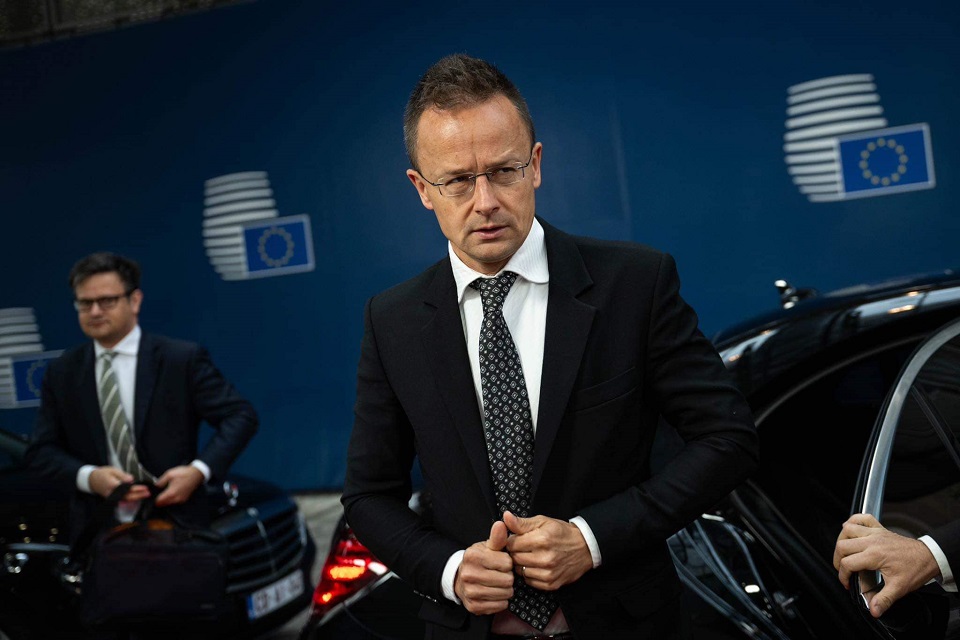
Péter Magyar, leader of the Hungarian opposition Tisza party, disclosed at a press conference what he called "insider information" from Hungary's Ministry of Foreign Affairs: the head of the ministry Péter Szijjártó allegedly destroyed official documents.
Magyar did not reveal his source of information but stated that he received it from people inside the ministry. According to him, it is a deliberate destruction of documentation rather than routine archiving.
Why This Timing Is No Coincidence
The statement came against the backdrop of Szijjártó's notable absence from public events. Hungarian media noted that the minister had not appeared before the press for several days and missed a number of official meetings — without official explanation from the government.
The office of Prime Minister Orbán and the Ministry of Foreign Affairs themselves had not responded to Magyar's accusations at the time of publication.
Context: Who Magyar Is and Why It Matters
Péter Magyar is the ex-husband of former Justice Minister Judit Varga. He entered politics in early 2024 following a major scandal involving the pardoning of a convicted pedophile linked to Orbán's circle. His Tisza party received approximately 30% of votes in the June 2024 European Parliament elections — the best result for Hungarian opposition in recent years.
Szijjártó, for his part, is one of the key architects of Hungary's policy of rapprochement with Moscow and Beijing. He led negotiations on extending contracts with Gazprom and represented Budapest at meetings that Brussels considers problematic from the perspective of sanctions discipline.
What This Could Mean
If the accusations have merit, this is not about a personal dispute between two politicians — it is about the potential destruction of evidence of activities that could have contradicted both Hungarian law and the country's obligations to the EU and NATO.
Destruction of documents in a state agency is a separate criminal offense in most legal systems. But in Hungary, where the prosecutor's office is subordinate to the Orbán-loyal General Prosecutor Péter Polt, questions remain about whether a real investigation will take place.
Magyar has already announced that he will hand over available materials to independent lawyers. If documentary evidence truly exists and becomes public — it will change the nature of the accusation from political to legal. If not — it will remain a pre-election maneuver ahead of Hungarian municipal elections.
The question is not whether to trust Magyar. The question is whether specific documents will emerge — or their absence will become proof in itself.



