Macron orders increase in nuclear arsenal: what it means for European and Ukrainian security
France has announced plans to expand its nuclear warhead stockpile and to build a new submarine, "Invincible," by 2036. We examine why Paris is moving forward with strategic deterrence and what consequences this holds for Ukraine.

By Tetiana Suchkova-Ladik
March 2, 2026 · 3 min read
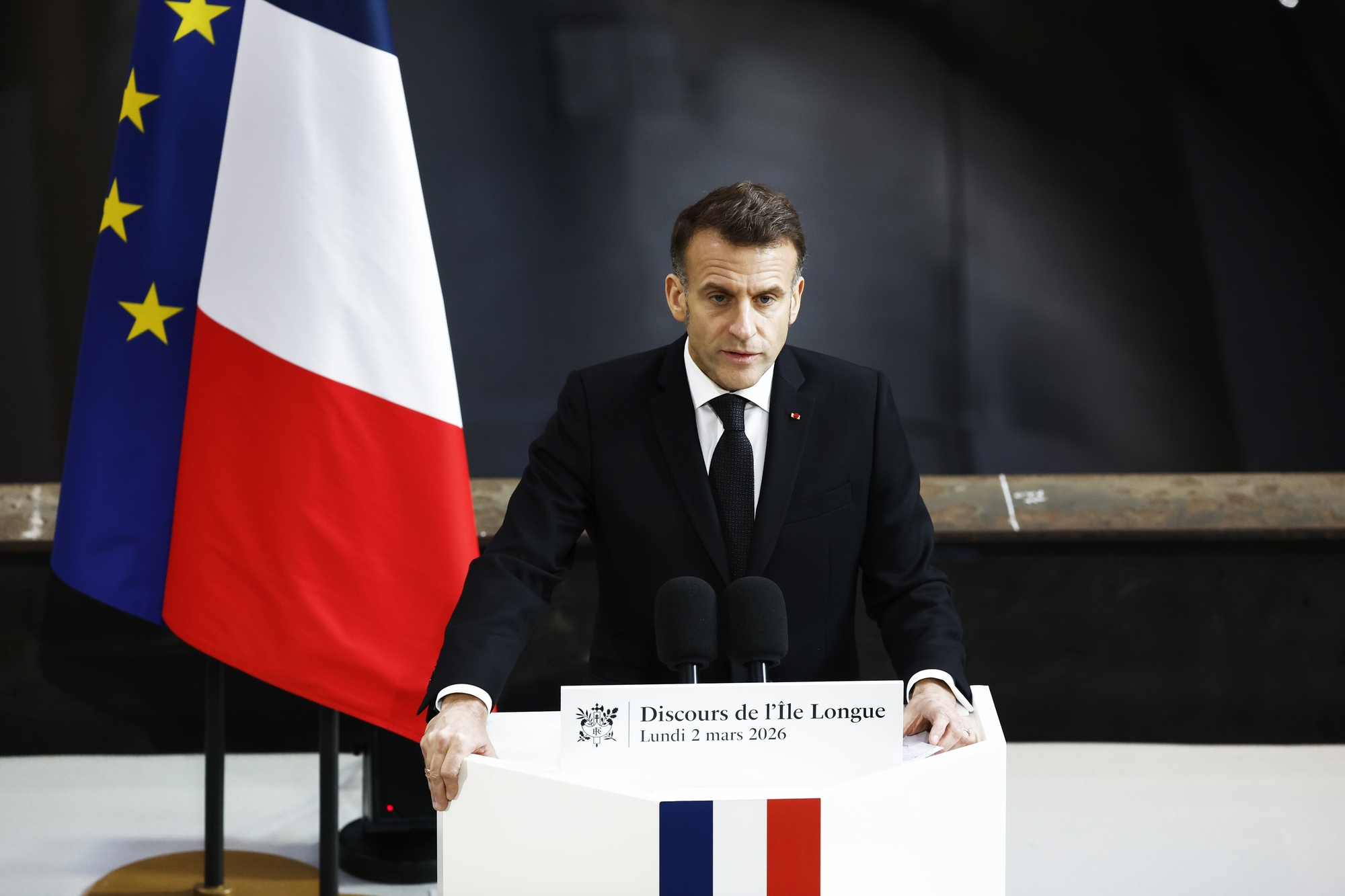
France Revises Its Strategic Pause: Macron’s Statements and a New Deterrence Course
Le Figaro quotes President Emmanuel Macron, who has ordered an increase in the number of nuclear warheads in the French arsenal and announced plans to bring a new nuclear-powered ballistic missile submarine into service in 2036. Official details (numbers, delivery schedules) are not yet being disclosed — this is part of a new policy of greater opacity regarding nuclear capabilities.
What Paris Announced
In addition to the order to increase warheads, Macron announced a modernization of strategic forces: upgrades to the Air Force’s and Navy’s cruise missiles and the launch of a program to develop hypersonic and maneuvering missiles for fighters and aircraft carriers. He also announced the name of the future submarine — "Invincible" — and indicated 2036 as the target year for entering service.
"That is why I ordered an increase in the number of nuclear warheads in our arsenal"
— Emmanuel Macron, President of France
"It is a great honor for me to announce today that the future nuclear-powered submarine... will be named 'Invincible' and will enter service in 2036"
— Emmanuel Macron, President of France
Why This Happened: Context and Logic of the Decision
The decision fits into a broader trend — strengthening strategic postures and a return to tougher rhetoric in response to an unpredictable security environment. Paris has several reasons to revise its policy: renewed great-power competition, drone incidents over the Île-Longue base in December 2025, and the approach of a Russian drone to the aircraft carrier "Charles de Gaulle" in February 2026. These episodes underscore the risks to maritime and air security near French strategic sites.
International Dimension and "Extended Deterrence"
Macron also announced an "extended deterrence" initiative, which, he said, the United Kingdom, Germany, Poland, the Netherlands, Belgium, Greece, Sweden and Denmark have agreed to join. At the same time the president immediately limited the institutional consequences: this will not be joint decision-making or execution — responsibility for nuclear policy remains within the framework of the French constitution.
"To put an end to all speculation, we will no longer disclose data about our nuclear arsenal"
— Emmanuel Macron, President of France
What This Means for Ukraine
First, strengthening French deterrence may raise the overall level of deterrence in Europe, which is beneficial for Ukraine — stronger security guarantees for the western flanks reduce the likelihood of escalation aimed at undermining European unity.
Second, this decision does not replace either economic or military assistance to Ukraine in the usual sense. The practical effect for Kyiv will depend on whether partners' declarations are transformed into concrete contracts for arms deliveries, training and logistics — in other words, on the preservation of political and material support.
Third, the buildup of Europe’s nuclear potential raises additional questions for arms control regimes and for maintaining strategic stability over the long term. Analysts note that increasing opacity on nuclear matters complicates monitoring and may raise the risk of misunderstandings in crisis moments.
Conclusion
France is choosing to strengthen its strategic potential amid increased uncertainty. For Ukraine this is a twofold signal: on one hand — an additional element of the European deterrent architecture; on the other — a reminder that long-term security depends not only on strategic arsenals but also on coordinated conventional capabilities and the political solidarity of partners. Now the onus is on turning the announced intentions into practical actions to support resistance and the restoration of territorial integrity.



