Miller Returned After 62 Years — Along with the Question of Who to Bury Next
# The Reburial of the Second Head of the OUN at NVMK Became the First Step of the State Program to Return Figures from Emigration. Next — Konovalets, Petlyura, and the Unresolved Question About Bandera.

By Tetiana Suchkova-Ladik
May 25, 2026 · 3 min read
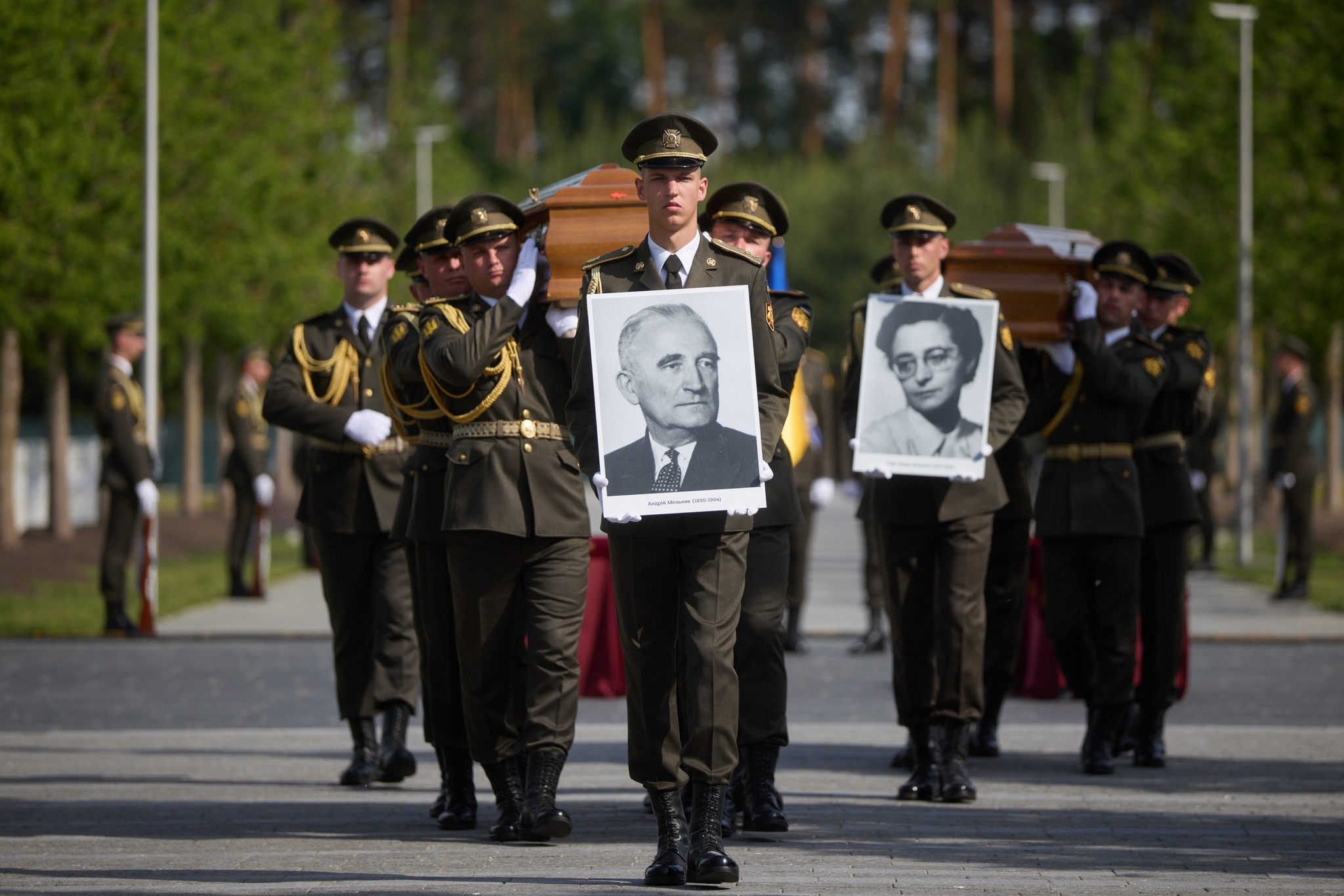
On Monday, May 26, Colonel of the Army of the Ukrainian People's Republic and second leader of the Organization of Ukrainian Nationalists Andriy Melnykov and his wife Sofiya Fedak-Melnykov were buried at the National Military Memorial Cemetery near Kyiv. Exhumed in Luxembourg on May 19, they crossed the Ukrainian border through Slovakia and spent three days at the Patriarchal Cathedral of the UGCC — for general commemoration. Since 1945, Melnykov lived in emigration, died in 1964 in Cologne and was buried in Luxembourg according to his own will — next to his wife's mother.
Ceremony as Political Statement
All state leadership appeared at the cemetery — President Zelensky, Prime Minister Syrydenko, Speaker Stefanchuk, Head of the Presidential Office Budanov, Foreign Minister Sybiga, and third president Viktor Yushchenko. The presence of such a composition is not protocol, but a signal: the state consciously includes Melnykov in the official canon of national memory.
"When we returned Colonel Andriy Melnykov and his wife Sofiya to Ukraine through Transcarpathia and half the country to our free capital, there was no discord on this path, which so often knocked us down before."
President Volodymyr Zelensky, Telegram
The phrase about "absence of discord" is not rhetorical embellishment. Melnykov is truly a controversial figure. In April 1941, he signed a memorandum to Hitler proposing cooperation against Bolshevism "under the protectorate of Germany." Unlike Banderites, the Nazis did not arrest Melnykovites or send them to Sachsenhausen. Some members of OUN(m) participated in punitive operations. This is a documented part of the organization's biography, which the state does not refute, but does not bring to the forefront either.
Pantheon as Project and as Problem
Melnykov's reburial is the first within the new system: in June 2025, the Cabinet of Ministers approved the procedure for reburial of outstanding fighters for Ukraine's independence in the 20th century at the NMMC. According to Deputy Head of the Presidential Office Iryna Vereshchuk, the next will be Yevhen Konovalets — founder of OUN, killed by an NKVD agent in Rotterdam in 1938 and buried there at Crosswijk Cemetery. Permission from the Netherlands has already been obtained.
Head of the Ukrainian Institute of National Memory Oleksandr Alfyorov reported that work is being conducted in parallel on over one hundred prominent figures. OUN leader Bohdan Chervak wrote on Facebook that "Konovalets and Petliura will return soon." Symon Petliura has been buried in Paris at Montparnasse Cemetery since 1926.
- Yevhen Konovalets — Rotterdam, Netherlands; permission obtained, date not announced
- Symon Petliura — Paris, Montparnasse Cemetery; negotiations ongoing
- Stepan Bandera — Munich; official speakers declined to respond
The last point is the most revealing. When journalists directly asked about Bandera's reburial, ceremony spokespeople refused to answer. Vereshchuk limited herself to a general statement: decisions will be made by separate Cabinet resolutions for each figure. The law on the Pantheon, which was supposed to define selection criteria, is still only planned for adoption.
Why Now
UINM Head Alfyorov also voiced a pragmatic argument: some graves abroad are in threatening condition due to lack of permanent care. But the context is military. The return of bodies from emigration fits into a broader logic of cultural sovereignty that Kyiv has consistently promoted since 2022: decommunization, rejection of shared symbolic space with Russia, construction of its own pantheon of struggle for independence.
Kyrylo Budanov at a meeting on the Pantheon back in March 2026 formulated this directly: "Returning historical memory is a very important matter that is especially relevant in times of war for sovereignty." That is, reburial is not just a symbolic gesture, but an element of information strategy during the active phase of war.
If the criterion for inclusion in the Pantheon is "struggle for independence," then the question about Bandera will sooner or later have to be resolved publicly: either include with context explanation, or exclude with justification — and both options will have specific diplomatic consequences in relations with Poland and Israel.



