Merz proposes Ukraine a seat at the EU table — but without voting rights
# Germany's Chancellor Deems Ukraine's Full EU Membership Unrealistic in Near Term, Proposes Alternative Format Germany's Chancellor believes that Ukraine's full membership in the European Union is unrealistic in the coming years and proposes an intermediate format for the country's participation in bloc institutions. Here's what this means in practice.

By Tetiana Suchkova-Ladik
April 24, 2026 · 2 min read
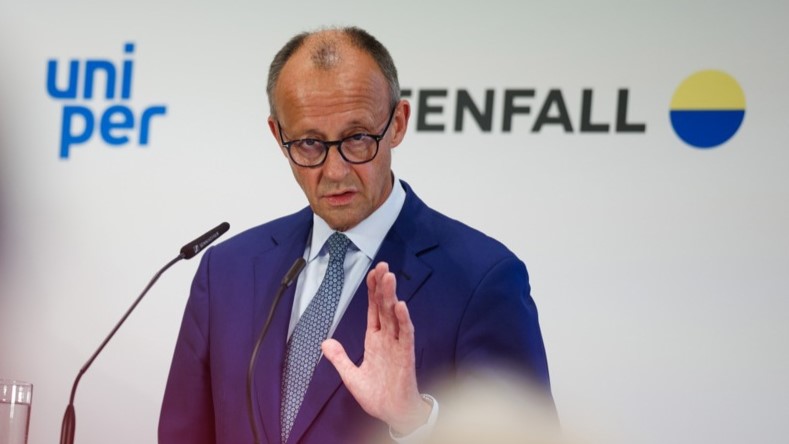
Friedrich Merz publicly acknowledged what has been discussed behind closed doors in Brussels for a long time: Ukraine's swift accession to the European Union will not happen. Instead, Germany's chancellor is promoting the idea of associated participation — Kyiv would gain seats at meetings of the European Council, European Parliament, and European Commission, but without voting rights on decisions that directly affect Ukraine.
Formally, this is a step forward compared to the candidate status that Ukraine received in 2022. In fact, it is the institutionalization of the current state of affairs: present, but not equal.
Why now
Negotiations on accession are open, and several technical clusters have already begun. However, real integration is being stalled on several levels simultaneously: the agricultural lobby of France and Poland is blocking market opening, the EU's budget arithmetic does not align with including a country with a population of over 40 million, and some member states — notably Hungary — are systematically hindering any progress.
Merz's proposal did not appear in a vacuum. Berlin is seeking a way to keep Kyiv within the orbit of European integration without taking on obligations that require unanimous decision-making by all 27 members.
What the format without voting rights offers
Presence at meetings means access to information, the opportunity to lobby a position before voting, and a signal to investors about the irreversibility of the course. This is not nothing. But there is a fundamental difference between "we are heard" and "our vote counts."
Decisions on sanctions against Russia, on trade agreements, on the distribution of structural funds — all of this would be adopted without formal participation by Ukraine, even in the scenario described by Merz.
Kyiv's reaction
There has been no official response to Merz's specific proposal yet. However, Ukraine's position became known during previous discussions about "phased integration": Kyiv agrees to transitional mechanisms only if they contain clear time frames and a legally binding path to full membership. The format of "participation without voting indefinitely" is something that Bankova has consistently refused.
The scale of the issue
According to Eurostat, Ukraine is potentially one of the largest EU member economies in terms of population and agricultural potential. Its inclusion would change the balance of power within the bloc: the weight of Eastern Europe would increase, and the relative influence of France and Germany would decrease. The fact that Berlin itself is promoting a limited format of participation is no coincidence.
If Kyiv agrees to participation without voting rights without a fixed deadline for full membership — would this not become a precedent that would allow the EU to indefinitely postpone the issue while not losing Ukraine as a strategic partner?



