"A mine the size of a bottle cap: how 'Pryanik' became a weapon against civilian streets"
Russia is systematically using remotely scattered anti-personnel mines "Prynik" (Gingerbread) in residential areas — from Nikopol to Kherson. Their main characteristic is invisibility, not lethality.

By Tetiana Suchkova-Ladik
April 6, 2026 · 2 min read
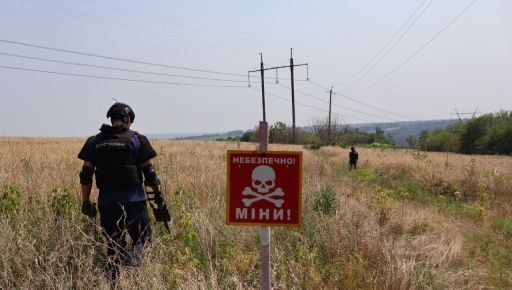
At the beginning of April 2026, residents of Nikopol were warned: mines could be lying on city streets. Not near the front lines — in the city itself. Small plastic objects measuring 5-6 centimeters in diameter, resembling a washer or bottle cap. Their official name is the "Prynik" anti-personnel mine (also known as "Plyushka"). Russians distribute them remotely — via drones or artillery cluster munitions.
Weapons Not for the Front
The "Prynik" is not designed to kill — it is designed to injure. The charge is relatively small, but sufficient to seriously wound the foot or limb of a person who steps on it. This very logic — to incapacitate a person rather than kill them — makes this type of weapon especially dangerous in civilian areas: one victim requires several rescuers and medical resources.
According to sappers, the mine is triggered by pressure — when a foot presses on the entire body containing the liquid explosive substance. The plastic casing is poorly visible to a metal detector. On asphalt, in grass, or among garbage, it is virtually invisible.
"We urge you not to travel through the specified area. The minefield may be larger."
Kherson Regional Police, April 3, 2026
Not Just Nikopol
The appearance of "Pryniki" in Nikopol is not an isolated case. During the first week of April 2026, such mines were detected in at least three populated areas: in Nikopol in Dnipropetrovsk Oblast, in Komyshany, and directly in Kherson — on Zalaegerszeg Street between Universytska and Perekopska streets. In Kherson, mines were also found on a car bridge across the Kosheva River. Oleksandr Prokudin, head of the Kherson Regional Military Administration, noted that "the mines are difficult to spot: they hide in grass, garbage, or on asphalt."
Remote mining of the right bank of Kherson region began in the first days of the full-scale invasion, but after deoccupation, it took on, according to local law enforcement assessments, a systematic character: explosive devices are increasingly being found precisely in residential neighborhoods rather than at industrial or strategic facilities.
What to Do If You Find One
- Do not approach, do not touch, do not attempt to move it
- Document the location visually (photo from a distance, landmarks)
- Call 101 (Emergency Services) or 102 (Police)
- Warn people nearby and move away from the object at least 200 meters
The Ministry of Internal Affairs and local authorities emphasize: the minefield may always turn out to be larger than the detected area — a drone or cluster munition scatters mines chaotically, and no map is comprehensive.
So far, Ukraine does not have a systematic public registry of remotely mined civilian territories in real time — the question is whether this will change now that "Pryniki" have begun appearing not in frontline fields, but on city streets hundreds of kilometers away from the trenches.



