Moscow braved Starmer's threats: what the frigate in the English Channel means
On April 8, the Admiral Grigorovich passed between two sanctioned tankers in British waters — and no one was detained. This is not merely a show of force, but a test of the legal boundary between sanctions and international maritime law.

By Tetiana Suchkova-Ladik
April 9, 2026 · 3 min read
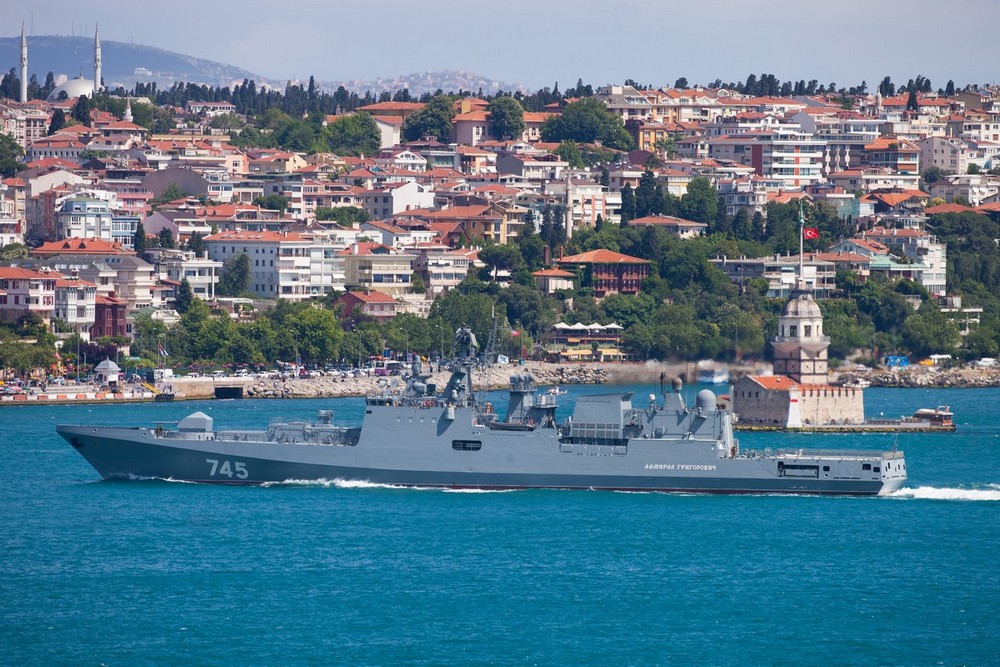
On the morning of April 8, the Russian frigate Admiral Grigorovich — a 3,620-ton missile ship of the Black Sea Fleet — was sailing through the English Channel right between two sanctioned tankers: Universal (Russian flag, departed from Vysotsk) and Enigma (Cameroonian flag, loaded in Ust-Luga). Journalists from The Telegraph observed the scene from aboard: the British auxiliary vessel RFA Tideforce followed behind, while HMS Richmond tracked the frigate in the North Sea. No one was stopped.
A month earlier, Prime Minister Keir Starmer publicly promised to go after the shadow fleet "even more aggressively" — even to the point of seizing vessels. Putin responded not with words, but with a route.
Why London didn't act — even with the intention
The legal conflict is simple and awkward: Article 17 of the UN Convention on the Law of the Sea guarantees the right of innocent passage through territorial waters for any vessels regardless of sanctions status. The British Sanctions Act of 2018 allows detention in territorial waters and the control zone — but only if a vessel is actively violating the regime (for example, transferring oil beyond the G7 ceiling). Tankers that simply pass through in transit formally remain in a legal "grey zone."
"This fear of the English Channel is not universal, and shadow fleet tankers will continue to use this route."
Mark Douglas, Starboard Maritime Intelligence
As an analysis by Defence Viewpoints documented, it is precisely the combination of the innocent passage doctrine and the practice of "re-flagging" — changing registration during a voyage — that makes interception a legally vulnerable step: each new registration essentially "resets" the vessel's sanctions status in the eyes of maritime law.
Six vessels before the frigate — and no detentions
Admiral Grigorovich was not the first challenge. According to GB News, at least six sanctioned tankers — including Vayu 1 — passed through the English Channel after Starmer's statement, approaching Dover within six nautical miles. British forces monitored, recorded, and escorted — but did not intercept. The difference on April 8 is only that Moscow sent a combat ship for the first time, turning a silent procession into a visible signal.
Foreign Secretary Yvette Cooper stated on LBC after the incident that permission to act against the shadow fleet "has already been given," and "operational decisions are made appropriately by the military." This phrasing is notably cautious.
Context: what has worked and why
In January 2026, Britain helped the US seize the tanker Bella I / Marinera in the North Atlantic — but the basis there was flag deprivation (the vessel was considered "derelict"), not sanctions as such. This precedent shows: seizure is possible, but requires a separate legal construction for each vessel, not a general threat.
- Universal — under OFAC, EU, and UK sanctions; departed Russian port Vysotsk on January 18.
- Enigma — under OFAC, EU, and UK sanctions; loaded in Ust-Luga on March 21, heading for Turkey.
- Admiral Grigorovich — Admiral Grigorovich-class frigate, armed with Kalibr cruise missiles and surface-to-air missiles; the fifth known entry into British waters.
London has sanctioned over 520 shadow fleet vessels — the largest list in the world. But a sanctions list and physically stopping a vessel are different tools, and Moscow is now publicly demonstrating the gap between them.
If Britain cannot find a legal framework that allows interception of transiting vessels without violating UNCLOS, the next frigate in the English Channel will not come alone — and the question will not be whether London will stop the tanker, but how many combat ships Moscow is willing to allocate for escort.



