Moscow Admits: Air Defense Downed Azerbaijani Plane. But "Settlement" — Without Trial or Punishment
Russia and Azerbaijan signed a joint statement on compensation for the J2-8243 flight disaster. The document closes the financial matter but leaves unanswered what Baku has been demanding for over a year: criminal liability for specific individuals.

By Tetiana Suchkova-Ladik
April 15, 2026 · 3 min read
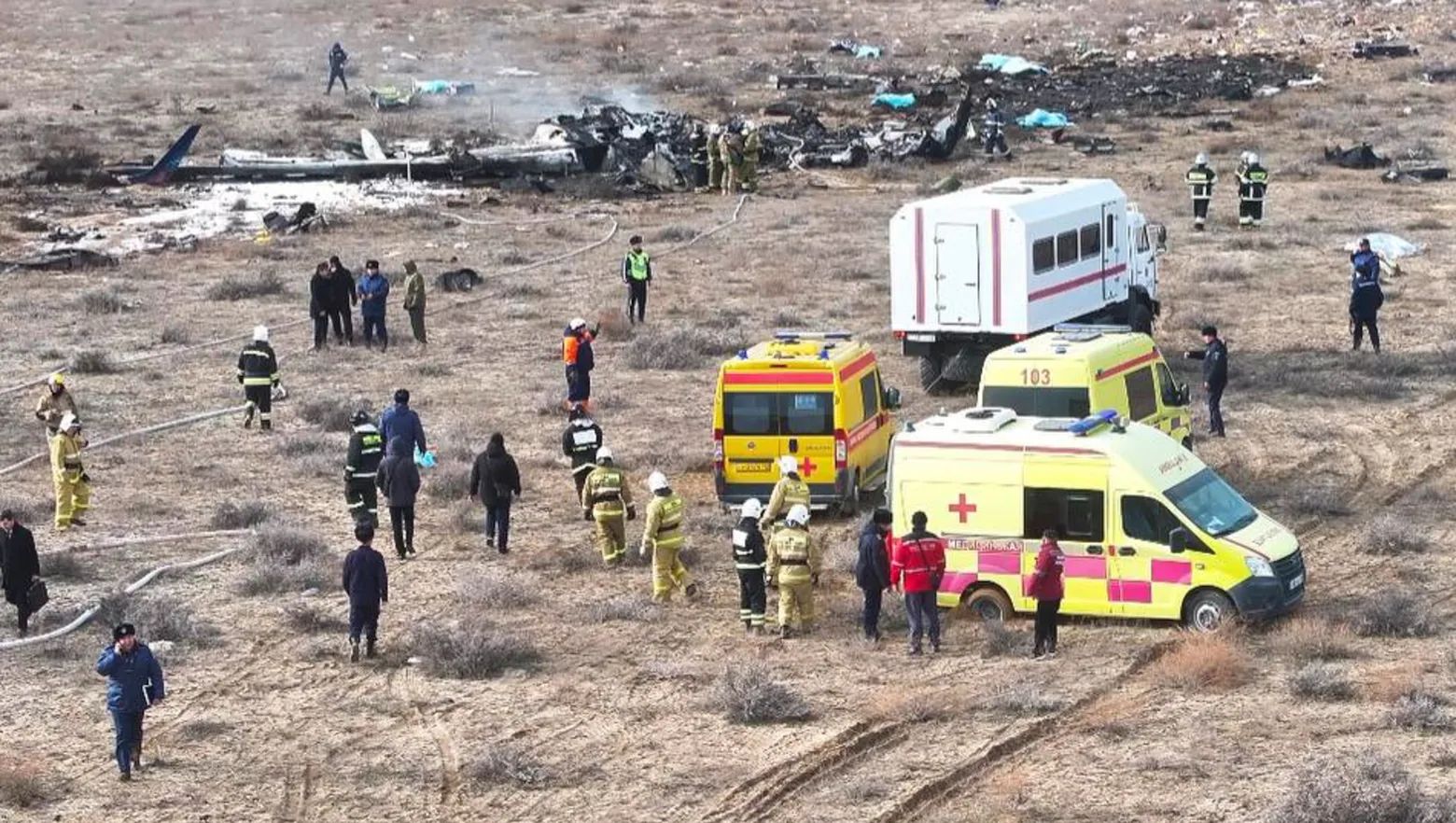
On December 25, 2024, an Embraer 190 of Azerbaijan Airlines (AZAL) was flying from Baku to Grozny. It was shot down by a Russian air defense system — the plane crashed near the Kazakh city of Aktau. Of 67 people on board, 38 died. Moscow initially spoke of a collision with birds.
What Was Signed
On April 15, the Foreign Ministries of Azerbaijan and Russia published a joint statement. It contained an admission: the catastrophe occurred as a result of "unintentional action of the air defense system in the airspace of the Russian Federation". The parties, according to the document, reached an "appropriate settlement of consequences, including the issue of compensation payments."
"The steps taken confirm the mutual desire for further mutually beneficial cooperation within the framework of allied interaction."
Joint statement of the Foreign Ministries of Azerbaijan and Russia, April 15
The statement refers to agreements reached during a meeting between Presidents Aliyev and Putin in Dushanbe on October 9, 2025 — effectively recording an agreement prepared six months earlier.
The Money Is There — The Mechanism Is Vague
Even before the statement was signed, Russian insurer AlfaStrakhovanie from February 2025 had paid AZAL 1.003 billion rubles (~$12.3 million) as the insurance value of the aircraft, and to the families of the deceased and injured passengers — 358.4 million rubles (~$4.4 million). This covered 46 of 62 passengers.
However, the Azerbaijani Foreign Ministry in September 2025 publicly rejected Moscow's attempt to count these payments as "compensation." Spokesman Aykhan Hajizade explained: insurance is an obligation under AZAL's contract with the Russian company, not an acknowledgment of state responsibility. "Equating insurance payments with the compensation that Azerbaijan demands from the Russian government is incorrect," he emphasized.
The current joint statement does not disclose either the amount of state compensation, the timeline, or the mechanism for verifying payments.
What Is Missing From the Document
For more than a year, President Aliyev had formulated three demands: Russia's acknowledgment of guilt, punishment of the specific military personnel who gave the order and carried out the launch, and full compensation. The Azerbaijani Prosecutor's Office repeatedly sent requests to Russia's Investigative Committee — without response. According to data from Azerbaijani publication Minval, the commander of the unit that shot down the plane received a promotion after the catastrophe.
- No public criminal prosecution has been initiated in Russia.
- The joint statement does not contain the word "liability" — only "unintentional action."
- The issue of punishment for those responsible is absent from the document.
Before signing the statement — in July 2025 — Baku announced preparations for lawsuits in international courts. Aliyev directly compared the situation to the downing of MH17, after which international bodies established Russia's responsibility following many years of proceedings.
Diplomatic Mathematics
For Moscow, the statement is beneficial: it defuses the acute crisis in relations with Baku without acknowledging state criminal responsibility. For Aliyev — it is a partial saving of face: the acknowledgment of the fact of the shooting is recorded in writing, the financial issue is closed. But the third demand — punishment of specific individuals — is not mentioned in the document at all.
If Baku has genuinely renounced the requirement for criminal prosecution, "settlement" means: the state acknowledged a technical error, but not a legal crime. If not — the question of a lawsuit to international bodies remains open, despite the signed document.



