Russia's Foreign Ministry Promised "Systematic Strikes" on Kyiv. CPD Calls It an Announcement of Terror — Not Military Rhetoric
# Russia announces new "consecutive" strikes after one of largest attacks on capital, calls for diplomat evacuation A day after one of the largest attacks on the Russian capital, Russia officially announced new "consecutive" strikes and called for diplomats to evacuate. Andriy Kovalenko from the Center for Counteracting Disinformation at the NSDC explained why now and for what purpose.

By Tetiana Suchkova-Ladik
May 25, 2026 · 3 min read
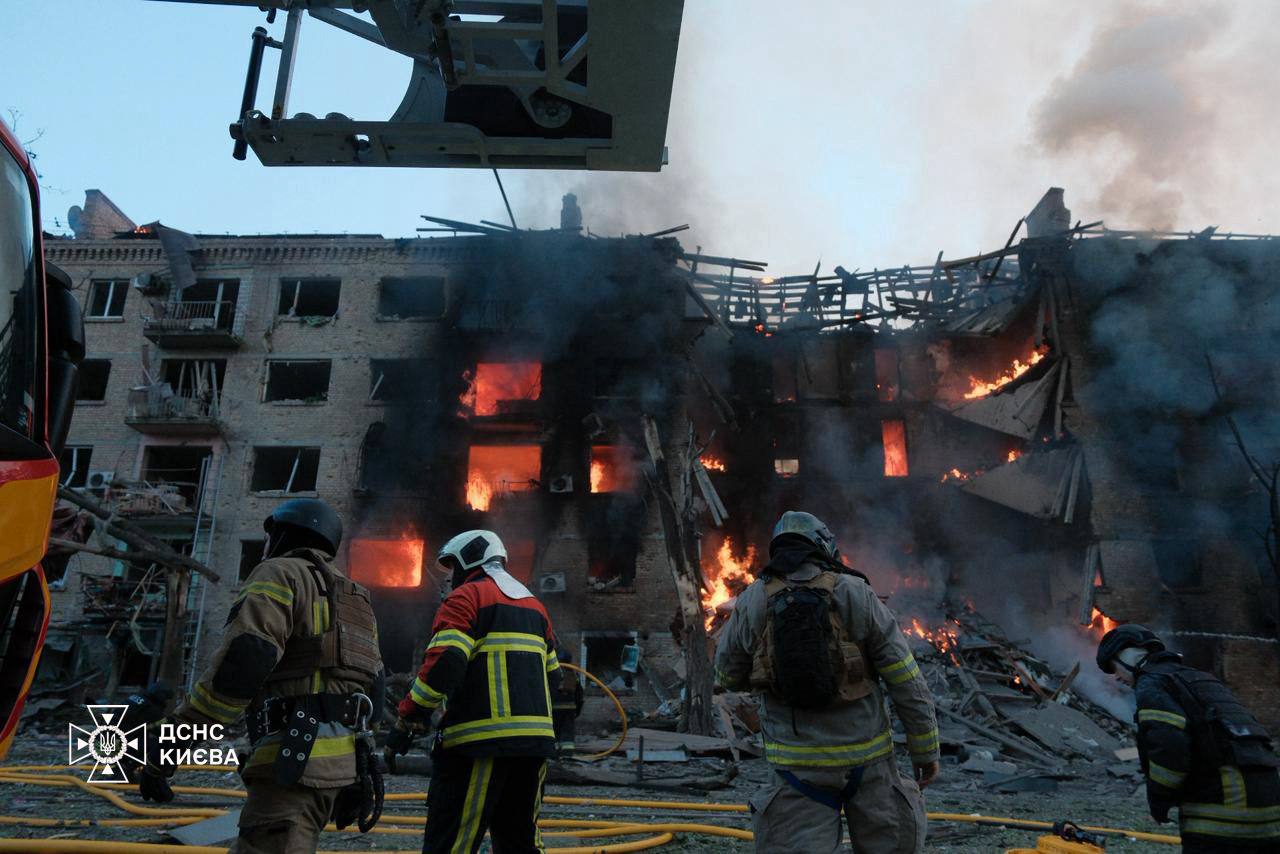
On the night of May 24, Russia delivered one of its most powerful strikes on Kyiv since the full-scale war began. 690 air attack assets — 90 missiles and 600 drones. Among the types used: ballistic Iskander, aeroballistic Kinzhal, cruise Zircon and Oreshnik missiles. Strikes were recorded in all eight districts of Kyiv: residential buildings, schools, a shopping center, and the vestibule of Lukyanivska metro station were damaged. The number of casualties exceeded 80 people.
The next day, Moscow not only did not remain silent — it announced a continuation.
What exactly did the Russian Foreign Ministry say
First, Foreign Ministry spokeswoman Maria Zakharova stated that "strikes on Kyiv have been and will continue to be delivered." Then the Foreign Ministry released an official statement: Russia is launching "consecutive systemic strikes" on Ukrainian defense industry enterprises in Kyiv, drone design and production facilities, "decision-making centers" and command posts. Minister Lavrov personally confirmed these intentions.
The pretext cited was the strike by Ukrainian Defense Forces on a college dormitory in occupied Starobilsk. The Foreign Ministry also "urgently urged" personnel of diplomatic missions and representatives of international organizations to "leave Kyiv as soon as possible," and residents of the capital not to "approach military and administrative infrastructure facilities."
No foreign embassy — not the US, nor EU countries, nor China — announced an evacuation.
Response from the Disinformation Center: not a threat, but a program
"Russia at the Foreign Ministry level announces further terrorism of civilians through missile and drone strikes"
Andriy Kovalenko, head of the Center for Countering Disinformation at the National Security and Defense Council
According to Kovalenko, the statement emerged in a clear context: before Putin's visit to China, Russia pretended to be considering ending the war. The current Kremlin statements demonstrate the opposite. "Through terrorism of civilians, Putin wants to mask his inability to ensure Russia's security," wrote the head of the center, noting that missiles are already reaching Moscow.
ISW analysts support this interpretation from a tactical perspective: Russian troops are not achieving significant advances in the 2026 spring-summer campaign, and the strike on Kyiv may have been intended to divert attention from battlefield failures and demonstrate "strength" to domestic and international audiences.
Starobilsk as a pretext, not a reason
The May 24 strike hit markets, museums, libraries, an opera theater, water supply facilities and residential buildings. None of these targets are related to a "response" to a military strike on the college. The pattern is familiar: Kovalenko recorded back in December 2025 that Russia "had planned attacks on civilian infrastructure from the beginning, and Kremlin statements are an attempt to mask true intentions."
- Air defense forces shot down 604 out of 690 targets — 549 drones, 44 cruise missiles and 11 ballistic missiles
- Oreshnik struck Bila Tserkva — closer to Kyiv than any previous launches of this type
- France condemned the use of Oreshnik, with Macron calling it "an escape forward and an impasse of aggressive war"
If Russia truly transitions to "systemic" strikes in the announced format — without reference to a specific "pretext" — it would mean that the information wrapper of "response" is no longer needed. The question is not whether Moscow will strike again, but whether allies will remain in condemnation mode — or finally transition to supplying systems capable of intercepting Oreshnik.



