Over 50 Missiles and Up to 700 Drones: Russia Strikes All Districts of Kyiv, Two Killed and 56 Wounded
# Russia Delivers One of 2025's Largest Strikes on Kyiv On the night of May 24, Russia launched one of its largest attacks on Kyiv this year, deploying X-101 cruise missiles, Kalibr missiles, Iskander systems, and aerodynamic weapons. The Shevchenkivskyi district sustained the heaviest damage: the Kvadrat shopping center was destroyed by fire, a business center was hit, a nine-story residential building was damaged, and two schools were struck.

By Tetiana Suchkova-Ladik
May 24, 2026 · 2 min read
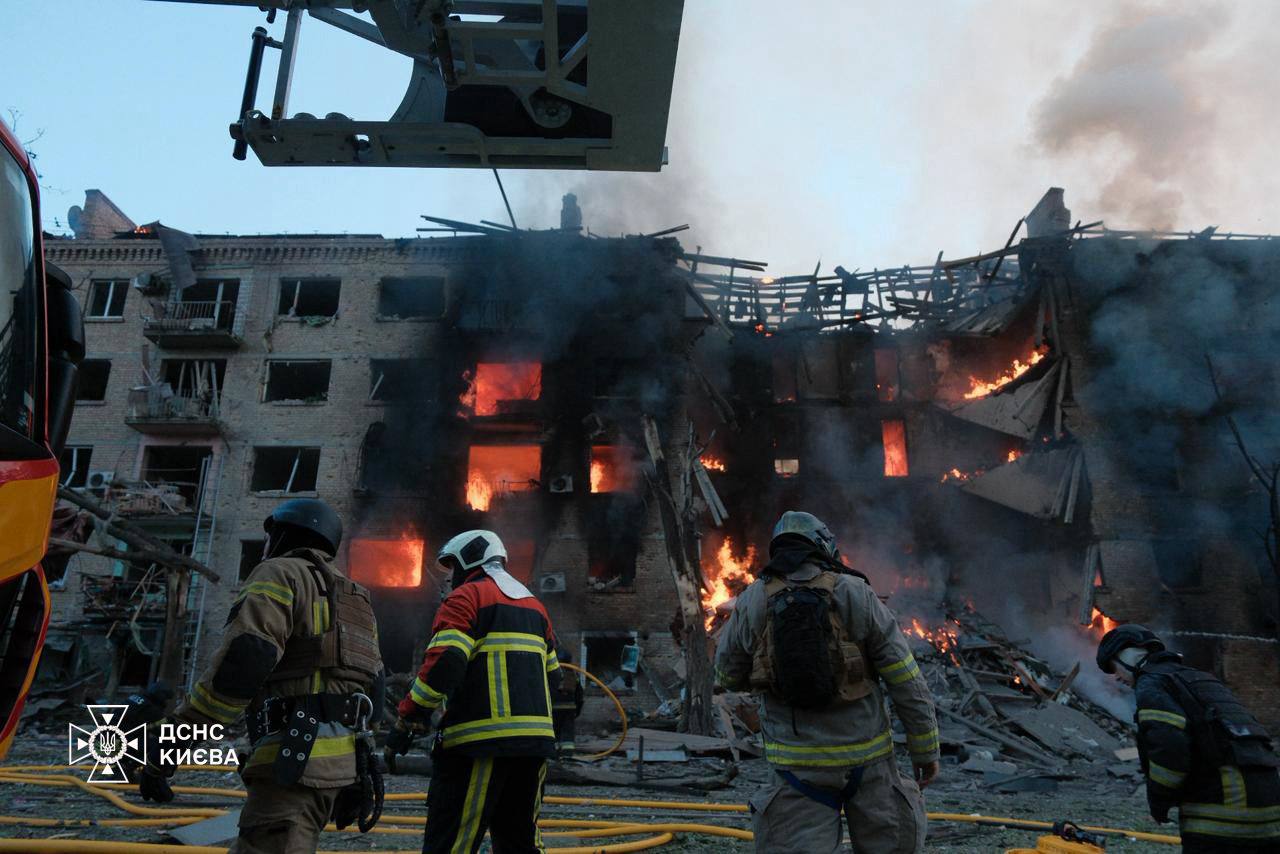
On the night of May 24, Russian forces delivered a massive combined strike on Kyiv and Kyiv region. According to monitoring channels, the enemy launched over 50 missiles and up to 700 drones. This is one of the largest attacks on the capital since the beginning of 2025.
The missile barrage was primarily composed of X-101, Kalibr, and Iskander-K cruise missiles, as well as an unusually high number of aerobalistic missiles for a single strike. During the attack, the threat of an RS-26 Rubezh intercontinental ballistic missile was also detected. Kyiv City Military Administration Chief Timur Tkachenko confirmed that "the capital suffered a massive ballistic attack."
What Burned and Where
The most severe destruction occurred in the Shevchenko district. There, debris and hits damaged two residential buildings, a business center, a market, and two schools at once—in one of them, the entrance to a shelter where people were located was buried. The "Kvadrat" shopping and entertainment center on Lukyanivska was hit directly and burned to the ground: only a charred frame, rubble, and remnants of signage remained from the building.
In a nine-story residential building in the same district, the strike hit between the eighth and ninth floors—one person was killed there. People were trapped in the business center shelter and had to be rescued. The blast wave damaged the vestibule of the "Lukyanivska" metro station—the station was temporarily closed.
Damage was recorded in all districts of the capital: in Darnitsky—a fire on the dormitory roof, in Pechersk—fire on the 13th floor of a 20-story residential complex, in Podil—debris on a residential quarter. Rescuers were called to more than 40 addresses.
Casualties and Injured
According to Kyiv Mayor Vitali Klitschko and the State Emergency Service, two people were killed in the capital. In Kyiv region, there are also casualties—Kyiv Regional Military Administration confirmed that strikes hit all districts of the region. Among 56 injured in Kyiv, 30 were hospitalized, including two children and three in critical condition. Rescuers were still clearing rubble at some addresses at the time of publication.
"The capital suffered a massive ballistic attack. New launches are possible."
Timur Tkachenko, Chief of Kyiv City Military Administration
Tactical Context
Analysts point to a change in strike structure: the Russians reduced the share of decoy drones—due to their low effectiveness against Kyiv's air defense—and increased the share of cruise missiles and aerobalistic missiles. This combination overloads interception systems and complicates target prioritization for air defense calculations. According to ZN.ua, Ukrainian intelligence had detected signs of preparation for a combined attack on Kyiv in advance.
A museum, administrative buildings, and 13 vehicles were also damaged. A construction hypermarket and a 16-story building, where fire covered floors 12-13, are on the list of fires extinguished by the State Emergency Service.
If Russia is indeed abandoning decoy drones in favor of a massive missile attack, the effectiveness of Kyiv's air defense will depend on whether partners can fill the deficit of interceptors before the next strike of this scale.



