Rocket Strike on Warehouse in Derhachi: Two Killed, Three in Critical Condition — Part of Massive Attack with 367 Means
On May 25, Russia struck a civilian enterprise in Derhachi in the Kharkiv region — one episode in one of the largest combined attacks of 2025, involving 55 cruise missiles and over 290 drones.

By Tetiana Suchkova-Ladik
May 25, 2026 · 2 min read
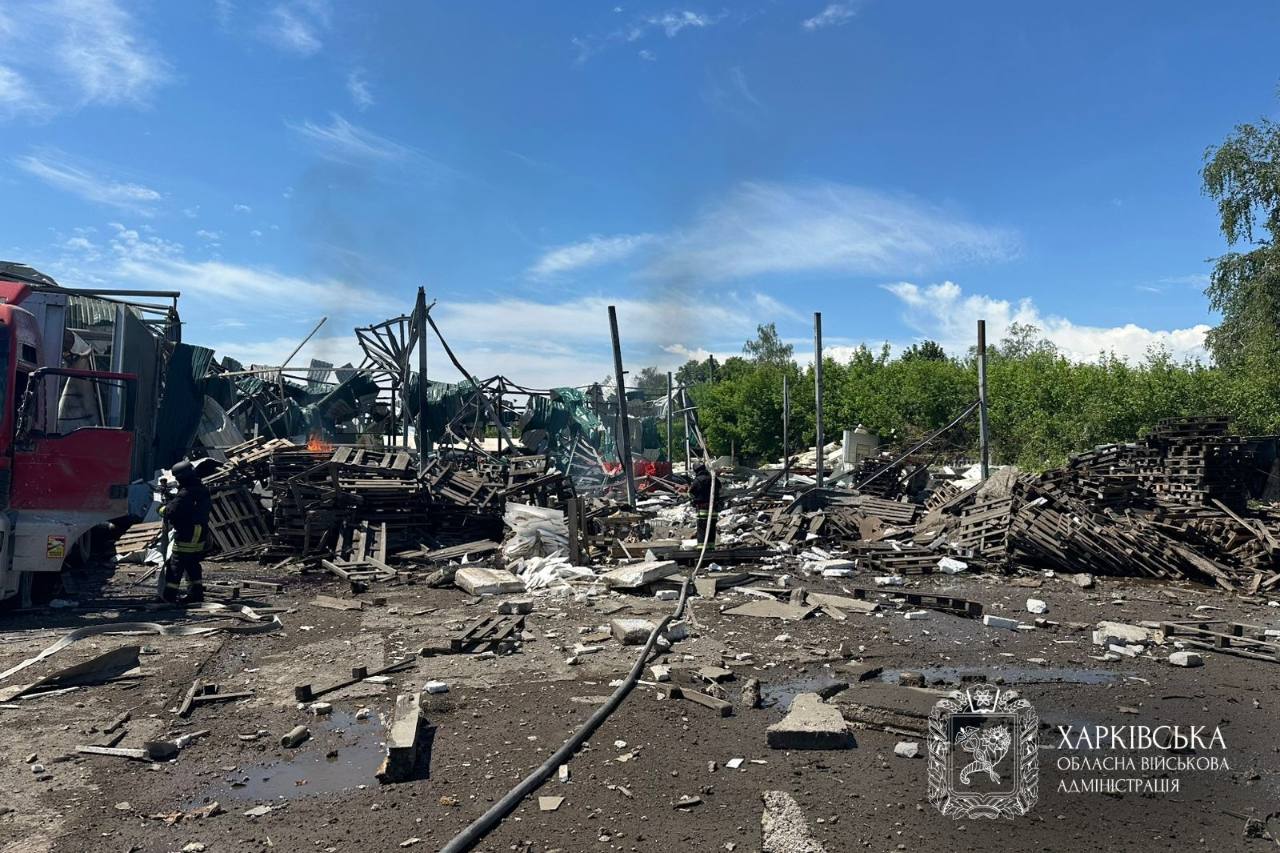
On May 25, a Russian missile hit a civilian enterprise in Derhachi—a city 17 km from Kharkiv. Two people were killed: a 68-year-old and a 25-year-old man. Of the 19 injured, 17 were hospitalized with blast injuries, three in serious condition. This is according to data from Kharkiv Regional Military Administration Head Oleh Synehubov and the Kharkiv Regional Prosecutor's Office.
What was struck and what was destroyed
The missile destroyed warehouse facilities of the enterprise, damaged cargo and passenger vehicles, as well as buildings of neighboring organizations. A fire broke out—State Emergency Service units extinguished it. The missile type was not officially specified: the strike on Derhachi occurred during the day, while the main wave of night shelling included Kh-101 and Kalibr cruise missiles from Tu-95 and Tu-160 bombers, as well as Iskander-M ballistic missiles.
Context: not an isolated strike
Derhachi is not a separate target. According to the Ukrainian Air Force, on the night of May 25, Russia used 367 air weapons: 9 Iskander-M/KN-23 ballistic missiles from Kursk Region, 55 Kh-101 and Kalibr cruise missiles from Saratov Region and the Black Sea, as well as over 290 attack drones. Air defense shot down 45 cruise missiles.
"Russia carried out one of the largest combined attacks since the beginning of the full-scale aggression"
Ukraine's Ministry of Foreign Affairs, statement from May 25, 2025
Defense Express analysts point to an atypical detail: Russia involved strategic Tu-160 bombers—the first time since November 2024. This may indicate a shortage of conventional Tu-95 carriers rather than an increase in capabilities.
Derhachi—a chronic target
The city in Derhachi Community is regularly struck: the night shelling on May 25 also affected neighboring Kozacha Lopan. Kharkiv Region remains one of the most attacked regions—both due to its proximity to the front lines and its dense infrastructure.
The strike on the warehouse complex bears no signs of error: the enterprise is located in a populated area, with civilian personnel of various ages. The Prosecutor's Office opened proceedings under the article on violations of laws and customs of war.
If Russia is indeed exhausting its carriers and engaging scarce Tu-160s even for strikes on warehouses in suburbs—does this mean that the "massed pressure" tactic increasingly depends on production rates rather than strategic target selection?



