Russia as a Vassal: Why NATO is Watching Taiwan to Predict a Strike on Europe
Former NATO Military Committee Chairman Rob Bauer explained the mechanics of the new threat: Moscow does not make decisions about attacking the Alliance independently — its capacity for aggression depends on whether it is beneficial to Beijing in the context of Taiwan.

By Tetiana Suchkova-Ladik
April 26, 2026 · 2 min read
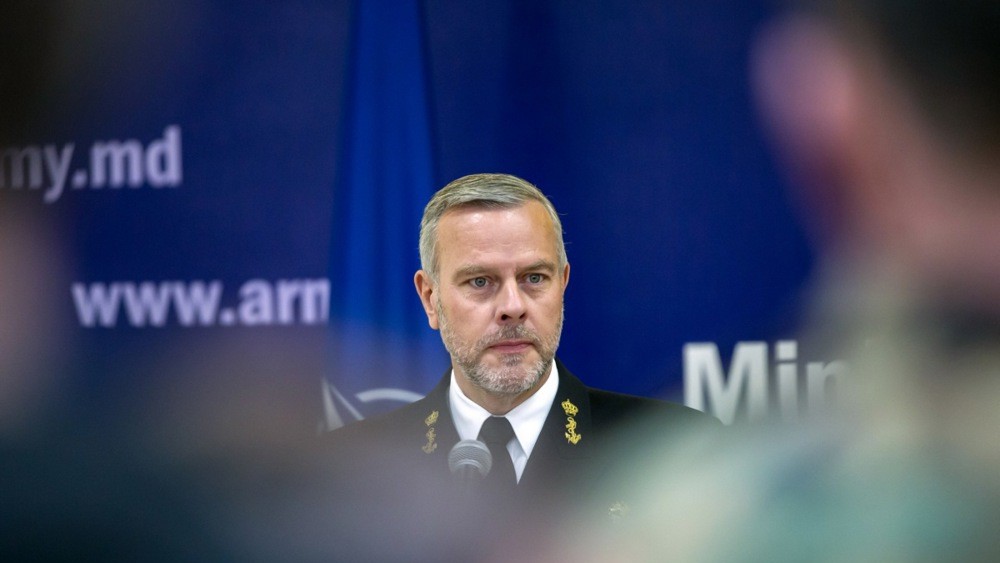
On Friday, April 24, at the 18th Kyiv Security Forum with the theme "Darkness or Dawn: Is there Light Ahead?" Dutch Admiral Rob Bauer said a sentence that reframes the logic of NATO planning: "The decision to attack NATO cannot be made only in Moscow — it will be made in Beijing. Russia is a vassal of China."
The Taiwan scenario as a trigger for Europe
Bauer, who led NATO's Military Committee until January 2025 and was the chief military advisor to the Alliance's Secretary General, expanded on this thesis in an interview with NV on the eve of the forum. According to him, the scenario that concerns NATO the most is a coordinated operation: China organizes pressure on Taiwan and simultaneously encourages Russia to strike one of the Alliance's countries.
"If Russia attacks a European country, the US will be forced to fight on two fronts — in Europe and in the Asia-Pacific region. This is a scenario that is currently being considered and causes concern in NATO."
Rob Bauer, former head of NATO's Military Committee, in an interview with NV
In other words, the threat to Tallinn or Warsaw does not originate from Putin's decision, but from Xi Jinping's decision regarding Taiwan. This changes the very model of early warning.
The economic lever that already exists
Vassal dependence is not a metaphor. China is one of the main buyers of Russian oil and gas after the West reduced imports. Chinese companies continue to supply dual-use components, facing sanctions but not stopping. Without this financial and technological resource, Russia could not maintain the current pace of war.
Bauer also reminded of the mirror vulnerability of the West: China extracts 60% of the world's rare earth materials and processes 90% of the total volume. Chemical components for a significant portion of critical medicines in Europe and the US are also of Chinese origin.
"We are naive if we believe that the Communist Party will never use this power."
Rob Bauer, November 2024
What this means for NATO planning
If Bauer's logic is correct, then the indicator of threat to Europe becomes not the concentration of Russian troops on the border, but the dynamics in the Taiwan Strait. NATO, according to the admiral, is already conducting relevant discussions. He called on allies to strengthen not only military force, but also industrial and financial potential — and not to allow a split among allies, particularly with the US.
- Russia is increasing its army quantitatively, but its quality has degraded since the beginning of the full-scale invasion — Bauer also notes this.
- He considers a "classical" victory — neither for Ukraine nor for Russia — unlikely.
- At the forum, the admiral presented a Ukrainian translation of his book "If You Want Peace, Prepare for War."
If Bauer's scenario is realistic, then the question is not whether Russia is ready to attack NATO — but when Beijing will need a second front: the answer depends on whether China will dare to take military action against Taiwan and whether it receives enough signals from Washington that the US is overstretched and not ready to fight simultaneously in two regions.



