"'Sheskharis' is burning again — but this time the stakes are higher than Russian oil"
Another strike on the oil terminal in Novorossiysk hits not only the Kremlin's budget — it complicates the transit of Kazakh oil to Europe and turns infrastructure attacks into a diplomatic problem.

By Tetiana Suchkova-Ladik
April 6, 2026 · 3 min read
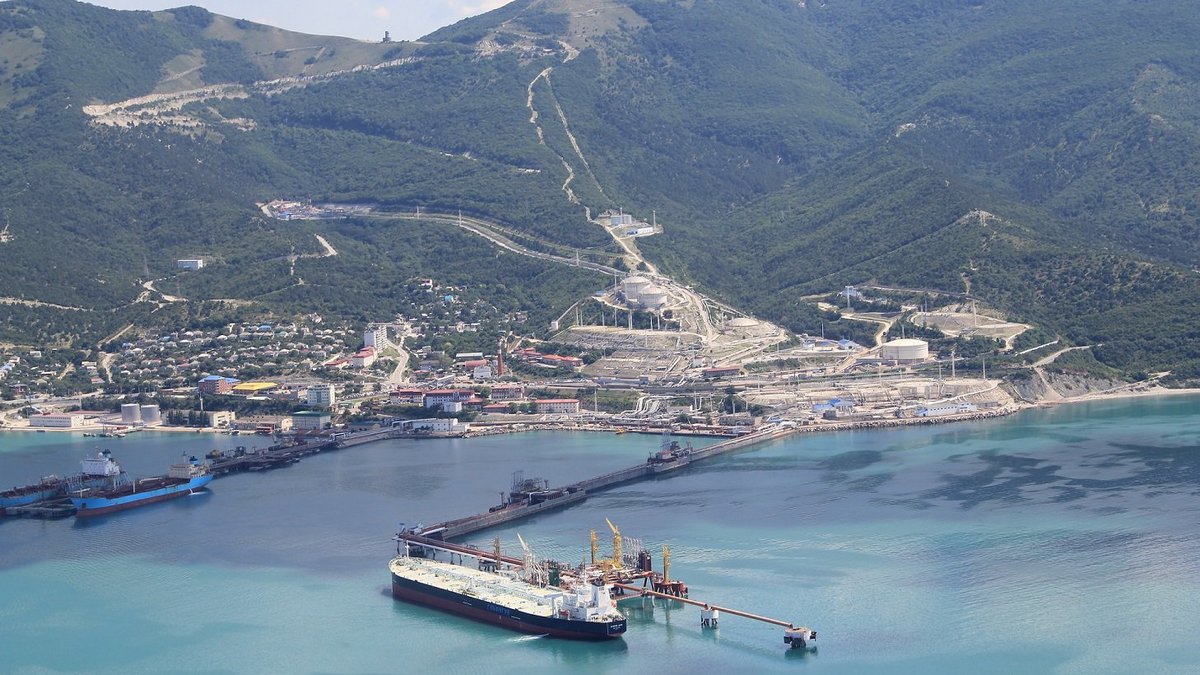
On the night of April 6, Ukrainian drones struck the Sheskharis oil terminal in Novorossiysk — a strategic hub through which the majority of Russia's maritime oil exports from the Black Sea pass. The fire was confirmed by Krasnodar Krai Governor Veniamin Kondratyev and the regional operational headquarters. Videos of the fire and air defense operations spread across the network even before official statements.
A terminal that has burned before — and still didn't stop
For Sheskharis, this is not the first attack. In November 2025, one of the terminal's deep-water berths (SPM-2) with daily loading capacity of up to 800,000 barrels per day was disabled by a naval drone. After that attack, the operational capacity of the port's maritime berths effectively fell to a third of normal. Then Transneft was forced to suspend oil pumping to the port, and global oil prices rose — Brent climbed 1.6%, to $64 per barrel.
The April strike occurs against the backdrop of incomplete recovery. According to Reuters, the Sheskharis terminal was supposed to load about 500,000 barrels per day, but after the latest series of attacks remained shut down, with the date of resumption of operations unknown.
Where Kazakhstan comes in — and why this is a problem for Brussels
An unexpected dimension of these strikes is not Russia, but Kazakhstan. Sheskharis handles an average of 1.5 million barrels per day from Russia and Kazakhstan through the Caspian Pipeline Consortium (CPC). Kazakhstan relies on this route for 80% of its oil exports.
The consequences are already being felt in practice. Due to attacks on Novorossiysk, Europe lost 3.8 million tons of Kazakhstani oil. On January 13, drones struck the tankers Matilda and Delta Harmony, which were waiting to load Kazakhstani oil. Kazakhstan's Energy Minister Erlan Akenzhanov emphasized that these vessels did not belong to Russia's "shadow fleet."
"Disruptions in loadings from Novorossiysk have already widened differentials in Mediterranean oil markets"
Times of Central Asia, on the consequences of attacks on CPC infrastructure
Analyst Olzhas Baidildinov warns that damage to the CPC could hit Kazakhstan's national company KazMunayGas, and rerouting oil through alternative routes over the next 36 months will prove technically difficult and significantly more expensive.
How much does recovery cost — and who pays
When CPC infrastructure was disabled, the consortium's throughput capacity fell by 30–40%, and Brent prices temporarily rose 4%. A series of strikes on Sheskharis, refineries in Saratov, and other oil infrastructure has, by some estimates, already paralyzed up to 40% of Russia's maritime oil exports — and inflicted billions in losses on the Kremlin.
- Berths No. 1 and No. 1A — service tankers with deadweight of 40,000 and 140,000 tons respectively; damaged in the November attack.
- SPM-2 — deep-water berth with capacity of 800,000 barrels/day; disabled on November 29, 2025.
- Pumping stations and pipeline infrastructure — damaged during combined strikes.
In parallel with strikes on land, the Ukrainian Defense Forces escalated their campaign against the "shadow fleet" in the Black Sea: in late November 2025, naval drones hit and disabled two sanctioned tankers — Kairos and Virat. This means simultaneous pressure on port infrastructure and on the fleet that was supposed to compensate for its downtime.
The April attack has not yet received official confirmation from the Ukrainian Defense Forces — this typically happens with a delay or after assessing results. If satellite imagery confirms damage to the berths — as it did after the November strikes — the question of resuming the terminal's operations will become relevant for Astana no less than for Moscow.



