Court gave suspended sentence to Aryev's daughter for hit-and-run — prosecution will appeal: key dispute over drugs
The Obolonsky Court has handed down a suspended sentence to Yaryna Aryeva, rejecting charges of driving under the influence of drugs. The prosecution had requested 6.5 years in prison and disagrees with the verdict.

By Tetiana Suchkova-Ladik
April 17, 2026 · 2 min read
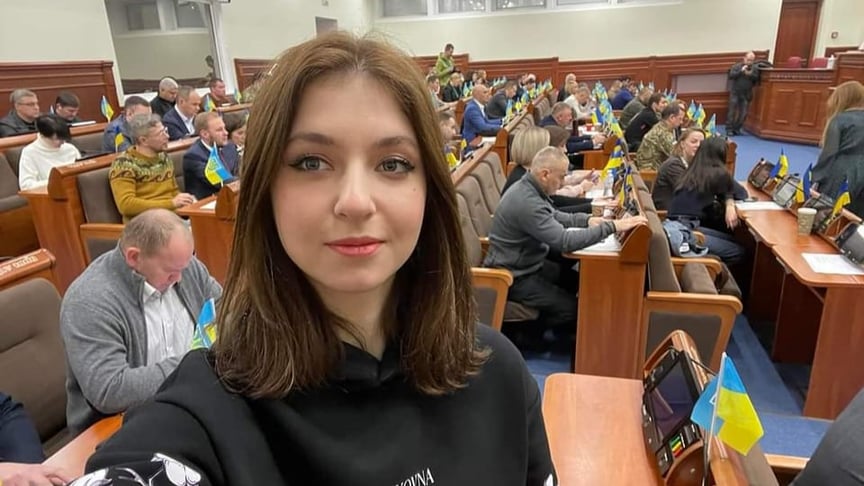
On November 27, 2022, on Stepan Bandera Avenue in Kyiv's Obolon district, a Volkswagen Polo struck a woman at an unregulated pedestrian crossing. Behind the wheel was Yaryna Aryeva — at that time a Kyiv City Council deputy from the European Solidarity party and daughter of Member of Parliament Volodymyr Aryev. The victim sustained fractures of the shoulder bone and jaw with traumatic tooth extraction, limb fractures, and closed head injury.
On April 13, 2025, the Obolon District Court of Kyiv issued a verdict: a suspended sentence and deprivation of driving rights for eight years. The court determined that the evidence did not confirm drug intoxication at the time of the accident.
What the dispute is about
The prosecution was built around Article 286-1 of the Criminal Code of Ukraine — violation of traffic rules while intoxicated with serious consequences. The provision stipulates 3 to 8 years of actual imprisonment: the law explicitly prohibits a suspended sentence under this article. The prosecutor requested 6 years and 6 months.
However, the court apparently reclassified the offense or acquitted on the intoxication charge. Without this qualifying element, the case falls under the standard Article 286, Part 2 — traffic accident with serious bodily injury without intoxication, where a suspended sentence is legally possible.
"I did not use any drugs. The examination conducted after the accident revealed nothing. Suddenly, half a year later, an examination surfaces with traces of drugs that I did not use"
— Yaryna Aryeva, 2023
Her father, Volodymyr Aryev, called the suspicion revenge for his criticism of the head of the Presidential Office, Andriy Yermak, even during the investigation. The prosecution did not change its position and announced it would appeal the verdict.
Timeline important for understanding the verdict
- November 2022 — Traffic accident. Aryeva's driver's license was not confiscated immediately.
- May 2023 — The investigation announced suspicion charges. According to prosecutors, a second examination revealed medications (or substances) in the blood that the first one did not detect.
- June 2023 — The appellate court strengthened the preventive measure to round-the-clock house arrest with an electronic bracelet. Aryeva resigned her deputy mandate: "It is impossible to fulfill my duties under these conditions."
- September–October 2024 — Substantive hearings finally began — nearly two years after the accident.
- April 13, 2025 — Verdict: suspended sentence.
Why this matters beyond one case
The central legal issue is not guilt in the traffic accident as such (Aryeva admitted it back in 2023), but the evidential dispute between two forensic medical examinations: the first, which revealed nothing, and the second, which appeared six months later. The trial court chose the first one. The prosecution believes the second is credible.
In practice of Article 286-1 of the Criminal Code, a suspended sentence is an exception to the law, not an interpretation at the judge's discretion: the norm provides exclusively for actual punishment. Therefore, if the appellate court finds drug intoxication proven, the verdict will have to be completely rewritten.
If the appellate court supports the Obolon court's position and recognizes that drug intoxication is not proven, a question will arise that extends beyond this case: how reliable are repeated toxicological examinations conducted months after an event, and can they serve as grounds for more serious criminal classification.



