Trump Flies to Beijing with an Awkward Question: Who Is Financing Iran Through Oil
A state visit to China on May 14-15 is not diplomatic courtesy, but an attempt to force Xi Jinping to choose between Iranian oil and American markets. Beijing is currently choosing both.

By Tetiana Suchkova-Ladik
May 11, 2026 · 3 min read
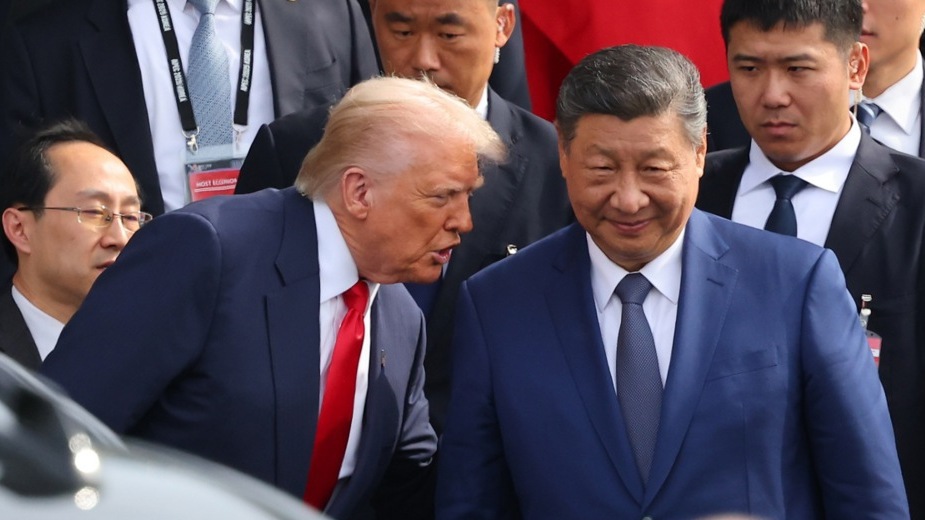
Trump arrived in Beijing in the evening of May 13. Official negotiations with Xi Jinping are scheduled for Thursday and Friday, May 14-15. The American president arrives in Beijing to discuss the war with Iran and other issues with his Chinese counterpart. However, at the core of this "state visit" is one specific issue that Washington does not formulate diplomatically.
Oil as a weapon — and as a problem
Washington accuses Beijing of financing Iran through large-scale oil purchases. "Iran is the greatest state sponsor of terrorism, and China buys 90% of their energy — and thus finances the greatest state sponsor of terrorism," said Finance Minister Scott Bessent.
An anonymous administration representative said that Trump could "pressure" China regarding the purchase of Iranian oil and the supply of dual-use goods to Tehran. Separately, Trump's trade representative Jamieson Greer confirmed to Bloomberg that the Iranian issue will be on the negotiation table.
"We do not want this to derail broader relations or any agreements that may be reached during our meeting in Beijing"
Jamieson Greer, U.S. Trade Representative
The wording is revealing: the U.S. wants to pressure Iran through China, but not at the cost of a trade truce.
Beijing's position: mediator, not ally
China said it wants the war to end and welcomed Iranian Foreign Minister Abbas Araghchi. At the same time, Beijing refuses to recognize American "unilateral" sanctions against Iran's oil sector.
In an unprecedented move, China applied a "blocking statute," for the first time in history obligating companies not to comply with American sanctions against Chinese oil refineries purchasing Iranian crude oil.
However, the fact that Beijing is eager to hold a summit between Trump and Xi Jinping suggests that China is far less confident in its positions than many observers believe. The recent visit of Iranian Minister Araghchi to Beijing is read by the United States as a signal: the PRC is trying to position itself as one that has already influenced Iran on the Strait of Hormuz.
What is really at stake
Iran blocked the Strait of Hormuz in response to American-Israeli strikes, shutting down a key artery of global energy transportation. Before the war, about 20% of global oil and liquefied gas supplies passed through the strait. Now commercial traffic has been drastically reduced.
Beyond Iran, Trump may raise China's support for Russia. The sides also plan to establish a new communication channel to discuss risks and opportunities in artificial intelligence. Trump, who traditionally positions himself as a deal-maker, seeks to announce significant purchases of American goods by Beijing. Leaders of Boeing and several agricultural companies are traveling to Beijing with the delegation.
Taiwanese leaders feel that these dynamics could put Taipei in a vulnerable position. "We are most afraid that Taiwan will not end up on the menu of negotiations between Xi Jinping and President Trump," a senior Taiwanese official told Bloomberg.
Who wins before the meeting even begins
Xi Jinping has long told his inner circle that "the East is rising and the West is declining." His confidence grew even more after he fended off an unprecedented trade escalation by Trump — tariffs exceeding 140% — through the leverage of rare earth minerals. When China threatened to limit their supplies in April and October 2025, Trump retreated rather than escalated.
The meeting, originally scheduled for March, was postponed after the U.S. became involved in war against Iran — the most severe energy shock in human history. Now Trump comes to Beijing in the position of a party that needs more from the PRC than the PRC needs from it — at least on the Iranian issue.
If Beijing agrees to publicly pressure Tehran to open the Strait of Hormuz, this will be a major diplomatic victory for Trump. But if Trump, seeking Chinese support on Iran, makes concessions on issues that Japan, South Korea, and Taiwan consider vital to themselves — the price of such a "victory" will turn out to be much higher than advertised.



