Trump Called Xi a "Friend" in Beijing — While $14 Billion in Weapons for Taiwan Remain Undelivered
The first visit by an American president to China in eight years took place without any major deals, but with rhetoric that alarmed Taipei and pleased Beijing.

By Tetiana Suchkova-Ladik
May 14, 2026 · 3 min read
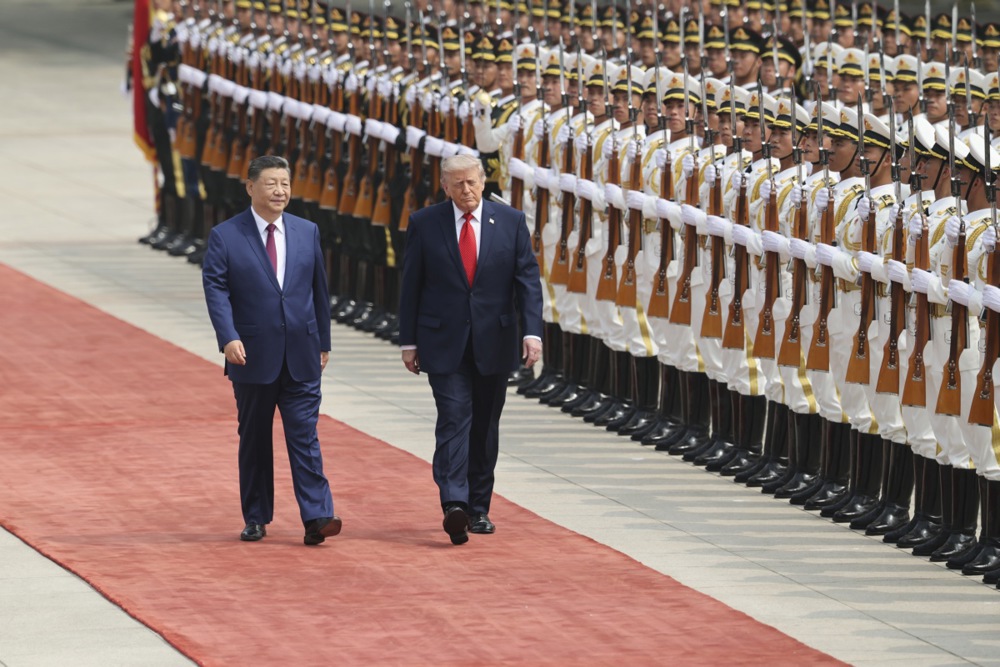
Donald Trump flew to Beijing for the first time since 2017 — and immediately declared that relations between the United States and China "will become better than ever before." Xi Jinping responded by proposing to be "partners, not rivals." The ceremony at the Great Hall of the People turned out to be a show of force: a red carpet, a pompous reception, and not a single concrete deal at the start.
What lies behind the warm words
The summit took place against the backdrop of four unresolved conflicts: Chinese restrictions on rare earth metal exports, which are paralyzing American aerospace and automotive industries, blocked chip supplies, the Taiwan question, and the Iran war. According to assessments by CFR and Chatham House analysts, the most likely outcome is a limited set of "well-rehearsed" agreements: continuation of the trade truce that Trump and Xi struck at the APEC summit in Busan in October 2025, symbolic purchases of American soybeans and Boeing aircraft.
"Expectations are low, and there will likely be no major deal — but the ceremony itself emphasizes how crucial these relations are for the entire world."
Scott Kennedy, CSIS
Taiwan: the question that won't leave the table
Xi Jinping publicly called Taiwan the "most important issue" for bilateral relations and warned that if it is not resolved properly, it will push relations to a "dangerous place." This is not new rhetoric — but it was heard precisely when Trump still has not implemented the $14 billion weapons supply package for Taiwan, authorized back in December 2025.
According to CNN, Trump told journalists about the weapons sale before departure: "President Xi would like us not to do this. And I will have that conversation." Taiwan's Foreign Minister Lin Chia-lung publicly assured that he trusts Washington, but his deputy was more candid in conversations with Bloomberg — there is concern.
Business delegation as a signal of priorities
Along with Trump, Elon Musk, Apple CEO Tim Cook, BlackRock head Larry Fink, and Boeing CEO Kelly Ortberg flew to Beijing — more than a dozen top executives. This is not an entourage, but a signal: real negotiating value for Trump is measured by deals he can sell to American voters. According to Al Jazeera's assessment, for Trump "the optics of success" matter almost as much as the substance of the agreements.
The Thucydides trap and the question Xi posed
The Chinese leader referred to the concept of the "Thucydides trap" — when a rising superpower and a dominant superpower inevitably move toward conflict. According to Harvard's Graham Allison, who popularized the term, he expects the trade truce to finally take the form of a formal agreement. But this is an optimistic scenario.
- Rare earth metals: China still holds the leverage — and according to CFR's assessment, the center of gravity in negotiations has shifted to this from tariffs.
- Iran: Washington is pressuring Beijing over Iranian oil purchases; quiet Chinese cooperation — or its absence — will become apparent in weeks, not hours after the summit.
- AI: The creation of bilateral working groups on artificial intelligence management is expected — without specific commitments.
As analyst Santiago Reglimí notes, "for Xi, success is maintaining stability without appearing to have conceded to Washington." Trump got the ceremony. Xi got time.
If the weapons package for Taiwan ultimately remains unfulfilled after the Beijing summit — this will not be a technical delay, but a precedent: trade concessions in exchange for silence on the island's security.



