Tusk: Orbán's people may have informed Moscow about an EU Council meeting — what this means for Ukraine
The Polish prime minister reacted to The Washington Post's investigation into P. Szijjártó's contacts with Russia's Foreign Ministry. This is not only a matter of Hungary's image, but of the risks to European decisions on aid to Ukraine.

By Tetiana Suchkova-Ladik
March 22, 2026 · 3 min read
Briefly
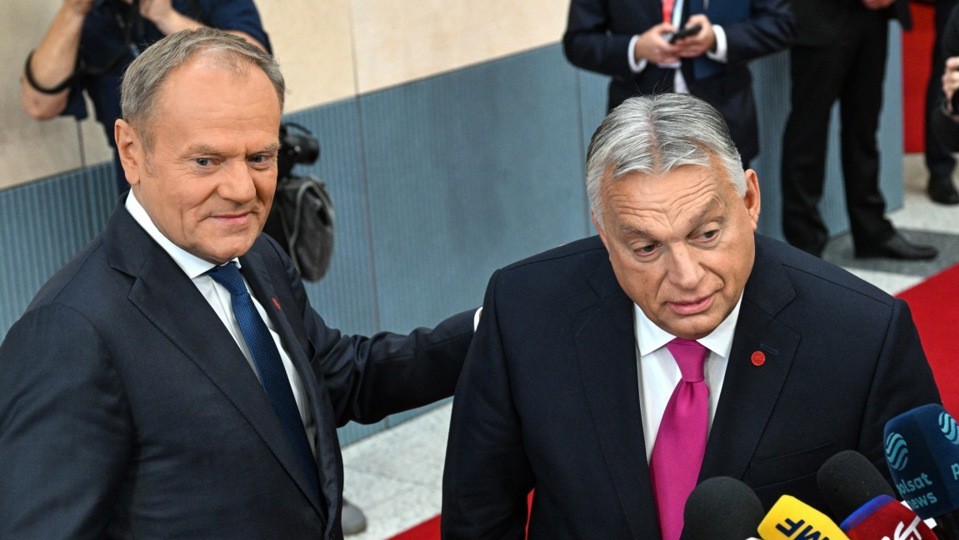
Polish Prime Minister Donald Tusk commented on a The Washington Post piece that claims Hungary’s foreign minister Péter Szijjártó allegedly passed information from breaks in EU Council meetings to a Russian diplomat. Tusk’s comment appeared on the social network X and underscores that these suspicions in Warsaw have been long-standing.
What the journalists reported
On March 21 The Washington Post published a piece citing an unnamed European official: allegedly, during breaks in EU Council sessions Szijjártó made “live reports” to Sergey Lavrov about what was being discussed. According to sources, the Hungarian minister has officially visited Moscow 16 times since the start of the full-scale Russian invasion; the most recent visit was reportedly on March 4. The WP also quotes a fragment of an internal Russian intelligence report that discussed a hypothetical staging of an assassination attempt on a pro-Russian Hungarian prime minister — details that are worrying in themselves.
The Hungarian government categorically denies these claims, while the Polish prime minister called the piece one that confirms their long-held suspicions.
"The news that Orbán's people are informing Moscow in detail about EU Council meetings should surprise no one. We have had suspicions about this for a long time. This is one of the reasons why I speak only when it is truly necessary, and say only as much as needed"
— Donald Tusk, Prime Minister of Poland
Why this matters for Ukraine
This issue goes beyond diplomatic intrigue. Hungary has long blocked an EU package of preferential loans for Ukraine worth €90 billion, a significant portion of which was to go to defence. If internal decisions discussed at EU Council meetings were reaching Russian channels in real time, that would mean a practical loss of confidentiality in negotiations — and a potential weakening of Ukraine’s position during coordination with partners.
In addition, Hungary’s elections on April 12 add further context: if power changes, Budapest’s policy toward Kyiv could shift. Analysts note three scenarios for relations between Orbán and Zelensky depending on the campaign outcome, which increases the significance of this information right now.
Reactions and risks
The expert community highlights several risks: first, the compromise of negotiation processes within the EU; second, the possible use of obtained information by Moscow to undermine sanctions or defence coordination; third, internal political intrigues in Hungary that could escalate ahead of the elections. At the same time, the claims are based on a publication citing an unnamed source — this reduces their directness but does not remove from the agenda the issue of transparency and the security of information exchange within EU institutions.
What Ukraine and its partners should do
Partners should act pragmatically: strengthen intelligence-sharing channels with trusted allies, put procedures to protect confidential information on the EU agenda, and increase the transparency of decisions related to support for Ukraine. Ukrainian diplomacy can use this case to stress the need for guarantees of continuity in defence and financial assistance, regardless of individual political fluctuations in member states.
Conclusion
If the accusations are confirmed, this will raise questions not only about the image of individual politicians but also about the mechanisms for protecting European solidarity. If not — trust among EU capitals will remain damaged in the information space. The ball is now in the partners’ court: will they turn the publication into concrete procedural steps to protect the decisions on which Ukraine’s security depends?



