Strike on Lukoil 1,300 km from the front — the day after allies asked to stop
The General Staff of the Ukrainian Armed Forces confirmed the destruction of the oil refinery in Kstovo. The operation occurred a day after Budanov publicly acknowledged that partners are asking Kyiv to suspend attacks on Russia's oil infrastructure.

By Tetiana Suchkova-Ladik
April 5, 2026 · 2 min read
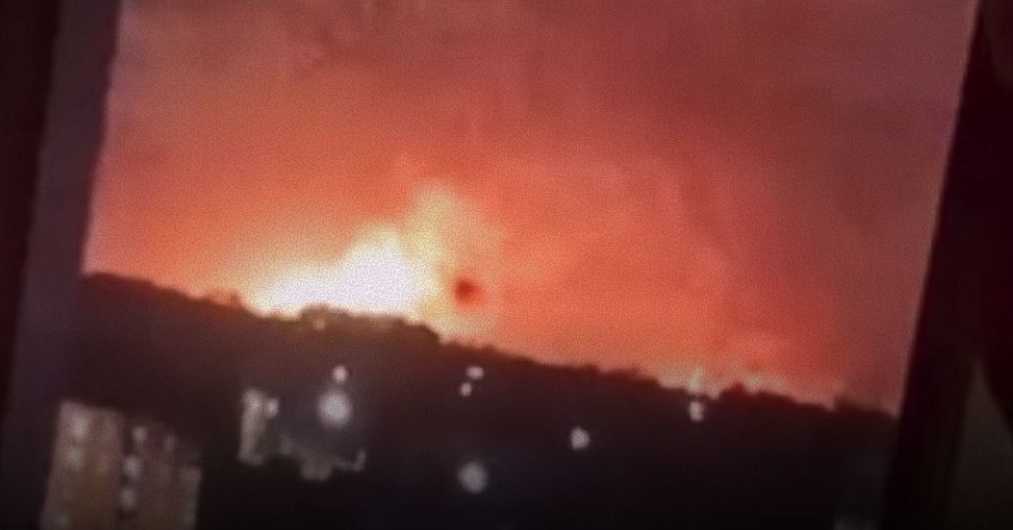
On the night of April 5, the Ukrainian Defense Forces struck the oil refinery "Lukoil-Nizhegorodnefteorgsintez" in the city of Kstovo in the Nizhny Novgorod region — roughly 800 km from Ukraine's state border and more than 1,300 km from active combat operations. The General Staff of the Armed Forces of Ukraine officially confirmed the operation. The strike caused a large-scale fire.
This is not the first attack on the refinery: in 2025 alone it was targeted at least three times earlier, including in October and in early November. At that time, the fire spread to an adjacent site housing the facilities of "SIBUR-Kstovo."
Who carried out the strike
UNN reports, citing the commander of the Unmanned Systems Forces, Robert "Madyar" Brovdi, that units of the 1st Separate Center of Unmanned Systems, the 9th Battalion "Kairos" of the 414th Brigade "Madyar's Birds," and the 413th unit "Raid" were involved in the operation. Simultaneously that same night, the Transneft oil terminal in Prymorsk and a military aviation depot in occupied Crimea were also attacked.
What Kstovo is and why the refinery is a target
The refinery, commissioned in 1958 and fully acquired by Lukoil in 2001, processes up to 17 million tonnes of feedstock per year — one of Russia's four largest oil refining enterprises. It supplies about 30% of gasoline consumption in the Moscow region and provides fuel directly for military needs. Damage to the PENEX isomerization unit — a key node in the production of high-octane gasoline — was recorded in previous attacks.
Diplomatic context
The strike occurred a day after, on April 4, Kyrylo Budanov, head of the Office of the President, said in an interview with Bloomberg that he had received pressure from allies.
"We are receiving certain signals about this."
— Kyrylo Budanov, Bloomberg, April 4, on partners' requests to stop attacks on Russia's oil infrastructure
The requests are linked to a sharp rise in global fuel prices amid a U.S.-Israeli operation against Iran. Budanov did not specify which country had made the request.
However, Kyiv did not cancel the attack — nor did it comment on any link between the diplomatic pressure and the decision to continue the campaign.
Confirmation of damage
NASA FIRMS satellite monitoring data registered a large burning hotspot across a significant area of the industrial zone. The Russian side has predictably described the incident as "the destruction of enemy drones," but accounts from local residents and satellite imagery indicate the opposite — the strike reached its target. Independent verification of specific damage to production facilities is not yet available.
- Refinery capacity: 17 million tonnes of feedstock per year
- Share of Moscow region gasoline consumption: ~30%
- Distance from the front line: more than 1,300 km
- Number of attacks in 2025: at least four (including this one)
If allies formally demand a halt to strikes on oil infrastructure, Kyiv will face a choice between putting pressure on Russia's fuel logistics and preserving coalition unity. The answer to that question ahead of talks in Riyadh will signal the real freedom of action of the Ukrainian Armed Forces deep in the rear.



