USS Nimitz in Caribbean Sea: Carrier strike group arrives on day Washington leveled murder accusations against Havana
On May 20th — Cuba's Independence Day — SOUTHCOM announced the arrival of USS Nimitz simultaneously with a federal indictment against Raul Castro. Coincidence or coordinated pressure — the White House does not distinguish.

By Tetiana Suchkova-Ladik
May 21, 2026 · 3 min read
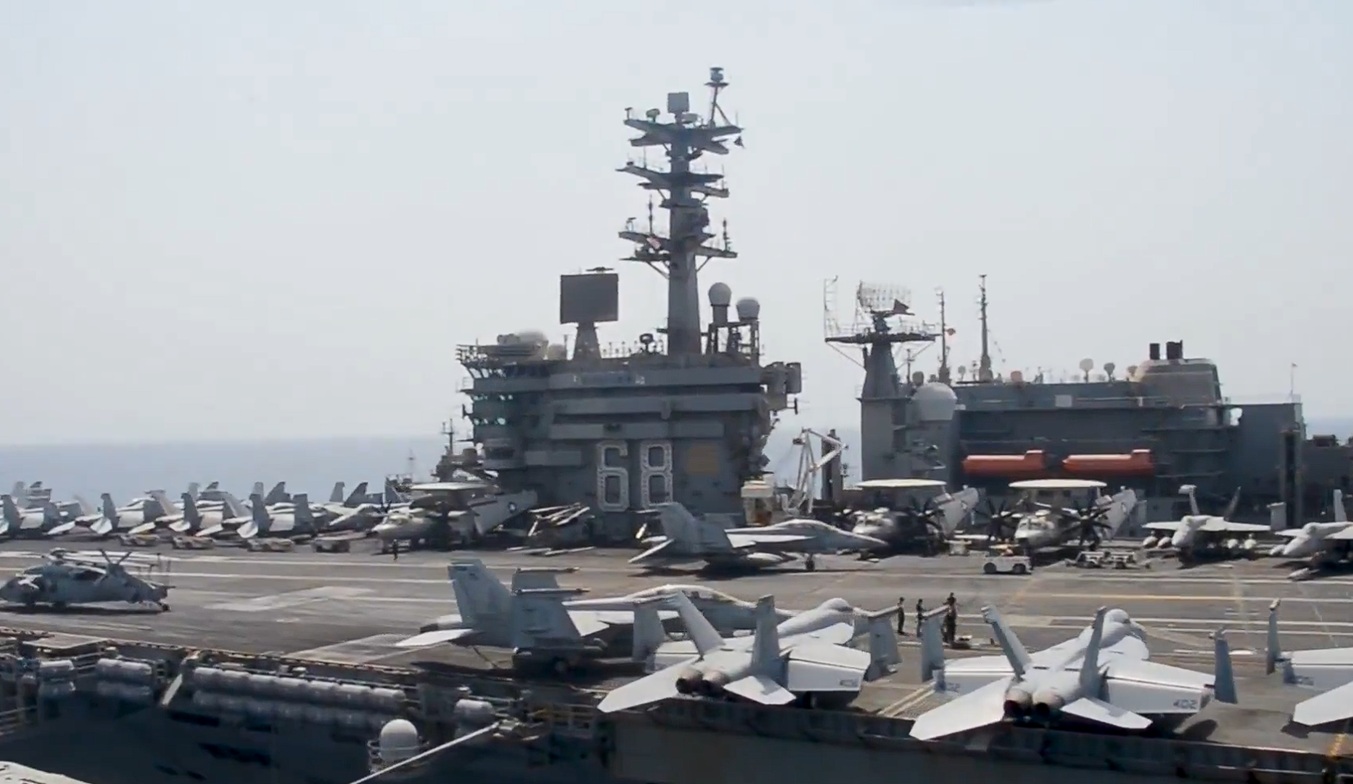
On May 20, the day of Cuba's independence, the U.S. Armed Forces Southern Command in South America and the Caribbean (SOUTHCOM) announced the arrival of a carrier strike group led by USS Nimitz (CVN-68) to the Caribbean Sea. On the same day, the U.S. Department of Justice filed federal criminal charges against former Cuban president Raúl Castro. According to Politico, SOUTHCOM conducted planning exercises for Cuban scenarios, and Trump signed a presidential statement with a direct threat directed at Havana.
What comprises the strike group
The strike group consists of the aircraft carrier USS Nimitz, Carrier Air Wing 17 with F/A-18E Super Hornet, EA-18G Growler and C-2A Greyhound aircraft, the Arleigh Burke-class destroyer USS Gridley (DDG-101), and the Henry J. Kaiser-class tanker USNS Patuxent (T-AO-201). The Nimitz, commissioned in 1975, arrived after joint naval exercises with the Brazilian Navy off the coast of Rio de Janeiro.
SOUTHCOM characterized the group as "an embodiment of combat readiness and presence, unmatched reach and lethality, strategic advantage." The command separately noted that USS Nimitz "has demonstrated its combat advantage throughout the world — from the Taiwan Strait to the Arabian Gulf."
Context: three steps in one day
The deployment coincided with three simultaneous signals from Washington: the Department of Justice released an indictment against Raúl Castro in connection with the 1996 shooting down of aircraft belonging to the Brothers to the Rescue organization, Trump used Maduro's detention as a direct warning to Havana, and SOUTHCOM — according to Politico — began planning exercises for possible scenarios involving Cuba.
"The arrest and deportation of Maduro sent a clear signal to his socialist allies in Havana: this is our hemisphere, and those who destabilize it and threaten the United States will face consequences."
— Donald Trump, presidential statement, May 20
On May 5, Trump threatened to deploy USS Abraham Lincoln "a few hundred meters off" Cuba's coast — but conditioned this on the resolution of the conflict with Iran. On May 17, Axios reported that Cuba received over 300 military drones from Russia and Iran, with potential strikes on Guantanamo Bay and Key West among the discussed scenarios.
Castro's charges: symbol or instrument
The charges against 94-year-old Raúl Castro concern his role as Cuba's defense minister during the shooting down of two civilian aircraft. Acting Attorney General Todd Blanche traveled to South Florida to announce the charges "jointly with a ceremony honoring the victims of Brothers to the Rescue."
In response, Cuban President Miguel Díaz-Canel rejected Secretary of State Marco Rubio's claims about Cuban suffering, while U.S. sanctions have reduced the island's energy imports by 80–90%, causing massive power outages.
Deployment planned — but who controls the signal
American officials emphasize that the deployment was planned in advance and is not a direct response to the Cuban crisis. However, the coordinated announcement on a symbolic date — Cuba's independence day — simultaneous with charges, executive order signing, and presidential statement blurs the line between routine rotation and deliberate pressure.
Trump told journalists that the carrier group arrived to "help Cubans" — phrasing without specific content, equally readable as humanitarian rhetoric and as a threat of regime change.
If Washington is genuinely preparing a scenario of military pressure, rather than merely showing the flag, the next indicator will be the deployment of USS Abraham Lincoln after its exit from the Iran crisis: Trump named this very carrier as the instrument of the "Cuban" operation.



