Admit to Avoid Punishment: How a 2017 Case Became a Verdict Without Sentence for the CPK Director
# Kyiv's Dniprovskyi District Court Finds Vitaliy Shabunin Guilty of Assaulting Pro-Russian Blogger, Acquits Him Due to Statute of Limitations The Dniprovskyi District Court of Kyiv has found Vitaliy Shabunin guilty of assaulting a pro-Russian blogger who is now subject to state sanctions—and immediately acquitted him due to the expiration of the statute of limitations. The defense considers the verdict a dangerous precedent.

By Tetiana Suchkova-Ladik
May 13, 2026 · 2 min read
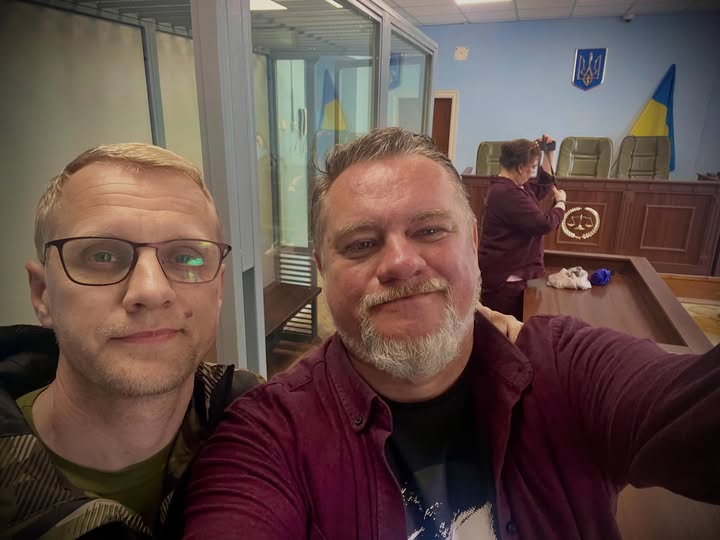
Eight years of proceedings — and it ended with a verdict carrying no punishment. On May 13, Kyiv's Dniprovskyi District Court found Vitalii Shabunin, head of the Anti-Corruption Center, guilty under Part 2 of Article 345 of the Criminal Code — violence against a journalist and moderate bodily injuries — and immediately released him from punishment due to statute of limitations expiration. Additionally, the court ordered compensation of 4,000 hryvnias for expert examination costs.
A conflict that became a precedent
The incident occurred on June 8, 2017, near a military recruitment office. Shabunin admitted to striking Vsevolod Filimonenko, explaining it as a reaction to insults directed at a colleague — and warned the blogger before the blow. Initially, the case was pursued under an article on bodily injuries. In January 2018, the prosecutor's office reclassified it as violence against a journalist and referred it to court — a step that was criticized by several media and human rights organizations at the time.
The defense insisted on two arguments: first, Filimonenko did not have actual journalist status — the media where he allegedly worked was not actually functioning, and the editorial assignment was signed by the director of a non-existent company; second, the defense called the medical conclusions about injury severity falsified. On video after the conflict, Filimonenko had no visible serious injuries and himself sprayed an unknown substance in Shabunin's direction.
The injured party — under sanctions from the state that protected him
While the case dragged through courts, Filimonenko's status changed radically. In March 2024, he appeared in a propaganda film by Russian "First Channel" titled "Zelensky and His Combat Drug Addicts," aimed at discrediting the Armed Forces of Ukraine. In September 2025, President Zelenskyy enacted an NSDC decision imposing sanctions against Filimonenko for ten years — for spreading pro-Russian propaganda. YouTube blocked his channel in Ukraine.
"This decision obviously can only have some reputational consequences,"
— Shabunin on the verdict, Ukrainska Pravda
Shabunin himself stated that the proceedings represent pressure from law enforcement. Investigator Yurii Nikolov wrote that the case was deliberately "taken out of the woodwork" by people connected to Oleg Tatarov, Deputy Chief of the Presidential Office — to discredit the head of the Anti-Corruption Center.
Why "released due to statute of limitations" is not a neutral outcome
The prosecutor's office itself, at the May 6 hearing, asked to recognize Shabunin as guilty but release him from punishment due to statute of limitations expiration. In effect, the prosecution conducted an eight-year case for a guilty verdict with no practical consequences for the convicted person.
Shabunin's lawyers warned of a systemic risk: a guilty verdict in this case creates a precedent where provocation receives greater legal protection than reaction to it. This is why the defense will appeal — despite the absence of actual punishment.
If the appeals court confirms the verdict, Ukrainian courts will effectively establish: it is sufficient to call someone with documents from a non-existent newsroom a journalist in 2017 — even if in 2025 the state itself imposes sanctions on that person for work on enemy propaganda. Whether the appellate court is prepared to reconsider the "journalist" status in light of these sanctions — or has the precedent already been set?



