"I am at your service": Transcript of October call shows how Hungarian PM positioned himself before Putin
Bloomberg obtained a transcript of a conversation from October 17, 2025, in which Orbán proposed to Putin to be a "mouse" helping the "lion." The summit in Budapest for which this was done never took place — but the recording remained.

By Tetiana Suchkova-Ladik
April 7, 2026 · 3 min read
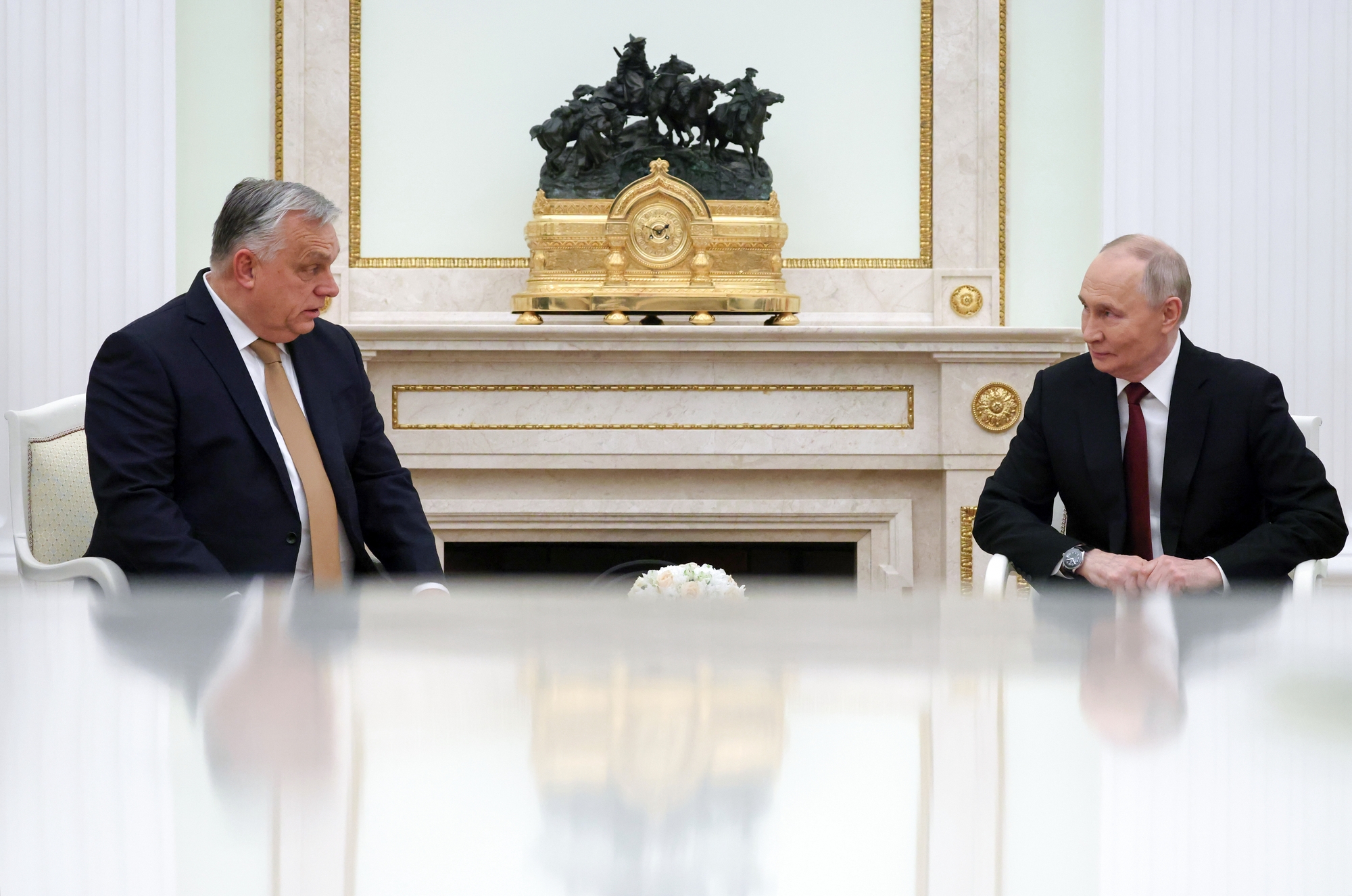
Hungarian Prime Minister Viktor Orbán told Russian dictator Vladimir Putin during a telephone conversation on October 17, 2025, that he was ready to personally organize a USA-Russia summit in Budapest and help resolve the war against Ukraine — in any way in which he "could be useful." Bloomberg obtained a transcript of this conversation compiled by the Hungarian side; its authenticity was confirmed by a person familiar with the details of the call, on condition of anonymity.
What exactly Orbán said
The central quote from the transcript is a metaphor that Orbán himself chose to describe his own role:
"Yesterday our friendship reached such a level that I can help in any way. In any matter where I can be useful, I am at your service."
Orbán to Putin, October 17, 2025, from a transcript reviewed by Bloomberg
According to Bloomberg, the Hungarian prime minister then compared himself to a "mouse" that helps a "lion" — an image that in the context of negotiations about the fate of a sovereign state sounds like an involuntary self-revelation of Budapest's diplomatic philosophy.
Context: the day Budapest was supposed to become the center of the world
The call took place a day after October 16, 2025, when Trump, following a conversation with Putin, publicly announced his upcoming personal meeting with him in Budapest. According to information from the Kremlin press service, Orbán proposed all conditions for holding the Russia-USA summit in that conversation — and Putin informed the Hungarian of the key topics of his just-completed conversation with Trump.
The summit was planned as a potential turning point in negotiations regarding Ukraine. However, on October 22, Trump canceled the meeting, explaining the halt to negotiations by saying they had "hit a dead end": Russia insisted on maximalist demands, including a refusal to freeze the front along current positions.
What Orbán needed this for
The answer lies in domestic politics. Hungarian elections are scheduled for April 12, 2026 — Bloomberg describes them as the most important elections in the EU this year. Orbán, who has held power for more than 15 years, is facing a serious rival for the first time — the leader of the opposition Tisza party, Péter Magyar. Independent pollsters report that the ratings of the ruling Fidesz have fallen below those of the opposition.
The Trump-Putin summit in Budapest was supposed to become for Orbán a symbol of geopolitical weight — proof to voters that it is he, not "Brussels bureaucrats," who determines the agenda. The summit's failure deprived him of this trump card right before the election campaign.
- Brussels learned about the preparation of the meeting essentially from public statements — EU diplomats called it a "surprise" for most European capitals.
- In parallel, Orbán blocked the allocation of €90 billion in credits to Ukraine and slowed negotiations on Kyiv's EU membership.
- In November 2025, he personally met with Putin in Moscow — Minister Szijjártó confirmed after the negotiations that Russia considers Budapest as a venue for a "peace summit."
Why the transcript appeared now
Bloomberg published the material on April 7, 2026 — five days before the election. This is no coincidence: the leak of a transcript compiled by the Hungarian government itself in the final week of the campaign maximally complicates Orbán's ability to refute it. He cannot claim the document is a forgery without casting doubt on his own office.
Budapest's reaction to the publication has not yet been forthcoming. Fidesz traditionally in such cases either ignores the issue or reformats the scandal as an "attack by Brussels" — a tactic that previously yielded electoral dividends, but against the backdrop of economic slowdown and Magyar's rise may not work as effectively.
If after the April 12 elections the opposition does manage to gain a majority — the transcript will become one of the documents by which Hungary's new government will determine what information Orbán passed to Moscow during the years when Hungary officially remained a member of the EU and NATO.



