"I made a decision as a combat officer": Zhukov resigned before the Council could dismiss him
Chief of the Patrol Police of Ukraine Yevhen Zhukov resigned within a day after a terrorist attack in the Holosiivskyi district. Six dead, video of police fleeing, signatures in the Verkhovna Rada — and a resignation letter before the issue became irreversible.

By Tetiana Suchkova-Ladik
April 19, 2026 · 2 min read
On the evening of April 18, an armed man opened fire on pedestrians in the Holosiyivsky district of Kyiv. He shot five people directly on the street, then barricaded himself in the Velmart supermarket and took hostages. One more person died inside — during the siege. The shooter was eliminated by special forces during the assault. He turned out to be 58-year-old Dmitry Vasilchenkov, a native of Moscow.
According to Mayor Klitschko, in total 6 people were killed, 9 hospitalized, and 6 more received assistance at the scene — including a four-month-old child. The investigation qualified the events as a terrorist attack.
The video that became a problem
In parallel with the casualty count, a recording from the scene was circulating online. It shows two patrol officers leaving their position after the first shots — without covering civilians or taking cover to respond. Interior Minister Igor Klymenko called their behavior "a shame for the entire system" and "disgraceful" and ordered the head of the National Police Ivan Vygyvskyi to conduct a service investigation.
"They just ran away" — this is how Minister Klymenko characterized the actions of police at the site of the terrorist attack.
Igor Klymenko, Interior Minister
A report that wasn't requested — but was expected
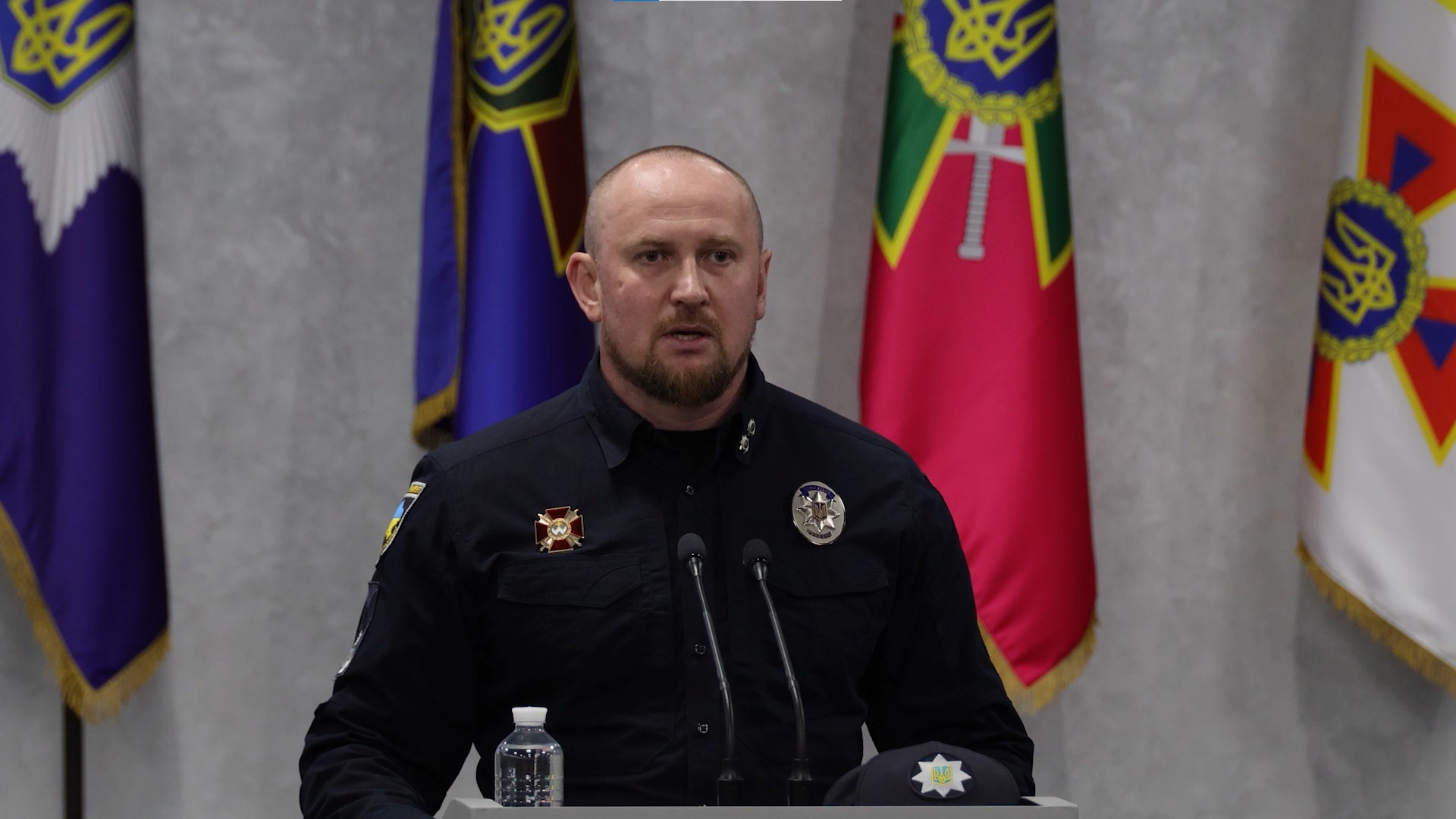
After the incident became public, the Verkhovna Rada began collecting signatures for Zhukov's dismissal. He did not wait for the result. At a press conference on April 19, he announced his resignation himself.
"As a combat officer, I made the decision to submit a report requesting my dismissal from my position. I think that would be fair."
Yevhen Zhukov, Head of the Patrol Police Department
Zhukov held this position since 2015 — ten years and two months, surviving several ministers and several heads of the National Police. He also emphasized that all commanders of the involved patrol officers would be held accountable — regardless of his departure.
What the Interior Ministry asks not to do
Klymenko separately called on not to transfer the evaluation of the actions of two police officers to the entire system. The argument is clear: that same evening, it was precisely the police special forces who neutralized the shooter and freed the hostages. At the same time, the minister stated that he believes citizens should be given the right to armed self-defense — an unexpected turn from the head of an agency that usually upholds the state's monopoly on force.
- Service investigation into the two patrol officers has been launched.
- Criminal proceedings on the fact of the terrorist attack have been opened.
- Zhukov's resignation — for now a report, the final decision is up to the leadership.
The key question now is not about Zhukov himself: if the service investigation establishes that the police officers did not violate any instructions — this would mean that the problem is not with two individuals, but with the protocols for training the patrol service, which Zhukov had been building over ten years.



