The West Still Explains to Its Societies Why to Arm Itself. Bauer Called This Idiocy in the Fifth Year
Former NATO Military Committee Chairman Rob Bauer said at the Kyiv Security Forum that the problem is not money or factories — the problem is that democratic societies have yet to agree among themselves on a fundamental matter.

By Tetiana Suchkova-Ladik
April 26, 2026 · 3 min read
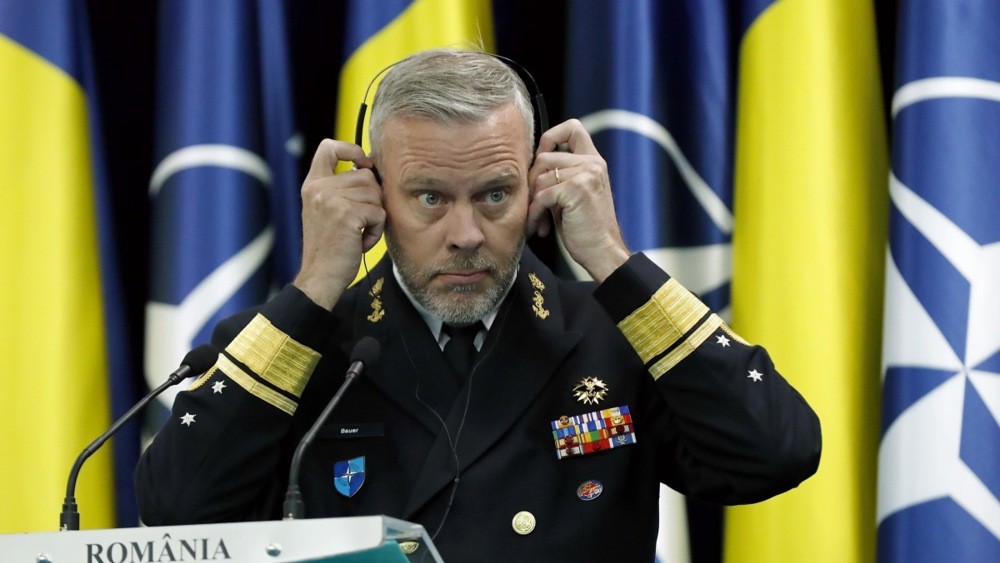
Rob Bauer is a retired Dutch Lieutenant Admiral who headed NATO's Military Committee for four years (2021–2025) and witnessed the Alliance undergo its most significant transformation since the Cold War. On April 24, as a private citizen, he spoke at the Kyiv Security Forum — and allowed himself a frankness that he could not publicly afford in office.
What he said — and why it's more than rhetoric
Bauer placed societal resilience at the center of the discussion about preparing for possible Russian aggression. His thesis: the West is spending energy not on ramping up production, but on convincing its own citizens that this is necessary at all.
«I consider it idiotic that in the fifth year of the war we still have to debate within our societies about the need to invest in the defense industry».
Rob Bauer, former head of NATO's Military Committee, Kyiv Security Forum, April 24, 2025
The word «idiotic» is not a rhetorical device. Bauer has for years championed the concept of «whole-of-society» security: security as the responsibility not just of the military, but of entire society — from citizens to business. According to him, without societal consensus, no increase in defense production will be sustainable: parliaments hold back budgets, voters vote against spending, media frame defense expenditures as money «for war» rather than «against war».
The figures that put Bauer's words in context
In 2025, all NATO allies exceeded the 2% of GDP threshold for the first time, and European members of the Alliance together with Canada increased defense spending by 20% compared to the previous year — as recorded by the Atlantic Council. It seemed like progress. But Bauer clarified a crucial distinction in an interview with DW on the sidelines of the same forum: spending money and increasing production capacity are not the same thing. Five years after the full-scale invasion began, Europe has still not reached the rate of ammunition and equipment production that matches the rate of their consumption on the front.
At the same time, Bauer noted: Ukraine can hold the front line, but at the current level of support — it is not necessarily able to win. This is not an assessment of combat morale, but the arithmetic of logistics.
Why «societal resilience» is not a soft issue
The concept Bauer is promoting has concrete dimensions: if society is not convinced of the threat, it elects parliamentarians who cut defense budgets. This is exactly what happened in most NATO countries after 1991 — and this is why by 2022 it turned out that warehouses were empty and production lines were shut down or repurposed.
- The Netherlands (Bauer's country) cut its military for a decade after the Cold War — and then spent years restoring basic capabilities.
- Germany announced Zeitenwende («change of eras») in February 2022, but the first real contracts with industry appeared much later.
- France and the United Kingdom are still debating the pace of increasing artillery shell production.
Bauer describes this as a structural flaw of democracies in times of crisis: decisions are made more slowly than the threat develops. Authoritarian systems do not have this limitation — and this is exactly what Putin took advantage of in 2022, betting on a «blitzkrieg» war against an unprepared West.
What comes next
Bauer is no longer in office, and therefore is not bound by diplomatic protocol. His book «If You Want Peace, Prepare for War» is coming out in 2025 — and the very fact that he is writing it now, rather than ten years from now, speaks to how critical he considers the moment to be.
The question that remains open is: if societal resilience is truly a condition for sustainable defense production — then who and how will build it in countries where defense is still perceived as an expense rather than an investment in existence? And will NATO develop a concrete mechanism for measuring this resilience — similar to how the 2% of GDP is measured — before the next crisis makes the question merely rhetorical.



