"Drove into a lake — received a minimal fine for lying to police. Now — 5 years without Poland"
Lviv blogger Andriy Havrylov drove a Corvette to Lake Morskie Oko, paid 100 zlotys instead of 5,000 — and only because he hid from police where exactly he parked. Social media exposed him.

By Tetiana Suchkova-Ladik
May 23, 2026 · 3 min read
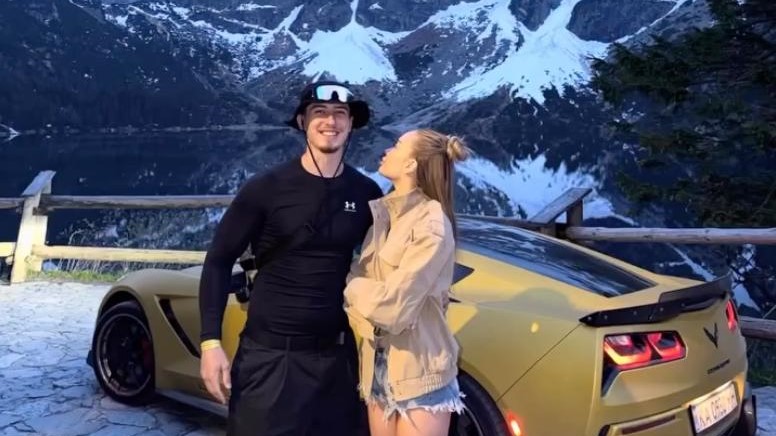
On May 22, a 23-year-old resident of Lviv Andriy Havrylov drove a Chevrolet Corvette with his girlfriend to Lake Morskie Oko — the heart of Tatra National Park in Poland. Private vehicles are prohibited from entering the park territory: visitors must hike several kilometers to the lake or use special shuttles or horse-drawn carriages.
The influencer himself shared the story on social media, claiming that he was the first person in history to drive to this location in his own car. On the way back, police stopped him, fined him 100 zloty, and charged him with eight penalty points.
"We are the first people in history who drove to Morskie Oko by car. All our friends said it was impossible to get there by vehicle."
— Andriy Havrylov, from a social media post
100 zloty instead of 5,000: how this happened
The Lviv blogger misled police and as a result received the minimum fine of 100 zloty (approximately 1,200 UAH) — although the violation carries a penalty of up to 5,000 zloty. A police spokesperson in Zakopane explained: if the officers had known that Havrylov reached the lake itself, the fine would have been much higher. "The police checked the man and concluded the procedure. Later it turned out that the influencer posted photographs from Lake Morskie Oko on social media."
"If the police had detained him at Morskie Oko, I suspect his car would have been impounded and the fine would not have been 5,000 zloty — the case would have been handed over to court," added the police spokesperson.
Tusk — Interior Ministry, Interior Ministry — ban
Polish Prime Minister Donald Tusk called on the Interior Ministry to urgently investigate the circumstances of the incident and apply "the strictest consequences." The response came quickly. The 23-year-old Lviv blogger will be banned from entering Poland for 5 years — this was announced by Polish Interior Minister Marcin Kierwiński on the X social network on Saturday, May 23.
"The perpetrator of the Morskie Oko raid will face consequences. Due to the violation of public order, at the request of police, he will be added to the undesirable persons list with a ban on entry into the territory of the Republic of Poland for 5 years."
Apologies and a closed Instagram
Havrylov claims he did not notice the prohibition sign. "I want to apologize to the Polish people because I simply did not know that you are not allowed to drive there," he wrote. The young man explained that he interpreted the warning about the impossibility of driving there as a reference to bad roads, not a prohibition.
Within hours of Polish media publishing news on the subject, the influencer's Instagram account was changed to private and content was hidden from non-followers. The influencer has nearly 880,000 Instagram followers.
This case is not just about one Corvette on a mountain road. It is about how content shot for engagement becomes evidence in a case against its creator. Havrylov himself published everything necessary for maximum punishment — and no account "privacy" could change that.
The question that remains open: if Polish police officially acknowledged that they fined Havrylov at the minimum because of incomplete information — will the mechanism of on-site verification be reviewed so that the next "influencer" cannot simply remain silent about their route?



