Zelensky offered Trump an iPad with a frontline map — no meeting and what it means
The President told the FT that he intended to show Donald Trump a tablet with a real-time operational picture of the fighting — not only a demonstration of technology, but also an attempt to convince the American leader of the price of every kilometer of our land.

By Tetiana Suchkova-Ladik
March 18, 2026 · 2 min read
What happened
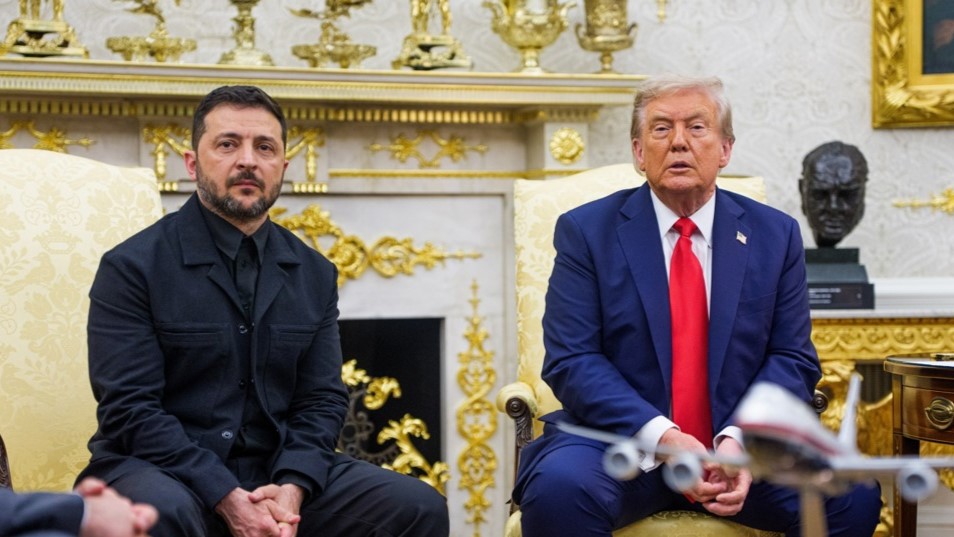
Based on reporting by the Financial Times (correspondent Christopher Miller), during an interview in February Volodymyr Zelensky said he wanted to give Donald Trump an iPad with a program that shows the situation on the front in real time. The presentation was planned for the Munich Security Conference — a meeting where a current or former U.S. leader would have been able to get a direct sense of the combat situation. However, Trump did not attend the conference, and the demonstration took place in a different way.
"To be honest, I wanted to give this to Trump... in Munich. Why? Because on my iPad I can immediately see which attacks are taking place — drones, missiles, etc. — what we are intercepting in real time, and also how much one kilometer of our land costs at any given moment."
— Volodymyr Zelensky, President of Ukraine (interview with the Financial Times)
What the software is and who uses it
Zelensky did not name a specific program; media and analysts link his description to the Delta system, which collects intelligence, uses elements of artificial intelligence, and is compatible with NATO platforms. According to an analysis by LIGA.net, the interface resembles a "game-like" map where data are aggregated in real time for planning strikes — but this is not entertainment, it is a tool for decision-making on the battlefield.
Such tablets, reportedly, are held by the president, by Prime Minister Yulia Svyrydenko, by Minister of Digital Transformation Mykhailo Fedorov, and by the senior military leadership. On 17 March Zelensky gave one iPad to King Charles III of the United Kingdom — a fact that underscores the role of the technology as an element of diplomacy.
Why this matters for us and for partners
First, it is a way to show an accurate picture of risks and losses: numbers and visualization work better than general arguments. Second, for allies such a demonstration is a tool for managing attention: when the leader of another country sees the same information, decisions on aid or sanctions become less abstract.
The absence of a personal meeting with Trump means a missed opportunity for direct persuasion — but not the collapse of the initiative. The technology is already working as a "language" between military staffs and diplomacy: it increases transparency, but at the same time raises questions about data security and how exactly partners use this information.
Conclusion
This episode shows that modern war is not only about political statements, but also about real-time data and their use in diplomacy. The task now is not only to demonstrate capabilities, but to turn them into concrete decisions by partners: additional resources, guarantees, or political support. Whether allies will be able to read this "map" as clearly as Ukrainian teams is a question that will be answered by the international community's next steps.



