€110 million and no new tank: Estonia rewrites its defense budget — and shares logic with Ukraine
Tallinn is allocating at least 0.25% of GDP to drones and digital systems for the Armed Forces—while simultaneously freezing a €500 million purchase of its own combat vehicles. A meeting between Fedorov and Pevkur documented not only the amount, but also a shared vision of which equipment determines the outcome of the war.

By Tetiana Suchkova-Ladik
April 25, 2026 · 3 min read
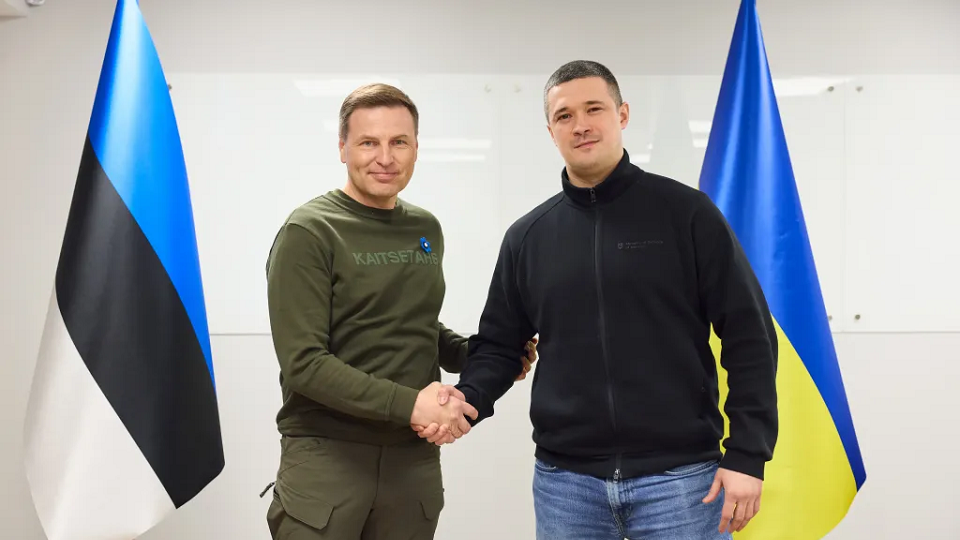
Defense ministers of Ukraine and Estonia, Mykhaylo Fedorov and Hanno Pevkur, held a meeting in Kyiv and agreed on cooperation priorities for 2026. According to Fedorov, the main criterion for selecting projects is the actual needs of the front, not abstract "expansion of partnership."
€110 million: what exactly is being funded
Estonia confirmed its commitment to allocate at least 0.25% of its GDP to military aid to Ukraine. In 2026, this amounts to approximately €110 million. The main emphasis is on the purchase of drones and counter-drone systems.
"The main focus is on purchasing drones and counter-UAV systems. This strengthens our capabilities in the most critical domains of the war."
Mykhaylo Fedorov, Defense Minister of Ukraine
The sum appears modest compared to Norway's $7 billion or Sweden's €3.7 billion, but Estonia is a country with a population of 1.3 million. Calculated per capita, this is one of the highest indicators among partners.
Why Tallinn froze its own tanks
Context for understanding the meeting is a decision made by the Estonian government a few weeks earlier: a program to purchase new combat vehicles worth over €500 million was suspended. The freed funds were redirected to air defense, drones, and unmanned systems. Pevkur explained the logic directly: "We are following what we learn from Ukraine." The share of heavy equipment on the battlefield is decreasing — hence the recommendation from the commander of the Defense Forces not to replace, but to modernize existing equipment.
Digital track: DELTA and IT coalition
A separate direction is Estonia's co-leadership, together with Luxembourg, in the IT coalition "Ramstein." Since its creation in September 2023, the coalition has attracted over €1.2 billion for developing technological capabilities of the Armed Forces of Ukraine. It currently includes 16 countries.
Ukraine, for its part, is ready to openly demonstrate the work of its own defense products — in particular, the situational awareness system DELTA, which in August 2025 was introduced at all levels of the Defense Forces by ministerial order. Fedorov presented the system as a technological advantage that Estonia can scale through the coalition to other partners.
- Drones and anti-drones — joint development and procurement within €110 million
- IT coalition — Estonia and Luxembourg coordinate digital assistance from 16 countries
- DELTA — Ukraine offers the system as an export standard
- Defense-industrial cooperation — joint production, details not disclosed
What remained behind the scenes
No mechanism for verifying whether the financing will actually go to the declared priorities has been publicly disclosed. "Priorities agreed upon" — a formulation that means intentions, not contracts. The sides did not name the details of joint weapons production and specific participating enterprises.
Pevkur confirmed that Estonia will continue training Ukrainian military personnel and supporting IT solutions. Estonian President Alar Karis also stated readiness to send a military contingent if a decision is made by the Coalition of the Willing — but this is a separate track, unrelated to the current ministerial meeting.
If Estonia truly reorients its own defense budget away from heavy equipment toward drones and simultaneously finances a similar transition in Ukraine — this is not a bilateral agreement, but a de facto testing of a new doctrine for the entire "Ramstein" format. The question is: will larger partners follow Tallinn's lead — and will this happen before the front line shifts again.



