17 years after AF447 disaster: court found Airbus and Air France guilty — after acquittal
The Paris Court of Appeal has overturned a 2023 acquittal verdict and established that both companies are "exclusively and completely" responsible for the deaths of 228 people over the Atlantic. The fine is symbolic, but the precedent is not.

By Tetiana Suchkova-Ladik
May 21, 2026 · 2 min read
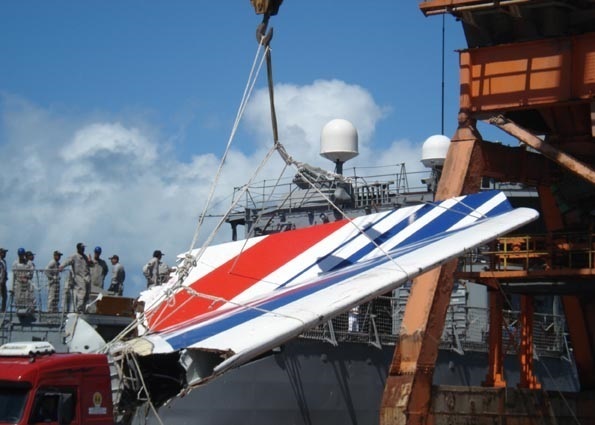
On June 1, 2009, Airbus A330 flight Air France 447 disappeared from radar over the Atlantic Ocean two hours after takeoff from Rio de Janeiro. On board were 216 passengers and 12 crew members — of 33 nationalities. None survived. The flight data recorders were only found in 2011 — following a search operation covering 10,000 square kilometers.
What happened that night
The French aviation accident investigation bureau (BEA) established a chain of failures: ice crystals blocked the Pitot tubes — speed sensors on the aircraft's fuselage. The autopilot disengaged, instrument readings became contradictory. The second pilot, who was at the controls while the captain rested, reacted incorrectly — pulling the control stick toward him instead of pushing it away. The aircraft entered a stall from which the crew never recovered.
"The crew was in a state of almost complete loss of control of the situation."
Alain Bouillard, chief investigator at BEA
A critically important detail established by the investigation: between May 2008 and March 2009, Air France's fleet recorded nine incidents involving temporary loss of speed readings on A330/A340 aircraft. Air France was aware of the problem with the Pitot tubes, but, awaiting recommendations from Airbus, postponed their replacement — only increasing inspection frequency. After the disaster, the company replaced them throughout its fleet.
Court proceedings: acquittal, then conviction
The case went through several turns. In 2019, investigating judges ruled to close the case without referring it to court. The prosecution appealed this decision — and in 2022 both companies finally found themselves in the dock. In April 2023, the court of first instance acquitted them: prosecutors, in the judges' view, failed to prove a direct causal link between the companies' actions and the disaster.
On May 21, 2026, the Paris Court of Appeal overturned that verdict. The court found Airbus and Air France guilty of involuntary manslaughter and determined that they bear responsibility "exclusively and entirely." Each company received a fine of 225,000 euros — the maximum provided for under French law for corporate involuntary manslaughter.
For Air France, whose annual revenue is measured in billions, this is mere minutes of income. But as France 24 notes, for the families of the deceased, the verdict means something else: recognition after nearly two decades of waiting.
What's next
Airbus has already announced it will appeal the decision to the Court of Cassation — France's highest court of appeal. In a statement from Toulouse, the company said the appellate court's verdict "contradicts the position of the prosecution" and conclusions drawn both in 2019 and in 2023. Air France has not yet made its official position public.
- 228 killed — 33 nationalities, the worst aviation disaster in French history
- 17 years — from the disaster to the guilty verdict
- 225,000 € — maximum fine for each company under French law
- Court of Cassation — the next level following Airbus's appeal
If the Court of Cassation upholds the verdict, the French precedent of corporate accountability for an aviation disaster will become a benchmark for jurisdictions where similar cases have yet to reach court. If it overturns it — the question of whether the standard of proof for "direct causation" is sufficient for systemic technical failures will remain open.



