"200,000 sq. m per day and 90% deficit: how Ukraine repairs roads at a borrowed pace"
April road repair record is a real achievement. But it comes with a financial abyss: the state is spending funds that are officially lacking by 46 billion hryvnias.

By Tetiana Suchkova-Ladik
April 18, 2026 · 2 min read
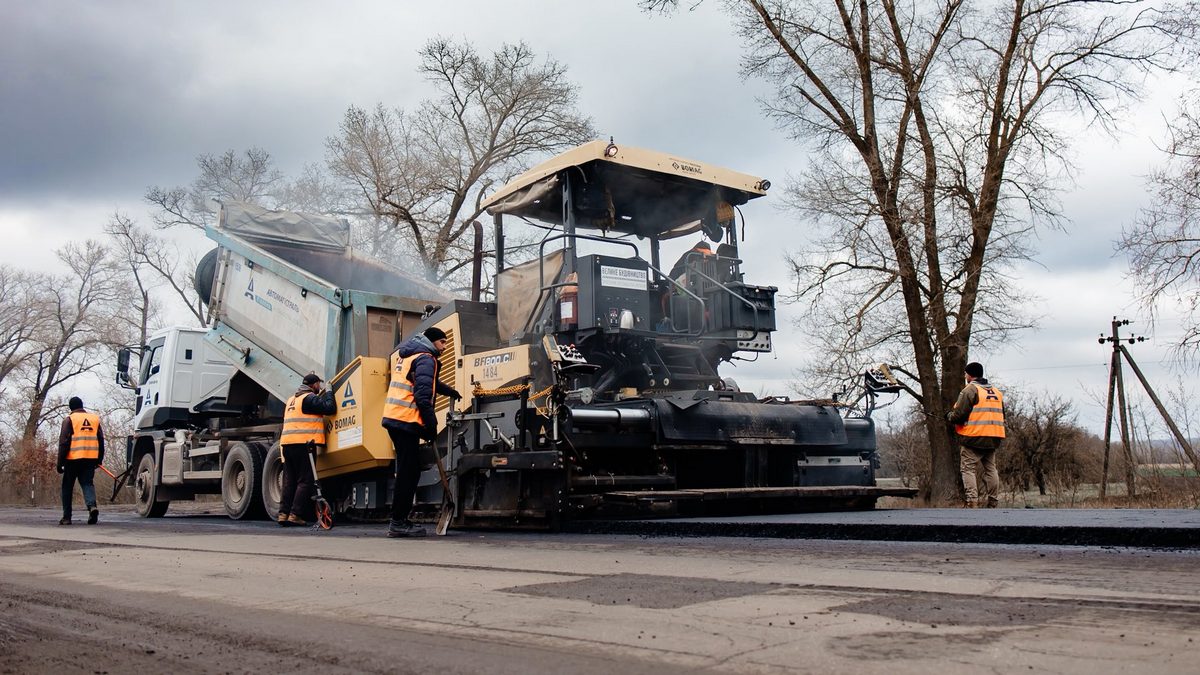
In April 2026, the pace of road repairs in Ukraine reached 200,000 sq. m per day for the first time since the start of the full-scale war. According to Vice Prime Minister for Recovery Oleksiy Kuleba, since the beginning of the year, over 4.4 million sq. m have been repaired — nearly half of the volumes on roads of national significance planned by June 1st.
The figure is indeed impressive in terms of dynamics: in winter, the pace was 4–5 thousand sq. m per day, in March — 30–40 thousand, in April — twice the March target. In parallel, approximately 200–235 brigades and over 2,100 workers have been involved in the work.
What's behind the record
Key context missing from government announcements: repairs are happening under conditions of critical funding shortage. Head of the State Agency for Recovery Sergiy Sukhomlyn stated to the Verkhovna Rada committee in February that normal road maintenance in 2026 requires 51.3 billion hryvnias, while the state budget provides only 4.6–12.6 billion. The sector's underfunding exceeds 90%.
"It is necessary to establish a Road Fund. Over the past two weeks, four countries have already expressed readiness to invest in this fund."
Sergiy Sukhomlyn, Head of the State Agency for Recovery, February 2026
Ukraine's Road Fund was effectively liquidated after the start of the full-scale invasion — funds were redirected to defense needs. Over four years, the funding deficit for road maintenance alone exceeded 80 billion hryvnias. The Recovery Agency services loans from 2020–2021 at 18.5–21% annual interest: in 2026 alone, their repayment consumes 15 billion hryvnias — more than the entire annual repair budget.
What exactly is being repaired — and why it matters to understand
Current work consists mainly of restoring upper surface layers: eliminating deformations and pothole repairs. Kuleba himself acknowledged that most roads have missed scheduled maintenance periods by two or more years. Complete reconstruction of road structure — capital repair — provides a long-term effect, but costs significantly more and is almost absent in current funding.
Among the leaders in repair volume is the M-05 Kyiv — Odesa highway, critically important for port logistics, military supply, and humanitarian transport. After winter, it became one of the most damaged highways in the country.
- Total damage on main highways — over 23 million sq. m
- Target by June 1st — approximately 10 million sq. m of current repairs
- Total annual need including capital repairs — 50+ billion hryvnias
- Actually allocated — approximately 12.6 billion hryvnias
The pace is record-breaking. But it depends on ad-hoc decisions — the Cabinet of Ministers allocated an additional 3 billion hryvnias from the reserve fund in March, earlier — 1.5 billion hryvnias for frontline roads. This is patching budget holes, not a systemic solution.
If by the end of 2026 the Verkhovna Rada does not restore the Road Fund mechanism with transparent oversight — and four donor countries have already declared readiness to invest specifically in it — April's record will remain a one-time spike, not a starting point for a new standard in infrastructure maintenance.



