23 strikes in one day: Russia attacks railway logistics — from depots to locomotives
On May 13, depots, bridges, and rolling stock were damaged in seven regions. Two railway workers were killed in Zdolbuniv — not at their workplaces, but simply in the city.

By Tetiana Suchkova-Ladik
May 13, 2026 · 3 min read
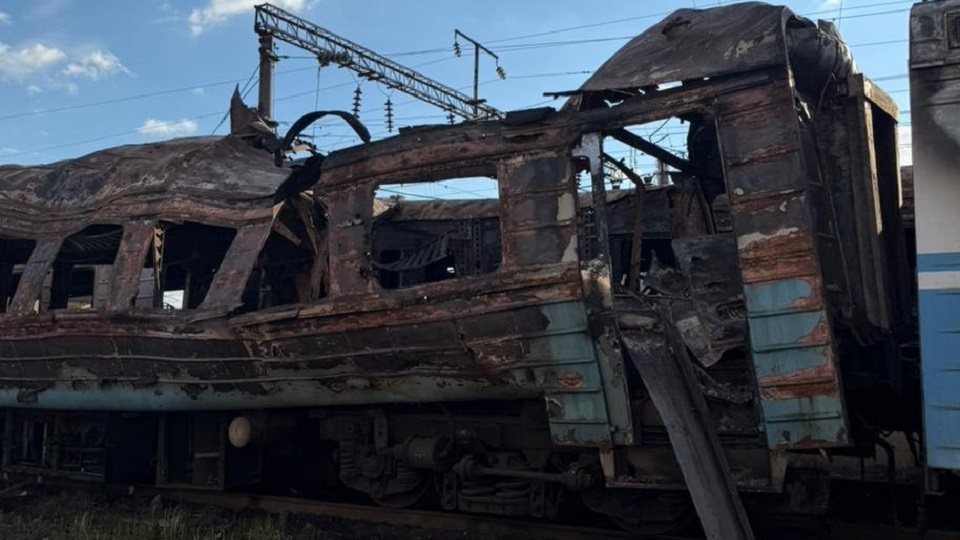
On May 13, Russia carried out one of the most concentrated strikes on railway infrastructure since the start of the full-scale invasion. In a single day — 23 hits across seven regions: Zakarpattia, Lviv, Zhytomyr, Rivne, Volyn, Kharkiv, and Dnipropetrovsk. Targets included energy infrastructure, bridges, passenger, wagon and locomotive depots, and rolling stock.
Ukrzaliznytsia Board Chairman Oleksandr Pertsovskyi confirmed hits on three locomotives overnight. Passengers were evacuated in advance — no deaths or injuries among them were avoided. One employee sustained a bruise while hurrying to shelter.
Zdolbuniv: Railway Town Under Direct Fire
The heaviest consequences occurred in Zdolbuniv in Rivne region. This is a major transport hub where locals counted dozens of explosions. Two railway workers were killed — they were not on shift, simply in the city. Another one was injured.
"The enemy's treacherous strikes on the railway town of Zdolbuniv took the lives of two of our colleagues. They were not at their workplaces at that time, but the enemy strikes indiscriminately"
— Ukrzaliznytsia
Presidential Communications Advisor Dmytro Lytvyn confirmed casualty figures and clarified: passengers were protected thanks to monitoring teams stopping trains when threats emerged.
Why Railways Are a Strategic Target
The attack fits into a documented tactic. In 2025 alone, Russia has attacked Ukrainian railway infrastructure about 800 times, causing damage exceeding 1 billion dollars, according to the Ministry of Development. Since the start of the full-scale invasion, total losses reached 5.8 billion dollars.
The logic is not just to destroy, but to paralyze. As senior Armed Forces officer Viktor Taran explains:
"Why would we hit 100, 200, 300 cars there? Destroy one locomotive, and those cars will never move"
— Viktor Taran, senior Armed Forces officer
Railways are the main channel for military logistics: large tonnage cargo, reserves, equipment. If movement slows, the load shifts to highways, which are far less efficient for mass transportation. This vulnerability, according to military analysts' assessments, is exactly what Russia is trying to exploit.
Zakarpattia: Largest Attack Since Full-Scale Invasion
Zakarpattia region warrants particular attention. Local authorities called the May 13 strike the most massive on the region since the start of the full-scale invasion. Zakarpattia is a key transit corridor between Ukraine and the EU. A strike on railway infrastructure here hits not only internal logistics but also international connections.
Vice Prime Minister Oleksiy Kuleba confirmed on Telegram: railways became one of the key targets of the attack, linking this to a systematic strategy of pressure on civilian infrastructure and logistics.
- 23 hits on railway facilities in one day
- 7 regions — from Zakarpattia to Dnipropetrovsk
- 3 damaged locomotives — overnight
- 2 killed railway workers in Zdolbuniv, 2 wounded
- 0 casualties among passengers — thanks to evacuation
Ukrzaliznytsia continues operations under attacks: passenger transportation in 2025 increased by 200,000 people compared to the previous year, and international connections with the EU — by 20%. Restoration continues parallel to strikes, but each damaged locomotive means weeks of repairs and a bottleneck for cargo flow to the front.
The question is not whether the network will withstand the next strike — it has withstood them so far. The question is whether restoration pace will be sufficient if Russia transitions from pinpoint strikes on depots to systematic destruction of hub stations like Zdolbuniv or Fastiv — those points that cannot be bypassed by any route.



