€25 Million Against Global Warming: OKKO Purchases Guaranteed Winter Season for Carpathian Resort
GORO Mountain Resort has signed a contract with Austrian DEMACLENKO for an artificial snowmaking system — one of the largest in the company's history. Behind this investment lies not just business logic, but also an answer to the question of whether mountain tourism can be built at all in a changing climate.

By Tetiana Suchkova-Ladik
May 21, 2026 · 3 min read
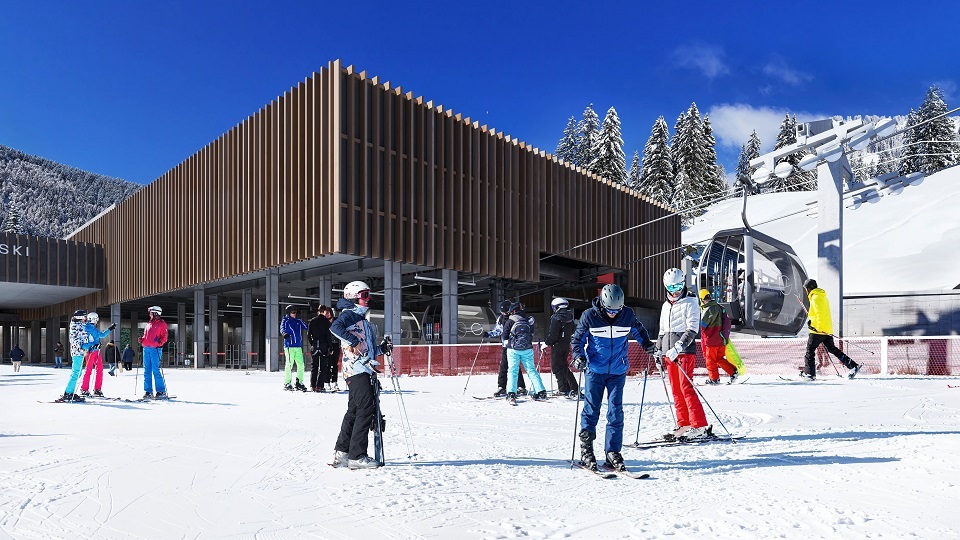
When snow can no longer be planned for — it can be bought. This is precisely the logic that OKKO Group is implementing by investing €25 million in an artificial snowmaking system for GORO Mountain Resort in the Slavsk community of Lviv Oblast. For comparison: this is one-fifth of the €120 million allocated for the entire mountain infrastructure of the resort's first phase.
What exactly is being purchased for 25 million
The contractor is Austrian company DEMACLENKO, one of the leaders in automated snowmaking systems. As Liga.net was informed by GORO's press service, the contract was signed in May 2026, although cooperation has been ongoing since 2018 — from developing the resort's master plan.
«GORO Mountain Resort is one of the largest contracts in DEMACLENKO's history. We are very proud to contribute to the success of this promising project through our many years of international experience».
Andreas Lammbacher, President and CEO of DEMACLENKO
The system includes EOS 4.0 and Titan 5.0 snow cannons, an automated SnowVisual management platform operating in real-time, pump stations, water cooling systems, and pipeline infrastructure. The stated goal is to achieve 100% snow coverage of first-phase slopes and at least 100 ski days per season annually, regardless of weather conditions.
Project scale: what is being built around it
GORO Mountain Resort is not just slopes. Near the villages of Volosayka and Verkhnia Rozanka, across approximately 1,200 hectares, OKKO Group is constructing a resort in three phases over 15 years. The first phase, which began in October 2024, includes:
- 10 ski slopes totaling 13 km in length, including Ukraine's longest slope at 3.9 km
- Ukraine's first and longest gondola cable car (2.8 km) and two six-person chairlifts
- five hotel complexes with over 1,100 rooms
- spa zones, restaurants, business and children's areas
Completion of the first phase is planned for 2028–2029. The total budget for the entire project is $1.5 billion.
State as a partner: benefits in exchange for commitments
On June 12, 2025, a tripartite special investment agreement was signed at Lviv Regional State Administration between the Cabinet of Ministers, the Slavsk community, and the developer companies. The document was signed by First Vice Prime Minister Yulia Svyrydenko and project leaders.
The state offers: up to 30% compensation of capital investments, corporate income tax exemption for 5 years after launch, duty-free equipment imports. In return, GORO has made specific commitments: to invest no less than 4.9 billion hryvnia according to an agreed schedule and to pay wages more than 40% above the average for Lviv Oblast — compared to the contract's minimum requirement of 15%. Violation of conditions means contract termination, return of benefits, and fines.
According to OKKO Group estimates, the opening of the first phase in 2028–2029 will create 6,000 jobs, and after completion of the entire project — over 25,000 in the tourism and recreation sector of the region. Minister Svyrydenko added that budgets at all levels will receive approximately 7.3 billion hryvnia in revenues over 15 years.
Where the risks lie
Artificial snowmaking solves the problem of unstable climate, but is itself an expensive and energy-intensive process. As ski resort operator Denys Krasavtsev noted in comments to MC.Today, «a season cannot be sudden» — modern systems allow snow production at +5°C, but this requires constant expenses for water, electricity, and maintenance. These operational costs ultimately are reflected in the price of ski passes.
The Austrian Federal Institute of Economics for Agriculture, Rural and Mountain Research calls tourism a potential catalyst for neglected mountain regions: successful initiatives can multiply employment and attract small businesses. But this works if the resort actually launches — and not just the first phase.
If GORO's first phase stays on schedule and within the stated budget, the Carpathians will receive an infrastructure standard that has never existed before. If not — this will be the most expensive test of state benefits' durability: will the repayment mechanism work when a $1.5 billion project is concerned during the midst of the country's reconstruction?



