$30 Million Per Hour: Who's Counting the Money While the Middle East Burns
# War between the USA and Israel against Iran has turned the oil sector into a profit machine — and placed Europe facing a dilemma it already experienced in 2022 after Russia's invasion.

By Tetiana Suchkova-Ladik
April 16, 2026 · 3 min read
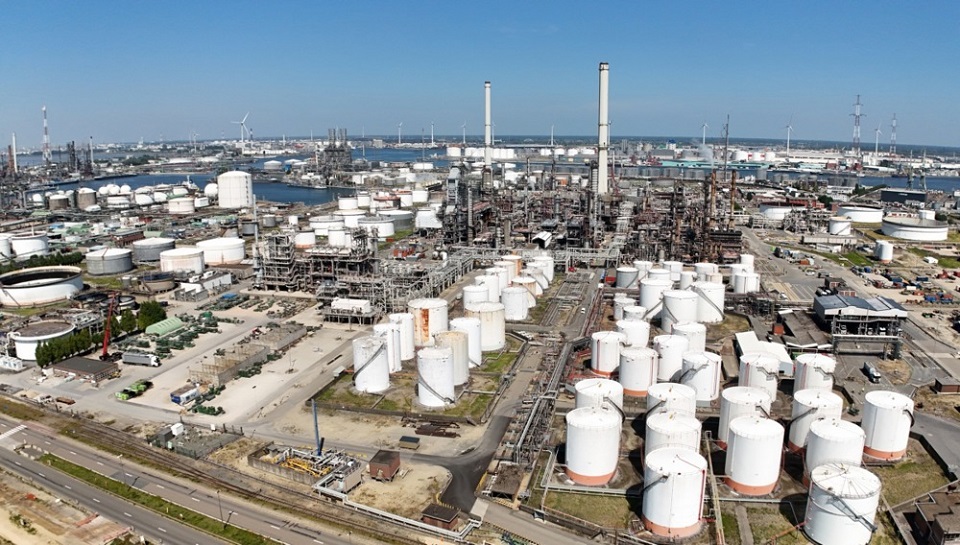
When on February 28 the United States and Israel launched a military operation against Iran, financial markets reacted instantly. The price of Brent crude crossed the $95 per barrel mark and continued to rise. According to data from Rystad Energy and Global Witness, analyzed by The Guardian, in the first month of the conflict, the world's hundred largest oil and gas companies were earning over $30 million in excess profits per hour — the difference between the pre-war price of $70 per barrel and $100 per barrel after the conflict began.
Who's profiting
Leading the rankings is Saudi Aramco: the Saudi state company is projected to receive an additional $25.5 billion by the end of 2026. In second place is Kuwait Petroleum Corp. with $12.1 billion. ExxonMobil completes the top three with $11 billion in excess profits.
But there is an unexpected beneficiary. As reported by OilPrice.com, Russian Gazprom, Rosneft, and Lukoil together could collect up to $24 billion in additional profit — despite sanctions and restrictions on maritime shipping. According to the Center for Research on Energy and Clean Air (CREA), in just the first two weeks after the fighting began, Russia earned approximately €6 billion from fossil fuel exports.
"Excess profits come out of the pockets of ordinary people — when they pay more for fuel and heating"
The Guardian
A paradox for Kyiv
The situation is complicated by a specific geopolitical dilemma described by EUobserver: Ukraine systematically attacks Russia's oil infrastructure — refineries, tankers, logistics hubs. The goal is to cut Moscow off from its ability to monetize high prices. However, Iran's closure of the Strait of Hormuz — a response to strikes by the United States and Israel — removed approximately 12 million barrels per day, or 12% of global supply, from the market. This pushed prices to a record $150 per barrel. The paradox: the more effective Ukraine's strikes on Russian infrastructure, the more Kyiv's own allies suffer from expensive energy at home.
What Brussels is doing
Five EU finance ministers — from Spain, Germany, Italy, Portugal, and Austria — sent a joint letter to the European Commission demanding the introduction of a bloc-wide tax on excess profits of energy companies. The European Commission confirmed it is considering this mechanism — similar to the one that existed in 2022 after Russia's full-scale invasion and then collected approximately €28 billion for public treasuries.
According to Euronews, just for subsidies and artificially limiting fuel prices, 22 EU countries have already spent €9 billion since the beginning of the conflict — in addition to €13 billion in additional costs for importing energy at higher prices.
- Dozens of countries have reduced fuel excise taxes to contain domestic prices — and simultaneously lose revenue for their budgets.
- Critics of the excess profits tax warn it could dampen investment in new projects and accelerate price increases.
- 350.org and the analytical center E3G propose directing collected funds toward accelerating the transition to renewable energy — to avoid repeating this scenario again.
Patrick Hailley, head of the investigations division at Global Witness, called these excess profits "a wake-up call about the dangers of fossil fuel dependence" — a formulation the organization already used in 2022, and which then changed nothing substantially.
If the European Commission does introduce a tax on excess profits and directs the funds toward renewable energy — rather than patching budget holes, as happened in 2022 — then the Iranian crisis could become the only precedent where a military conflict accelerated rather than delayed the green transition. But this "if" remains unanswered in Brussels for now.



