China turns domestic price war into record overseas sales with 349,000 electric vehicles in a month
In March 2025, China exported over 349,000 electric and hybrid vehicles in a single month for the first time — a 140% year-on-year increase. Behind this figure lies not only demand for cheaper cars, but also an internal crisis in the Chinese market that manufacturers are addressing through exports.

By Oleg Bazylewicz
April 9, 2026 · 2 min read
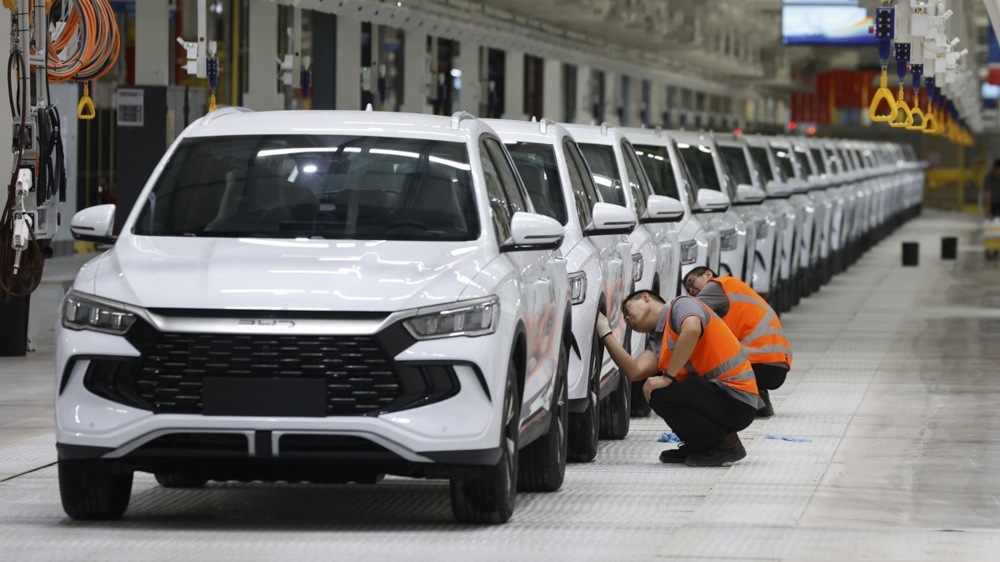
When BYD cuts prices on its electric cars in China by 30% and more — this is not marketing. BYD recorded declining domestic sales for three consecutive months at the end of 2025, and the March export record is a direct consequence of this pressure. Manufacturers are not so much conquering the world as seeking an outlet for excess capacity.
What's behind the number 349,000
According to data from the China Association of Automobile Manufacturers cited by Bloomberg, in March China exported 349,000 electric and hybrid vehicles — twice as many as a year earlier. About a third were BYD vehicles. Geely and Chery also made the top three exporters list.
China overtook Japan as the world's largest exporter of automobiles in general — thanks to record supplies of electric vehicles and the rapid growth of BYD, Chery and other manufacturers, even despite tariffs changing key markets in Europe, Mexico and the Middle East.
Tariffs did not stop — they changed the product
When the EU introduced tariffs of up to 45% on Chinese electric vehicles in October 2024, Brussels' logic was simple: more expensive means fewer purchases. But Chinese manufacturers responded by changing their product mix.
"Tariffs applied only to fully electric vehicles. Plug-in hybrids fell only under standard tariffs of 10%."
Carbon Credits, analysis of Chinese EV export dynamics
Chinese automakers sharply reoriented toward plug-in hybrids. Their exports to Europe increased six-fold year-on-year at certain stages of 2025. In hybrid categories, Chinese brands achieved a market share of over 13% in the EU, EFTA and the UK — and for the first time surpassed Korean manufacturers.
However, researchers at CEPR show that the share of Chinese EVs on the EU market fell from ~55% in early 2024 to ~42% in mid-2025 — but similar dynamics were observed in countries without tariffs, such as Norway and Switzerland. This suggests that the slowdown reflects global trends, not just EU trade policy.
Where the flow goes if not to Europe
While Brussels maintains tariffs, China is actively redirecting flows. In Southeast Asia, the top three Chinese exporters are BYD, Geely and Chery. In South America, BYD and Chery lead by a large margin among suppliers.
In parallel, manufacturers are investing in local production — to avoid tariff barriers altogether. BYD's approach to the top position in the exporters ranking is occurring despite the expansion of BYD's production capacity outside China.
Why this matters beyond the car market
Approximately every fifth Chinese car export is an electric vehicle or plug-in hybrid. In just the first nine months of 2025, China shipped EVs worth approximately $48 billion.
For consumers in countries without protective tariffs, this means one thing: cheaper electric cars are already on the way. For Japanese and Korean manufacturers — profit cuts and loss of position where they dominated not long ago. Japanese automakers felt the pressure: profits fell, capacity utilization weakened — and the challenge is not just about tariffs but fundamental competitiveness in the EV era.
If the EU and the US do not expand tariff protection to hybrids — negotiations on this are ongoing — the next Chinese export record could prove even harder to challenge.



