"$41 million from Japan: funds allocated not only for roads, but also for public broadcasting and agriculture"
Foreign Minister Kuleba and Japan's Ambassador signed a grant agreement for 6.2 billion yen — the fifth phase of the emergency recovery program since 2023. Funds will be distributed across four areas, with the selection of some proving non-trivial.

By Tetiana Suchkova-Ladik
May 21, 2026 · 2 min read
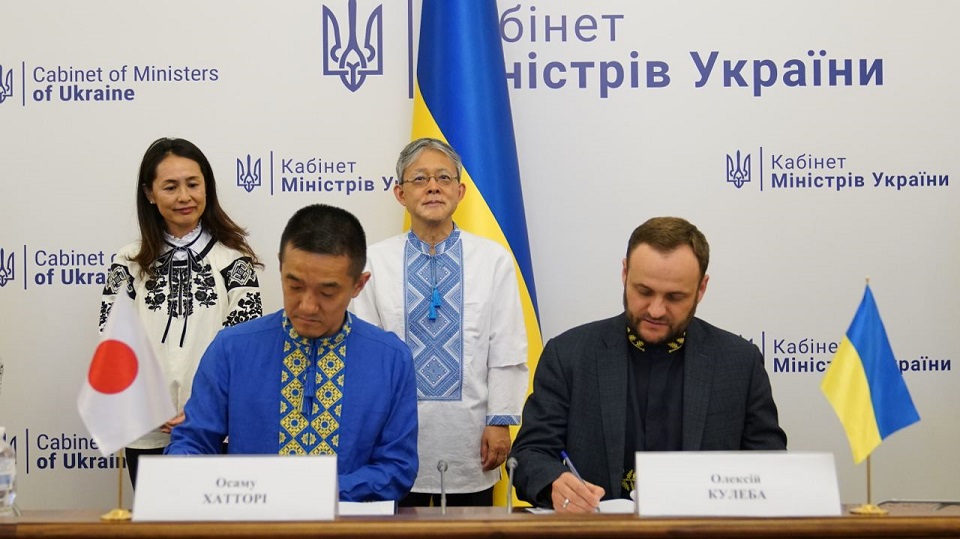
Ukraine and Japan signed a grant agreement for 6.2 billion Japanese yen — approximately $41 million — as part of the fifth phase of the Emergency Recovery Program. The agreement was signed on May 21 by Vice Prime Minister Oleksii Kuleba and Masashi Nakagome, Extraordinary and Plenipotentiary Ambassador of Japan to Ukraine. The funds are provided as a non-repayable grant — not a loan — and will be distributed through the Japan International Cooperation Agency (JICA).
Four directions — and one unexpected one
According to a statement from the Ministry of Development, the funds are allocated across four priority areas:
- Municipal infrastructure — the largest share, approximately $15 million: restoration and modernization of public infrastructure through Ministry of Development projects;
- Healthcare — support for the medical sector;
- Agriculture — support for agricultural enterprises and producers;
- Public broadcasting — media funding, which the Japanese side qualifies as the foundation of state resilience.
The last point is no coincidence.
«The agreement covers support not only for critical infrastructure, but also for healthcare and the media sector — areas that form the foundation of our state's resilience»
— Oleksii Kuleba, Vice Prime Minister for Recovery
What lies behind the $41 million figure
The Emergency Recovery Program with Japanese support has been operating since 2023. According to Kuleba, in the previous four phases Tokyo allocated 100 billion yen — approximately $650 million. The fifth phase is relatively modest in scope, but according to the Ministry of Development, the agreement will contain clearly detailed specific projects and purchases, which distinguishes it from framework agreements.
Distribution through JICA means that the Japanese side maintains operational control over fund disbursement: the agency does not simply transfer the sum, but accompanies project implementation — standard practice for Japanese grant assistance.
Context: why Japan is financing public broadcasting
The inclusion of the media sector in the grant agreement reflects a broader Japanese position: Tokyo views information resilience as a component of security, not merely a humanitarian need. This aligns with how Japan structures aid to Ukraine overall — avoiding direct military financing, but systematically supporting civil institutions.
Japan's total aid to Ukraine since the start of the full-scale invasion exceeds $12 billion — including humanitarian, financial, and recovery packages.
If the project details in the agreement text are disclosed, it will become clear how much the Japanese control model differs from the practices of other donors — and whether it will become a benchmark for new phases of recovery following a possible ceasefire.



