General contractor of the Podil Bridge declared bankrupt — what it means for completion and budgetary risks
The Kyiv Commercial Court has declared Eco‑Bud‑Trade LLC bankrupt: according to official data, its debt to creditors exceeds UAH 3 billion, while the prosecutor's office is seeking recovery of more than UAH 10.6 billion. We examine why this matters for the city and the state and what consequences to expect in the near future.

By Tetiana Suchkova-Ladik
March 20, 2026 · 2 min read
Brief
On March 12 the Kyiv Commercial Court officially declared bankrupt the general contractor of the Podilskyi Bridge construction — LLC "Eko‑Bud‑Trade." The court stated the enterprise's critical insolvency and the absence of assets capable of covering its debts.
"The company's financial condition is characterized by signs of critical insolvency. No assets of the debtor have been found that could be used to repay the existing debt to creditors, no proposals for the debtor's rehabilitation have been received, and there is no internal financial capacity to restore solvency."
— Ruling of the Kyiv Commercial Court
What exactly the general contractor owes
According to the court ruling, the total debt to creditors exceeds UAH 3 billion. Among the main creditors are the Main Department of the State Tax Service in Kyiv (≈1.47 billion UAH), subcontractor LLC "Specproekt‑Invest" (≈1.17 billion UAH) and the Antimonopoly Committee (≈362.6 million UAH). Individual amounts for other counterparties are also recorded in the registry.
What the prosecutor's office demands
The Podil District Prosecutor's Office, in the interests of the state, has filed claims regarding void contracts totaling more than UAH 10.6 billion (separate claims of UAH 2.2 billion and UAH 8.4 billion). If these demands are satisfied, this could change the order of distribution of claims among creditors and affect potential compensation for state losses.
Practical consequences for the bridge and residents
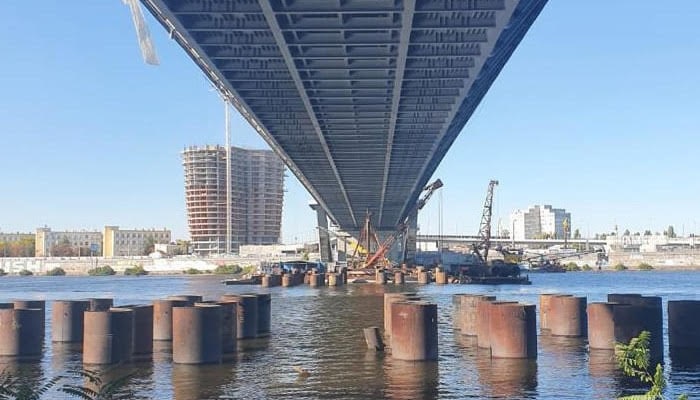
Bankruptcy does not mean an automatic halt to construction — the commercial activity of "Eko‑Bud‑Trade" is ending and the company will be liquidated, but work on the site had effectively been transferred. In 2023 construction was transferred to the Avtostrada group of companies, which continued the works: on December 1, 2023 the first exit to Rusanivski Sady was opened, on December 1, 2024 the second exit toward Troyeshchyna was opened, and in August 2025 traffic on the bridge was opened in all lanes.
Why this matters now
First, state funds and trust in procurement procedures are at stake: the prosecutor's claims point to risks of void or questionable contracts. Second, the bridge is critical capital infrastructure; delays or additional costs affect traffic and the city's development budget. Third, the case demonstrates how legal, financial and organizational risks intersect in infrastructure construction.
What next
The next steps are the legal bankruptcy proceedings and the court's consideration of the prosecutor's claims. At the same time the bridge continues to operate, and the next infrastructure stages — opening the exit to Podil and preparing for construction of the Podilsko‑Vyhurivska metro line — remain on the city authorities' agenda.
Questions for oversight: will the prosecutor's claims translate into actual compensation, who will bear financial responsibility for the identified violations, and how can risks to the budget be minimized in future large contracts — the answers will determine how quickly and without additional losses the capital will receive completed infrastructure.
"This is not just a case about one company — it's a test of how effectively control mechanisms over large contracts on state sites work."
— comment from a construction market analyst
The bridge as an infrastructure asset is already serving Kyiv residents. The formal response to the bankruptcy should be not only the legal closure of the case but also guarantees that similar risks will not jeopardize other projects that change the life of the city.



