Cabins for Kyiv funicular doubled in price — and order was placed during the war
Kyivpastrans announced a tender for the same two cabins it planned to purchase back in 2021 for €6.5 million — now for €13 million. The difference amounts to over €6 million in European Investment Bank and city budget funds.

By Tetiana Suchkova-Ladik
May 14, 2026 · 3 min read
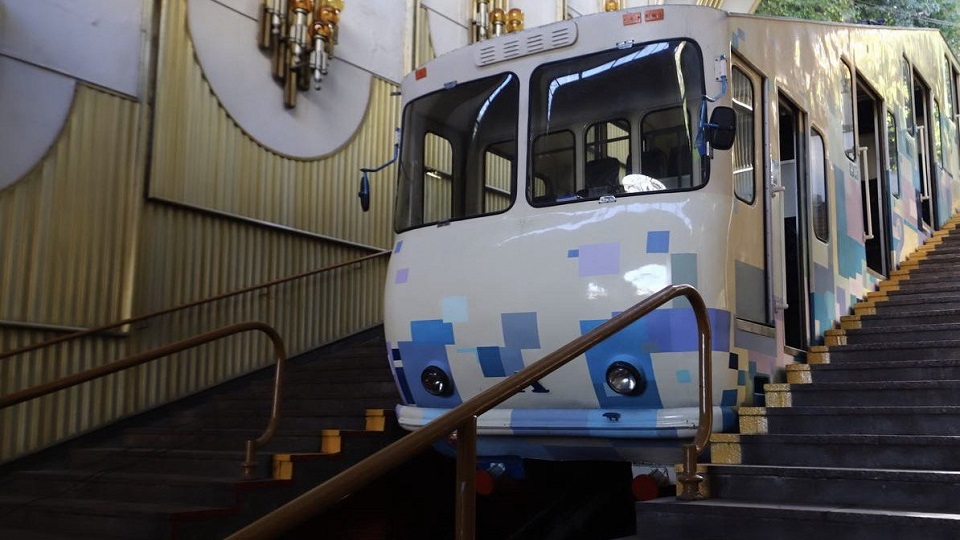
In 2021, Kyivpastrans announced the first international tender for two new cabins for the capital's funicular. Budget — 6.5 million euros, financing from the European Investment Bank. The deal did not happen then: the tender was halted by the invasion. Now the same order costs 13 million euros — twice as much.
State Enterprise "Kyivpastrans" published a new tender in Tenders Electronic Daily (TED) — the official EU procurement bulletin. Financing — again jointly from the EIB and Kyiv City Council. Applications are accepted until June 30, 2025. First delivery — no later than 18 months after the advance payment.
What is included in 13 million
According to Fixygen, citing EU tender documentation, in addition to two passenger cabins, the buyer will receive a set of spare parts for two years of maintenance, main stock of parts, technical maintenance and diagnostics equipment, as well as staff training. The price is stated without VAT and customs duties — meaning the final amount will be higher.
Why twice as expensive
A direct answer from Kyivpastrans was not provided publicly. But the context is telling. According to Glavkom, as far back as 2018, the company announced tenders for cabins three times with a total expected value of 232.4 million hryvnias — all failed. In 2021, Austrian Garaventa AG (Doppelmayr Group) already appeared among potential suppliers. Now the market for specialized rail-cable transport is effectively monopolized by a few European manufacturers with no alternatives.
Meanwhile, Kyivpastrans became involved in a major trolleybus procurement scandal: as reported by the publication "Nashi Hroshi," 16 units were purchased for approximately $444 thousand each, while Chernivtsi in 2022 paid $282–295 thousand for the same model. The State Audit Service opened an investigation. It was against the backdrop of this scandal that the new funicular tender emerged — already in euros, funded by the EIB.
"Overall, throughout the year you can find 10–20 billion hryvnias being spent inefficiently and not for defense needs. We are left to monitor state enterprise procurements, because savings in their spending will become profits for the budget."
Yurii Haidai, senior economist at the Center for Economic Strategy
Architectural monument — and transport at the same time
Kyiv's funicular is not just an attraction. It annually transports up to 2.8 million passengers, connecting Podil and Upper City. The cabins have not been updated since 1984 — meaning for over 40 years. In parallel, the company announced a separate tender for technical inspection of the structure for 1.6 million hryvnias — to prepare for a full-scale restoration, as the funicular has the status of an architectural, scientific, and technical monument.
EIB financing formally guarantees the bank's audit oversight. But the verification mechanism for the justification of the price offer itself is not public. If the tender winner is determined within the announced budget rather than below it, it will be difficult to verify whether 13 million euros is a market price or a comfortable one without disclosure of comparative analysis.
If the State Audit Service, which is already monitoring Kyivpastrans' trolleybus contract, applies the same approach to the funicular cabin tender — comparing the stated amount with current prices from Garaventa or competitors on open markets — the question of the doubled budget will receive either an answer or a scandal.



