Akhmetov's Company Claims Funds from Subsoil Agreement Fund — So Far URIF Has Only Financed Drones
DTEK Naftohaz is negotiating with the American-Ukrainian fund URIF regarding financing for deep wells. So far, the fund has approved only one of three planned investments for 2026 — and that went not into energy resources, but into defense technologies.

By Tetiana Suchkova-Ladik
April 16, 2026 · 3 min read
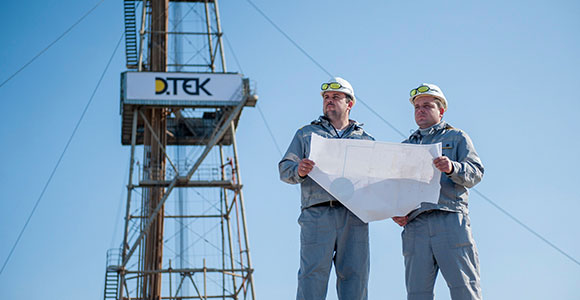
DTEK Naftohaz — the gas extraction division of Rinat Akhmetov's structures — is negotiating with the American-Ukrainian Investment Fund for Reconstruction (URIF) on financing part of its projects. According to Bloomberg, this concerns the "most complex and most expensive" directions: in particular, drilling operations at depths exceeding 6 kilometers, which private capital is hesitant to undertake without guarantees.
What is URIF and where is the money
The fund was established in May 2025 as part of an agreement on mineral resources between the USA and Ukraine. Its financing mechanism is not direct budget tranches, but reinvestment of a portion of revenues from Ukrainian natural resources: 50% of royalties, rental payments and license fees from new permits should go to URIF. According to Forbes Ukraine, from State Geological Service auctions in December 2025 alone, the fund received rights to over 700 million hryvnias.
The fund's investment advisor is consulting group Alvarez&Marsal, decisions are made by a joint American-Ukrainian board of directors. From over 200 submitted applications, eight projects worth a total of $1.2 billion entered the first portfolio — but final approval has so far been granted to only one.
"URIF's first investment — Sine Engineering — is dual-use in its purest form. This is our answer to the question about priorities"
Yehor Perelyhin, Deputy Minister of Economy of Ukraine
Sine Engineering is a Lviv startup from 2022 that produces radio communication systems for drones, resistant to jamming on the front line. The investment decision was made on March 25, 2026. Resource extraction is not yet on the agenda.
Where is DTEK, and where is state Naftohaz
In parallel, the state company "Naftohaz" submitted ten projects to URIF on extraction and energy efficiency. As Kyiv Post reports citing Bloomberg, Naftohaz CEO Serhiy Koretskyi encouraged Western partners to use existing licenses — in particular, for the Olesky block in the Carpathians, where Chevron began shale exploration before 2014 and then exited after the annexation of Crimea.
DTEK Naftohaz — a private structure with different logic: here they do not appeal to past licenses, but ask for financing for specific expensive work. The company has already signed a memorandum with American Baker Hughes at the CERAWeek conference in Houston — the agreement covers deviated drilling, bit services and high-tech operations to increase extraction. But a memorandum is not money.
Why this is not just corporate news
Akhmetov is the richest person in Ukraine, and his presence in a fund created under pressure from the American administration is itself a question. The EBRD in 2024 directly refused to finance DTEK precisely because of ownership structure: "Freeing the economy from the influence of oligarchs is absolutely fundamental," explained bank president Odile Renaud-Basso at the time. DFC, which manages the American portion of URIF, has not yet established such public restrictions.
- URIF approved 1 of 3 investments planned for 2026 — and it concerns drones, not natural resources
- 138 applications submitted through the portal, only 8 entered the first portfolio
- Selection mechanism: screening committee → board of directors (USA + Ukraine jointly)
- DTEK is negotiating with the fund, but no decision has been announced
- EBRD previously refused DTEK due to "oligarchic ownership"
Deep wells are not a symbolic project. Drilling at 6+ km in complex geological conditions costs tens of millions of dollars per location, and return on investment depends on whether the military conflict continues and whether access to deposits is preserved. This is precisely why private capital does not go there without external guarantees — and precisely why DTEK is in line for URIF.
If DFC approves DTEK's application, it will be the first case where an American state fund enters a project of a company that the EBRD refused due to de-oligarchization criteria — and then the question of whether the "mineral resources agreement" is a tool for reform or simply an investment window without conditions will receive a concrete answer.



