Kyiv-Chisinau with Access to the Runway: Why One Test Flight Will Decide the Fate of the Route
On April 13, train No. 351 will arrive at Revaka station for the first time — a 10-minute ride from Chișinău's central station to the airport. If demand justifies it, the stop will become permanent — and this will change the logic of the entire connection.

By Tetiana Suchkova-Ladik
April 11, 2026 · 2 min read
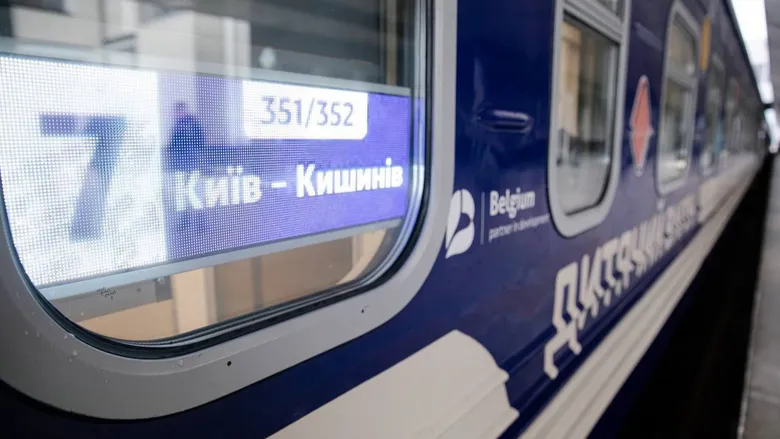
The Kyiv–Chișinău train was resumed after a 24-year break only in November 2022. At that time, the route ended at the central station of the Moldovan capital — and passengers who needed the airport had to separately search for a taxi or bus. On April 13, Ukrzaliznytsia and Moldovan CFM are taking the next step: test train No. 351 will be extended to Revaka station, which is adjacent to Chișinău International Airport.
Ten kilometers that have gone unused for years
Revaka is not a new station, but forgotten infrastructure. The Chișinău–Revaka railway branch, 10 kilometers long, has existed for a long time, but passenger traffic here was practically nonexistent. Moldovan Railways conducted track repairs — replacing worn sleepers and rails on degraded sections — and lifted speed restrictions. The test train covered this section in 9 minutes, which CFM's technical team assessed as a positive result.
Upon arrival in Revaka, passengers will be met with a free shuttle to the airport terminal. Ukrzaliznytsia directly outlines the condition for scaling:
"The test trip will demonstrate the relevance of a stop near the airport and, provided there is significant demand among travelers, Revaka can appear on route 351 on a permanent basis."
— Ukrzaliznytsia
Context: Moldova is building a railway hub, not patching holes
The test run is not an isolated action. Moldova is simultaneously preparing full-fledged rail service to the airport: the launch of regular service is planned for spring 2026 and will be partially financed by European funds. The goal is to increase the average speed on the section to 50 km/h and launch commercial operation of the infrastructure. In other words, this current test with the Kyiv train is both a check of demand and a warm-up for the full launch.
A separate dimension is the route network. In October 2025, the Kyiv–Ungheni–Bucharest train appeared, which "branches off" from the Chișinău route. So Revaka potentially becomes not just a stop near Moldova's airport, but a hub point for passengers from several directions.
What this means in practice
- Route No. 351 departs from Kyiv and covers the distance in approximately 15 hours — an overnight journey without transfers.
- A stop in Revaka reduces the final "station–airport" leg from taxi unpredictability to a fixed shuttle.
- For Ukrainian passengers with domestic flights closed off, this is one of the few ways to reach an international airport by land transport from Kyiv without transfers.
One trip on April 13 is, in essence, a vote by passengers for or against a permanent stop. If demand proves to be "significant" by Ukrzaliznytsia's criteria — though the company did not disclose what exactly that means in numbers — Revaka will remain on the schedule. If not, the infrastructure will wait for its moment until 2026.



