"The Mother of All Deals": how the upcoming EU–India agreement is reshaping the export landscape and what it means for Ukraine
The agreement between the EU and India is effectively ready — a market of 1.4 billion people opens major opportunities for European exports, but a number of exemptions and high Indian tariffs make the results ambiguous. We examine why this matters for Europe and how it could affect Ukrainian interests.

By Tetiana Suchkova-Ladik
January 26, 2026 · 2 min read
Briefly
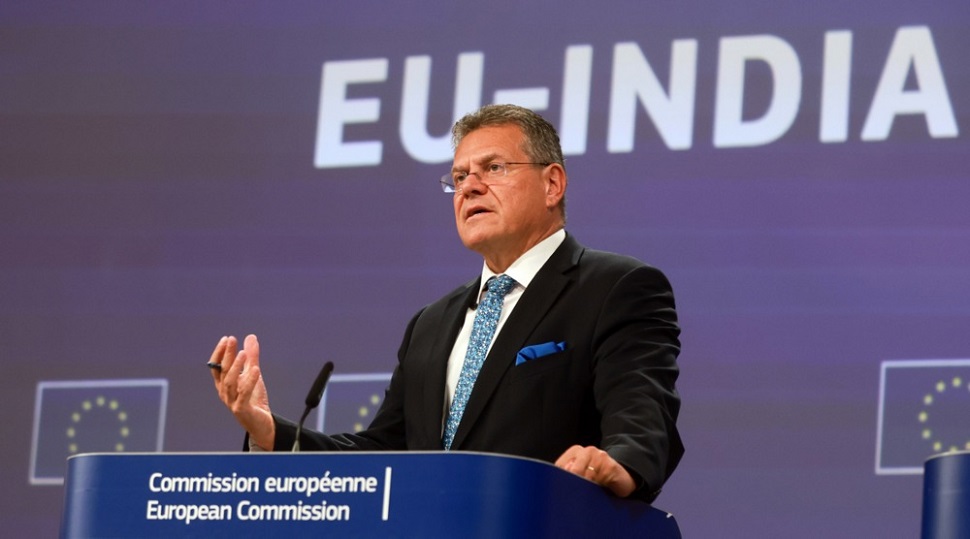
The European Commission has announced the final stage of negotiations on a free trade agreement with India. Trade Commissioner Maroš Šefčovič called it "the mother of all deals" — and not just as a catchphrase: it concerns access to a market of 1.4 billion consumers and a zone that could cover about 2 billion people when combined with other trade arrangements.
What exactly is being proposed
According to the European Commission and Šefčovič’s interview with Euronews, the agreement would include a significant reduction of tariffs on a wide range of goods and services, but will not be comprehensive — the most sensitive sectors will remain excluded. Currently about 6,000 European companies operate in India; in 2024 European exports there amounted to roughly €48.8 billion.
"This is the largest trade agreement in history"
— Maroš Šefčovič, European Commissioner for Trade
Why the negotiations were difficult
Šefčovič openly says that Indian delegates are tough negotiators: in some sectors tariffs there reach 150%. At the same time, Reuters reports an agreement on car tariffs: a partial reduction from around 110% to 40% for a limited list of expensive imported cars, with a further gradual reduction to 10% for certain models.
"We decided to leave the sectors most sensitive to us outside the agreement in order to focus on a positive outcome"
— Maroš Šefčovič, European Commissioner for Trade
Strategic significance for the EU
Agreements of this scale have not only economic but also geopolitical consequences. For Brussels it is a way to insure against global trade shocks, send a signal to other partners and reinforce the EU's role as a trading player on the world stage. Important context: trade channels are already suffering from tariff spikes and political pressure, so market diversification is a pragmatic response.
What this means for Ukraine
Ukraine is not a direct member of the agreement, but the effects will be felt. First, strengthening European supply chains makes the EU more resilient — this is positive for our economic and security stability. Second, Ukrainian companies integrated into EU supply chains (components, raw materials, IT services) may gain indirect benefits from increased trade between the EU and India.
However, the risks are also clear: partial exclusions and protected Indian sectors mean that benefits will be uneven and will depend on how quickly European partners reconfigure production chains.
Risks and next steps
The agreement still requires ratification and detailed implementation. Brussels hopes it will send a signal to other partners, especially against the backdrop of difficulties with MERCOSUR. At the same time there is a risk of escalation of trade disputes with third countries — for example, reports of possible US tariffs on India add further uncertainty.
Conclusion
This is not an instant breakthrough or a universal recipe: the agreement opens important opportunities for the EU, but does so selectively. For Ukraine the priority is to closely monitor the diversification of European supply chains, seek niches for integration and work to ensure that Europe’s move toward new markets also benefits our economy. Whether partners can turn a political statement into concrete contracts is a question for the coming months.



